Steven Thomma writes for Knight Ridder:
To many on the outside, it looked like a mistake when Vice President Dick Cheney failed to notify the White House press corps first of his shooting accident. But in the White House, it reflected a strategy of marginalizing the press.
More than ever, the Bush White House ignores traditional news media and presents its message through friendly alternatives, such as talk-show hosts Rush Limbaugh or Sean Hannity. And when a reporter appears belligerent in a televised confrontation with the White House spokesman, as NBC’s David Gregory did this week, the imagery helps the administration turn the story into one about the press, which energizes a Republican base that hates the media anyway.
More than just a matter of sniping at an enemy, the Bush administration sees the traditional media as hostile. Working to erode their legitimacy in the public’s eyes is a critical element of its determination to weaken checks on its power.
Bush culties oblige. Like bratty children they throw tantrums at the press whenever it presents Dear Leader in a less than glowing light. Bush toady Thomas Sowell, who pretends to be some kind of journalist, actually wrote this:
There is nothing in the Constitution or the laws that says that the media have a right to be in the White House at all, much less to have press conferences.
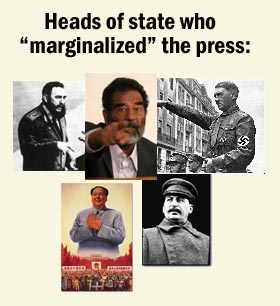
Many world leaders have agreed with Sowell:
Sowell, who appears not to have two connecting brain cells anywhere in his head, begins his column “The first revolt of the American colonists against their British rulers was immortalized by Ralph Waldo Emerson as ‘the shot heard round the world.'” Does Sowell believe colonists outside Massachusetts would have learned about Lexington and Concord were it not for independent colonial newspapers like the New England Courant and the Pennsylvania Gazette? I guess Sowell thinks King George would have issued a news release. He also says “The accidental shooting of Harry Whittington, while he was on a hunting trip with Dick Cheney, has nothing to do with government policy or the Vice President’s official duties.” Oddly, he held Bill Clinton to a different standard.
Thomma of Knight Ridder continues,
… more than any of its predecessors, Bush’s team has learned to deal with the media on the White House’s terms.
Cheney, for example, spoke about the shooting in an interview with Fox News, where hosts all week voiced sympathy for him and criticism for the press badgering him. (In fairness, Fox anchor Brit Hume posed many of the same questions that the White House press had asked – but only Hume got answers.)
Cheney also makes frequent appearances on talk radio, where he’s often fawned over. “We are thrilled and excited to have with us the vice president of the United States … for a precious few minutes,” Limbaugh said during one recent Cheney visit.
This week Limbaugh echoed the White House line, proclaiming: “This is not about Dick Cheney. It’s about the media.”
Thomma writes that Scott McClellan is not just stonewalling the press; he is baiting the press so they’ll play their assigned “bad guy” role for the camera.
At the start of a recent off-camera briefing, for example, White House spokesman Scott McClellan interrupted NBC’s Gregory when he asked about the shooting.
“David, hold on, the cameras aren’t on right now. You can do this later,” McClellan said. On camera later, Gregory appeared abrasive when McClellan stonewalled his questions. While reporters may think such exchanges show that the White House is unresponsive when the public has a right to know, White House aides know the TV imagery makes the press corps look petulant and appear more interested in posturing than in the public interest.
“McClellan is a brick wall disguised as a government official. He wins any time the press bangs its head against the wall,” NYU’s [Jay] Rosen said. “Part of the White House strategy is essentially cultural, that resentment against the press is itself converted into a political asset.”
If you are old enough to remember the Nixon Administration you’ll remember that Nixon and Agnew attempted to make the press their “bad guy,” too. As reporters dug deeper into Nixon’s Watergate and Agnew’s bribery scandals, Nixon apologists of the time complained the press was just picking on their guys because of “liberal bias.” That Nixon and Agnew might actually be guilty as sin doesn’t seem to have crossed their minds.
But Nixon and Agnew were amateurs at media manipulation compared to the Bushies. And Nixon and Agnew didn’t have Faux News, which for all intents and purposes is a propaganda arm of the White House disguised as “independent” news media. But some things don’t change. Like the right wingers of more than 30 years ago, today’s wingnuts are all-too-easily manipulated into betraying every value America ever stood for while calling themselves “patriots.”
 Thomma continues,
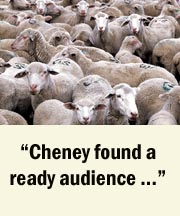
.. Cheney found a ready audience when he suggested that the White House press corps was angry only because he’d left them out of the loop.
“I had a bit of the feeling that the press corps was upset because, to some extent, it was about them,” he said. “They didn’t like the idea that we called the Corpus Christi Caller-Times instead of The New York Times.”
Conservative bloggers echoed that line of attack, despite firm statements from loyal Republicans such as former Defense Department spokeswoman Torie Clarke and former White House press secretary Marlin Fitzwater, who both said that Cheney had acted irresponsibly by not immediately disclosing to the nation that he’d shot someone.
Live TV broadcasts of news briefings also help the White House manipulate the media. Pundits, bloggers and talk-show hosts often spend more time criticizing reporters’ questions than the issues they’re raising. And reporters probing aggressively for information from polite but unresponsive officials can look like snarling jackals.
Jay Rosen of PressThink says the veep did not make a mistake by stonewalling media:
The way I look at it, Cheney took the opportunity to show the White House press corps that it is not the natural conduit to the nation-at-large; and it has no special place in the information chain. Cheney does not grant legitimacy to the large news organizations with brand names who think of themselves as proxies for the public and its right to know. Nor does he think the press should know where he is, what he’s doing, or who he’s doing it with. …
… How does it hurt Bush if for three days this week reporters are pummeling Scott McClellan over the details of when they were informed about Cheney’s hunting accident? That’s three days this week they won’t be pummeling Scott McClellan over the details of this article from Foreign Affairs by Paul R. Pillar, the ex-CIA man who coordinated U.S. intelligence on the Middle East until last year.
And we’ve also been distracted from the stonewalling of the NSA spy scandal, notice. Yesterday the Senate Intelligence Committee decided not to investigate the NSA “surveillance” program.
Some days I think that it’s going to take a miracle for this nation to survive the Bush Administration with democracy intact.
Barbara…this is OT but I couldn’t believe this when I read it!
http://thinkprogress.org/2006/02/17/ports-uae/
What is your take on it?
NEOJOE — either the Bushies are corrupt as hell or they don’t have the good judgment God gave spinach. Or both.
I think that the debate was about whether or not to tell the press at all. If they couold have figured out a way, no one outside the circle would have ever known.
Dont despair! The invasion of Iraq will prove to be fatal to Bush and his legacy. At some point America is going to have to face up to the mistake,just like Vietnam. At 6 billion dollars a month spent on credit we can go on with the folly for years,but in the end there will be no victory. The only power Bush has now is to continue hawking his pipe dreams of democracy in Iraq while running down the clock for the handoff to the next administration.
maha – You are correct that Thomas Sowell pretends to be some kind of journalist. His grammar is incorrect as well. He said “media have” which is wrong. It should have been “media has”. Let’s just call him The Pretender.
maha- FYI – Brian Lamb today is at National Press Club. His question today, “What is the definition of a Journalist?”. It’s an interesting program.
Britwit — well, strictly speaking, “media” is a plural noun which would take the verb “have” instead of “has.” “The News Media” gets used as a singular noun a lot, as if it were a monolithic entity, but that’s inaccurate. So I have to agree with Sowell over “media have.” You are still a lot smarter than Sowell, though. 🙂
Yeah, “what is a journalist” is an interesting question. I don’t think of blogging as journalism, but others do.
“Some days I think that it’s going to take a miracle for this nation to survive the Bush Administration with democracy intact.”
Sadly, democracy is not intact now, and it will take the miracle for your nation to survive bush and company.
Then again if you follow my understanding of the US definition of democracy, ie: a country or a dictator that follows orders from the US = democracy; a country (regardless of it’s leader being elected by whatever majority of its citizens) that doesn’t follow orders = dictatorship.
If your are using that definition then I guess the US has a democracy, because bush certainly follows the directives of whoever is running the US government
I’ve posted a couple entries on these issues.
http://spiiderweb.blogspot.com/2006/02/we-be-watching-you.html
http://spiiderweb.blogspot.com/2006/02/we-be-watching-you.html
If you link you will see I agree with you. I’m very concerned our democracy can’t survive this administration. I’m an optimist and a pragmatist. We are in deep shit and everyone has to grab a shovel to dig us out. Don’t all of us know to cringe when someone says, “Trust me”?
Oh shit! I listed the same blog entry twice. The second should be.
http://spiiderweb.blogspot.com/2006/02/pay-attention-folks.html
Just a question….would you buy a used car from either Cheney or Bush. If you answer yes to that question, we need to divide the country in two
Pingback: The Moderate Voice
Maha
in re #2…spinach may even be kind….I was thinking dirt.
maha – I stand corrected! Thank you (re: my comment 5 and your 7). Thank you for softening the blow. I see that media is the plural of “medium”.
I agree with you; I don’t consider blogging journalism either. Some of the people who called in to talk with Brian Lamb on C-Span commented that they considered Rush Limbaugh a journalist! Unbelievable!
Just heard that Harry Whittington is being released from hospital today and will hold a press conference in 90 minutes from now. I bet the White House is relieved that he is going home. I bet he will have a nurse at his home to monitor.
Britwit…
Where did you hear that?
NEOJOE –
I heard on CNN. In fact, I was just logging on now to state that CNN just announced that Harry Whittington’s Press Conference will be at 1:00PM Eastern today.
In reference to # 7 Oh I get it.. It’s the difference between singular and plural. America(singular) “has” the god given right to torture innocent people, as opposed to, American’s(plural)” have” the god given right to torture innocent people. It makes sense to me!
Thanks Brit!
Fascinating to read those little bits of Clintoniana, complements of Thomas Sowell. My gosh, what innocent days in comparison. And yet the handwriting was on the wall. The other side took it and ran. My former Clinton-loving boss is still angry at the guy for messing things up for Gore. (Where would we be now, one wonders wistfully.)
I read the entire article by Pillar and felt like I was in deja vu land. Like we didn’t know this stuff from the beginning? But of course it’s not the party line and so therefore we don’t need to take it seriously, do we? (We’re edging closer to Bush’s friend Putin, everyday.)
Lately, I can’t decide whether I identify more with those poor folks rearranging the deck chairs on the Titanic, or like Alice in “Alice in Wonderland.”
And it’s creeping eerily toward how those guilt-by-association helpless moderates in pre Nazi Germany must have felt.
What can we do besides vent? Alerting each other is like preaching to the choir. It’s the “others” we have to reach out to. They are just as vigorously “saving America” in their own misguided “true believer” ways. (Can one have a regular life anymore? Or is that becoming unpatriotic?)
Marginalizing The Press
It seems to me that only the truth gets marginalized.
1. More Photos from Abu G, apparently it was bad for the media to report and publish these photos. The fact is the torture happened is an unfortunate detail!
2. Dead Eye Dick, apparently it was bad for the media to insist on details of the story. The fact that he actually shot someone in the face and then appears to have attempted to cover-up details is just an unfortunate detail.
3. NSA spying “terrorist surveillance”. Again bad for the media to report on this “secret” program. Never mind that it’s legality is questionable at best.
4. We’ll you get the idea.
5. Former President Carter “embarrasses” president bush by bringing up the fact that Dr. King and is wife were illegally spied on at Ms King’s funeral. The funeral of a civil rights leader is no place to bring up any violation of that leaders civil rights that may of happened in the past?
Wait I quess that’s the press marginalizing the truth, now I’ve confused myself. I must go listen to Rush now he will clear all this up for me.
FYI Dick Cheney is speaking live in Cheyenne on CNN right now.
samiam-
Yes, I was watchng Cheney in Cheyenne. It appears to be a real love fest for Dick The Dick! He is on sacred ground in his native state. It’s safe turf just like when Bush always selects military bases or schools for his talks.
They cut Cheney right off, thank God. Faux news is waiting for Bush to remark on war on terror. I’ve seen this before, have you? Cheney starts a speech and the Bush cuts him off in the media.
samiam- Yes, I have; there’s a struggle going on there internally. Now, old Bush is on CNN talking from Tampa with a staged audience, as usual. Here he is talking about the use of wood chips and saw grass for a fuel alternative. Now, he’s on to Medicare.
Britwit-
Safe turf for Cheney, all right. Makes me sick because I lived in Wyoming for awhile. Beautiful state, lovely people. What a legacy.
Bush is going on hyperdrive to “reassure” us, isn’t he?
Now it’s the Taliban again, is it? News article yesterday said Afganistan is going down the tubes. We lost two opportunities to save it.
Those poor villagers would turn in terrorists who would pay bribes and go right back out again. Would you want to be one of those villagers then?
Is he talking to a kindergarten class? This is as entertaining as “My Pet Goat.”
“Our long term strategy is to liberate people.” Oh, I feel so much better.
“Marginalizing†the Press Filed under: News Media — maha @ 9:01 am Steven Thomma writes for Knight Ridder:
Was the reason VP failed to notify the White House press corps first of his shooting accident to marginalize the press, or something worse and nefarious?
If your pedestrian criminal drinks and maims does he alert the media or take cover?
But is the VP a pedestrian criminal>?
VP then talked to Hume. He said an executive order gave him the authority to declassify national security secrets. But how was the outing of the classified operative Plame in pursuit of legitimate purposes, as for exampe no one filed a FOIA. It must then have been an abuse of power, a high crime or misdemeanor, an impeachable offense. Could the Wittington incident have been concocted as a secret service scheme and cover to resign for personal reasons (ala Chappaquidick)?
How can Mr. Sowell say with a straight face the Constitution does not permit the media from entering into the White House when there’s freedom of the press and there’s “We the People” and the People’s House is the White House?
VP’s actions subsequent to the shooting of Mr. Whittington has something to with “elected” VP’s character, candor and and values.
Perhaps the likes of McClellan should be replaced with a GOP “truth teller” like sycophants Hannity, O’Reilly or Limbaugh.
As I recall from the Nixon era, the “liberal press†were the “nattering nabobs of negativism”, just weeks before tax challenged Agnew’s resignation.
Frankh99 in Miami contributed to this report.
samiam- I’ve never been to Wyoming but need to put that on my list of places to visit. I think that I’ll select the summer season to go. I have a friend that graduated from the University there and she loved it.
I guess old Dick had to bring Lynn with him just to show that she wasn’t “peeved” about last weekend.
In your reference to “My Pet Goat”, it wasn’t even a well written book. Did you ever hear Bush reading it?. I think that I would have selected a better book to be read. I don’t think that Bush, however, would have approved the book, “Duck For President”. It’s a hilarious book and won 2 children’s book awards.
Bush on CNN today while he was in Tampa, again, talked about Americans being addicted to oil. If he has concerned, why doesn’t he just do his “dog & pony” act from DC and save the fuel? The same for Dick the Dick since he didn’t need to go to Wyoming. He just wanted to be on sacred ground for his “coming out” after the shooting.
Harry Whittington’s press conference. The man came across as a gentleman and a great looking guy for 78.
Of course the Hospital Administrator stated that Harry was “too tired” to answer questions. I personally think that he could have taken 5 or 6 questions from the Press. He may have, of course, been caught telling the truth!
I recall reading an initial report that said Whittington approached from Cheney’s right side. It seems that Harry would have been hit on his left side had that been the case.
The, I believe it was, The LA Times said that Cheney told the police in the county where the ranch is that he was swinging to his left.
Cheney had to change the story to coincide with the reality of where the injury was located — Harry’s right side.
Britwit,
I don’t understand Bush’s “addicted to oil” bit. Where did this come from all of a sudden? Did it finally penetrate his brain that it is a nonrewable resource? And that China and all the other developing countries, who want first world economies, are going to be competing for the last drops available? Why didn’t he listen to Carter, Gore? It’s like he was suddenly converted or something.
Speaking of Wyoming (known for its oil), it’s truly the most beautiful place on earth. The Grand Tetons particularly. http://www.terragalleria.com/parks/np.grand-teton.html
I’m going to have to read “Duck for President” – thanks!
Bush’s addicted to oil bit is about offshore oil in Florida and Kali-fornia. It is also about ANWAR and the need to attack Iran to keep our economy fluid.
Bush did not convert. He is an “end of times” believer.The mind set is to get all you can before the tribulation, after that, it’s in “God’s hands”.The really cool part is that one can be the world’s biggest asshole, but if Jesus is your personal savior, you get the “E” ticket ride, everyone else gets Beelzebub.
This is how it works.
I get you, erinyes. I’ve often suspected him of this mindset, too. Even if I thought I was misinterpreting his beliefs, his actions surely are setting us on a course toward Armaggedon.
But I’m still wondering – why is he saying we’re addicted to oil? Does he mean we should stop driving SUV’s? Use wood chips and saw grass like Britwit and I heard on Faux news today? Not drill in Alaska? Did it suddenly occur to him that being out of oil means Armaggedon for this way of life we hold dear and he’s feeling a little panicked? What’s up? Why would he care if we’re heading there?
Maybe there is no way to understand the guy. Maybe he’s more like the reality-challenged people I’ve seen in the libraries than I thought. He’s in over his head, that’s for sure.
So is Cheney the Vice President of Corpus Christi, or the VP of the entire USA?
“But I’m wondering-why is he saying we’re addicted to oil”
On a typical Florida day, all major cities from Miami to Orlando, Tampa, and Jacksonville have major traffic jams. The math is easy on this one…
Figure 25 gallons of gas per car x how many miles of jammed up traffic.Divide this by the number of people per vehicle. Now factor in the amount of natural gas and crude oil beneath the lands of Iran and Venezuela. Multiply that factor by the angry retoric directed at the leaders of those countries by Bushco.
The common denominator is :addicts in need of a fix will do whatever is necessary to stop the pain. The Iran oil Bourse is set to open around March 20. From what I understand, Iran and Venezuela will no longer use the U.S. dollar, but will shift to E.U. dollars.INMHO, the bushit about the oil addiction will be the excuse that Iran and Venezuela are going to try and starve us deliberately, which Bushco will spin into something of an act of war.
This could get interesting, especially if China , India, Russia, and the E.U. stand up and say “ENOUGH!!”, which just might happen.
I believe Bush thinks we’re in the “end times”. I think it was in an interview with Bob Woodward where Bush was asked about the future and replied ” It won’t matter,we’ll all be dead anyway”.
As to how to understand the thinking process of these guys, think crocodile. Crocodiles view the world as either prey , predator, or inanimate. You’re either with him, against him, or you don’t count.
Almost every OPEC country is in some kind of trouble, either civil unrest, or in war or threatened with war.
A fundy guy I know was telling me that Israel is about to have a huge new oil strike which will alter the face of the ME. I have read that there is intense drilling in Israel by a Texas oil man who is consumed by the Book of Revelations /end times cult Another Texas fundy is trying to breed a “Red Heiffer” for sacrifice to bring about the second comming.
We live in interesting times, one where “new realities” are created daily.
I was interupted befor I finished. I’m not sure if China has the catbird seat by design , or simply “serendipity”, but the Chinese are in a superburb position. They have a booming economy, cheap labor, unlimited markets, and due to their huge population and fearless outlook, no one dare mess with them. The Chinese literally have us by the balls. I was stuned to see an article in the paper this week about the U.S. telling China to back off. This is like telling the banker holding your mortgage to piss off when you are three months behind in payments!
While our leaders continue to bully and intimidate, China has been busy cultivating relationships throughout the world, particularly in South America, The Caribbean, and Africa.IMHO, China is giving us enough rope to hang ourselves, or at least enough so that we won’t be able to counter their power when the time comes for them to move.
It is the peak of Irony that the Chinese will very likely be the top dogs in the world as a result of the drunken sailor attitude of our leaders.
erinyes,
Thanks for all the depressing info. Actually I have been aware of much of this, but you’re much better informed than I am. I remember warning and ranting to my conservative parents about Bush’s “end of the world” mentality during the last election, but I was simply confused by how we got from “Let’s drill in Alaska and everything will be fine” to the panicked “we’re addicted to oil.” You’ve helped me gain a wider view of the world’s machinations. Also, you’re quote from him to Bob Woodward reminds me that he’s a nut but, more dangerously, he’s a nut in charge during a time of a major shift in world affairs that would take a genius to steer us in correctly.
(How do you think we would have fared under Gore?)
Oops, “your quote,” not “you’re quote.” Excuse the error!
That hospital appearance by Whittington was still another in an endless string of bizarre Republican photo-ops and stage shows. It was all about Il Duce Dick, not his victim, the guy who stood there with purple bruises and pellet holes on his face, coughing frequently. The whole sorry spectacle was designed to gloss over the VP’s ineptitude and subsequent coverup. And yet the whole absurd performance was covered straight by the conventional media, as if there wasn’t anything at all phoney about it. The Texas aristocracy with connections to big oil and Haliburton, meanwhile, nodded approvingly and said nothing further.
The conventional media just went along, as usual, but progressive blogs got it exactly right and so did Jon Stewart, David Letterman, Jay Leno and other comedians.
I suspect that the tremendous laughter and applause that came from these guys’ jokes was a sort of psychic outpouring of relief that at least SOMEONE out there in TV land is eager to tell the plain truth about what’s going on around us.
The US government has gradually descended into moral bankruptcy and criminality. Fascist swine like Karl Rove and the rest of his Republican black shirts lie by necessity, it’s the only way they can herd their sheep. They have blood on their hands by lying their way into a pre-emptive, unnecessary war. They’ve got a leader who has achieved cult status. He’s literally adored, revered. To their subservient and ignorant followers, neither Bush nor Cheney can do any wrong.
The rest of the world looks on, and wonders. How on God’s earth can this sort of thing happen again in an allegedly civilized country? Didn’t anyone learn anything in the 40s? And again in the 70s?
Apparently not.
Pingback: The Mahablog » Patriotism v. Hate Speech
I am surprised more hasn’t been said about the shooting.
It has been my understanding that pro gun people insist
guns don’t shoot people, people do, and guns are fine in a responsible person’s hands. How did this happen if guns are
safe in the “right” hands. Why is it that getting peppered is not so unusual if guns are safe in around responsible adults?