
At the Washington Post, if it’s “bipartisan” it must be righteous.
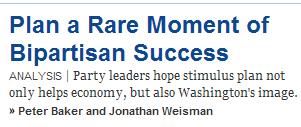
Baker and Weisman’s article reveals a House of Representatives oozing with self-congratulation.
President Bush hailed “the kind of cooperation that some predicted was not possible here in Washington.” House Speaker Nancy Pelosi (D-Calif.) used the words “bipartisan” and “bipartisanship” 10 times in a brief appearance. “Many Americans believe that Washington is broken,” said House Minority Leader John A. Boehner (R-Ohio). “But I think this agreement, and I hope that this agreement, will show the American people that we can fix it.”
Paul Krugman has another opinion.
Specifically, the Democrats appear to have buckled in the face of the Bush administration’s ideological rigidity, dropping demands for provisions that would have helped those most in need. And those happen to be the same provisions that might actually have made the stimulus plan effective.
So what else is new?
Aside from business tax breaks — which are an unhappy story for another column — the plan gives each worker making less than $75,000 a $300 check, plus additional amounts to people who make enough to pay substantial sums in income tax. This ensures that the bulk of the money would go to people who are doing O.K. financially — which misses the whole point.
The goal of a stimulus plan should be to support overall spending, so as to avert or limit the depth of a recession. If the money the government lays out doesn’t get spent — if it just gets added to people’s bank accounts or used to pay off debts — the plan will have failed. …
…Yes, they extracted some concessions, increasing rebates for people with low income while reducing giveaways to the affluent. But basically they allowed themselves to be bullied into doing things the Bush administration’s way.
In his blog, Krugman explains why this is a problem.
Update: See also David Sirota, “The Stimulus Swindle“; Michael Mandel, “How Real Was the Prosperity?“
I guess MBNA will be happy to get everyone to pay 300 on their credit card bill….
Gee, was it just two years ago, in the run-up to the mid-term elections, when Republicans were yammering about the doom that would result from giving the Representative from gay old San Francisco, that proto-socialist Nancy Pelosi the Speaker’s chair?
I guess all that went the way of all that free-market ‘the economy is just fine and dandy’ twaddle. No, we’re all Keynesians now, I guess, as long as we give the government money to Bush’s friends and not to the people who could really use it.
I’m waiting for someone to explain to me why it is in the Democrats interest to compromise in a House where they have the majority, rather than make the Bushistas pass their bill in the Senate, and compromise in the conference committee. Is it because the party is pathetically unable to harness the power of the media to put the blame for failure on His Lame-ducked-ness?
I’m still waiting for that feisty Democratic House of Representatives we were promised in 2006. Sure we got subpoena power, but since the White House is comfortable with laughing at subpoenas, so what? Has anyone important gone to jail? And now, on a PRIME Democratic issue, they’re compromising? Jiminy Cricket!
Speaking of complete failures to mobilize a narrative in the media, why haven’t we heard anyone lately asking about where the Clinton surplus went? It would sure be swell if we didn’t have to borrow even more from China and the Saudis to finance this stimulus package.
How is it, exactly, that we don’t have that money in the bank anymore, so we could be using it in hard times? Which party spent it all on tax cuts for the rich and a pointless (and seemingly endless) war? Maybe if they hadn’t shipped pallets of untraceable cash to Iraq, we could give it to people here now, right? How many checks to poor people could we have gotten out of what we gave contractors to build us hospitals and police stations with sewage leaking from the ceiling?
Maybe someone (like a ‘proto-socialistic’ Speaker from a safe seat in San Francisco?) ought to be suggesting that the party that brought us all that waste should just shut the hell up and let the progressives design a stimulus package that will work, rather than happily ‘compromising’ with them. The GOP obviously have no idea of what will work, or economic principles, so why should they be involved?
(My, I’m cranky this morning.)
Boehner wants to show the American people that “they” can fix the problems in Washington? Doesn’t Boner realize that he is a big part of the problem in Washington? I distinctly remember him shedding his crocodile tears on the house floor for the sacrifices of the military men and women serving in Iraq, when he was the asshole who helped put them there, and did everything in his power to make sure they continued in their suffering by remaining there.
Boner has proved himself to be a party hack without any regard for the best interests of the American people. And any words of a lovey dovey reconciling nature coming from his lips are pure lies.
It’s like the old addage..You can’t get blood from a stone… and you’re not going to get sincerity or honest bipartisanship from a two faced creep like Boehner.
There really is only one party, it is the Corporate Party in two colors, Red (hard fascism) or Blue (soft fascism). The people no longer have a representative government. You can vote, but only those with enough campaign contributions from the corporate leaders can reasonably expect to win. MSM is owned by our corporate leaders as well, so this makes control fairly simple. For those who despite the odds might win w/o their support, well, as Stalin said, it is not who votes that count, it is who counts the vote that is important.