
 Charlie Savage writes in today’s Boston Globe:
The chairman of the Senate Judiciary Committee, accusing the White House of a ”very blatant encroachment” on congressional authority, said yesterday he will hold an oversight hearing into President Bush’s assertion that he has the power to bypass more than 750 laws enacted over the past five years.
”There is some need for some oversight by Congress to assert its authority here,” Arlen Specter, Republican of Pennsylvania, said in an interview. ”What’s the point of having a statute if . . . the president can cherry-pick what he likes and what he doesn’t like?”
Specter plans to call administration officials and constitutional scholars to the hearings, to be held in June. Even if the Senate finds Bush really has exceeding his authority, there is little they can do about it beyond refusing to fund programs — or impeachment.
Specter’s announcement followed a report in the Sunday Globe that Bush has quietly asserted the authority to ignore provisions in 750 bills he has signed — about 1 in 10.
Over the past five years, Bush has stated that he can defy any statute that conflicts with his interpretation of the Constitution. In many instances, Bush cited his role as head of the executive branch or as commander in chief to justify the exemption.
On Monday night’s Countdown, Savage explained that often the laws Bush says he can ignore have nothing to do with war or national security, however.
OLBERMANN: With the signing statements or the PATRIOT Act renewal, the ban, military ban on torture, it seemed as if an argument could have been made for preserving the wartime powers of the president. That certainly can be argued. But there was something there to discuss.
But in some of these cases, whistleblower protections, nuclear regulatory officials, and what—the war has nothing to do with that, does it?
SAVAGE: That‘s right, Keith. There‘s the—in the domestic spying program scandal last year, which continues, the torture ban waiver that he asserted, and more recently, the—his assertion that he could ignore the oversight provisions of the PATRIOT Act.
The common theme in all those was, I‘m the commander in chief, we‘re at war. No matter that the Constitution gives all kinds of war-making powers to Congress, really, these laws don‘t apply when we‘re at war, because I have to protect the national security.
But what I found when I went back and read all these documents, which no one has paid attention to in the media or in Congress for the last five years, is that Bush‘s claims that he can ignore and defy laws that he thinks, under his own interpretation of the Constitution, are unconstitutional, has gone well beyond anything to do with national security.
Certainly the military and spy agencies have a lot to do with these laws that he‘s saying he doesn‘t have to obey, but there‘s many others that have to do with giving information to Congress, protecting whistleblowers who want to bring government wrongdoing to the attention of Congress, affirmative action, which has nothing to do with national security at all, or even his own interpretation of his own powers, but rather his interpretation of the, you know, the equal protection clause of the amendment, which is—the Supreme Court has been quite clear about.
Read Glenn Greenwald for more analysis.
When Bush doesn’t like a bill, instead of trying to compromise with Congress, or even veto the bill, he pretends to accept it and then negates the bill behind Congress’s back with a “signing statement.” I wrote about signing statements in more detail, including their use by past presidents, in this post. Bottom line, Bush is claiming power no other president has claimed, including Abraham Lincoln during the Civil War and Franklin Roosevelt during World War II, because he’s a “war president.” Or “the decider.” Or whatever he wants to call himself.
I say this indicates what a piss-poor leader the man is. Exercising power is not the same thing as leadership, as John Gardner argued —
Although leadership and the exercise of power are distinguishable activities, they overlap and interweave in important ways. Consider a corporate chief executive officer who has the gift for inspiring and motivating people, who has vision, who lifts the spirits of employees with a resulting rise in productivity and quality of product, and a drop in turnover and absenteeism. That is leadership. But evidence emerges that the company is falling behind in the technology race. One day with the stroke of a pen the CEO increases the funds available to the research division. That is the exercise of power. The stroke of a pen could have been made by an executive with none of the qualities one associates with leadership.
Seems to me “leadership” involves the free and willing followship of other people. But a dictator is someone who has enough power that he doesn’t have to bother about leading.
Is the Globe the new WaPo? (WaPo circa 1973, that is.)
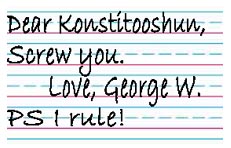
maha, is that a “karateexplosions” graphic? From the now-defunct Scotty Show on dKos? If so, where is Georgie’s picture of a cat?
The graphic is a maha original. 🙂
It would make a great bumper sticker!
The Decider!
“Dear Konstitooshun,
Screw you.
Love, George W.
PS I rule!”
What George actually said was much worse. From this article at capitolhillblue.com:
Meeting in the White House with the President, “GOP leaders told Bush that his hardcore push to renew the more onerous provisions of the [Patriot] act could further alienate conservatives still mad at the President from his botched attempt to nominate White House Counsel Harriet Miers to the Supreme Court.
“I don’t give a goddamn,” Bush retorted. “I’m the President and the Commander-inChief. Do it my way.”
“Mr. President,” one aide in the meeting said. “There is a valid case that the provisions in this law undermine the Constitution.”
“Stop throwing the Constitution in my face,” Bush screamed back. “It’s just a goddamned piece of paper!”” [emphasis mine]
It’s time to call for nation-wide marches – on July 4th – to simply say “We Don’t Want A King, George”.
If you blog it, by the tens of millions, they will come.
Kat
Bush is doing the “Scalia” to Congress, the Supreme Court and “we, the people” with his “signing statements”. I find it disturbing that there has not been more made out of this.
However, Bush managed to raise the ire of my favorite Repub, Arlen Specter. Hopefully, something will come of this, if only one less vote at the mid-terms.
First, Bloviator Specter ain’t about to do anything to The Dictator. He’s all talk and no guts that guy. Second, seems to me if the Senate really wanted to do something they could. Selectively cut off the funds to Mr. Bush.
But in the end it’s gonna come down to who can win the race to string Bush up by the heels: The CIA who are actively managing the Plame case or the Democrats who if they take either house of Congress will bury Bush and his AssClowns under a mountain of subpoenas.
My bet to win?
Put yer money on the CIA.
I don’t really understand the political advantage of the signing statements over vetoing a bill. I guess he was trying to be all sneaky sneaky and make it look like he was complicit with Congress even when he wasn’t, but now that the jig is up, he’s saying he doesn’t have to follow laws he finds unconstitutional? Then why sign it to begin with? Trying to understand the Bush administration is giving me a headache! (It would be nice, of course, if the press would ask him these questions, if only so we could see him squirm a little, but we all know that’s not gonna happen.)