October 11, 2007

Political Prisoners

You must read this story by Adam Cohen in today’s New York Times:

Paul Minor is the son of Bill Minor, a legendary Mississippi journalist and chronicler of the civil rights movement. He is also a wealthy trial lawyer and a mainstay of Mississippi’s embattled Democratic Party. Mr. Minor has contributed $500,000 to Democrats over the years, including more than $100,000 to John Edwards, a fellow trial lawyer. He fought hard to stop the Mississippi Supreme Court from being taken over by pro-business Republicans.

Mr. Minor’s political activity may have cost him dearly. He is serving an 11-year sentence, convicted of a crime that does not look much like a crime at all. The case is one of several new ones coming to light that suggest that the department’s use of criminal prosecutions to help Republicans win elections may go farther than anyone realizes. …

…Mr. Minor, whose firm made more than $70 million in fees in his state’s tobacco settlement, suspects it was his role in the 2000 Mississippi Supreme Court elections that put a target on his back. The United States Chamber of Commerce spent heavily to secure a Republican, pro-business majority, while Mr. Minor contributed heavily to the other side.

The Chamber of Commerce was particularly eager to replace Justice Oliver Diaz Jr. on the state Supreme Court. After Justice Diaz was re-elected, the Bush Justice Department hit him with a number of fraud, bribery, and tax evasion charges, none of which stood up in court. Justice Diaz, acquitted, is still serving on the bench.

But Paul Minor was not so fortunate. Although he was acquitted of a number of similar charges brought against him, the feds finally found a jury that would convict Minor on vague allegations of trying to get an “unfair advantage” from a judge.

Mr. Minor’s prosecution, like the others in this scandal, gave a big boost to the Republican Party. The case intimidated trial lawyers into stopping their political activity. “The disappearance of the trial-lawyer money all but wiped out the Democratic Party in Mississippi,” Stephanie Mencimer reports in her book, “Blocking the Courthouse Door.” …

…And there is the matter of timing. The prosecution of Mr. Minor and Justice Diaz came just as Gov. Ronnie Musgrove, a Democrat, was running for re-election against Republican Haley Barbour. The Republicans spent heavily to tie Mr. Musgrove to Mr. Minor, and Mr. Musgrove was defeated.

And then there’s Alabama Gov. Don Siegelman, serving more than seven years in prison on dubious charges, and Georgia Thompson, a Wisconsin civil servant who was freed after serving four months on baseless corruption charges.

In Wisconsin, Ms. Thompson’s trial coincided perfectly with Democratic Gov. Jim Doyle’s re-election campaign, and Republicans tried to link Doyle to Thompson. Mr. Siegelman’s prosecution looks like it was timed to prevent him from becoming governor again. It may be that all three of these cases were simply attempts to use the Justice Department to get Republican governors elected.

Ms. Thompson was fortunate to get a good federal appeals court panel, which ordered her released. Mr. Minor and Mr. Siegelman may not be so lucky. Former Attorney General Alberto Gonzales and many other key players in the United States attorneys scandal are gone, but Congress has a lot more work to do in uncovering the damage they have done to the justice system.

Yesterday, Adam Zagorin reported for Time magazine that Karl Rove himself may be linked to the Siegelman case.

A Republican lawyer claims she was told that Karl Rove — while serving as President Bush’s top political adviser — had intervened in the Justice Department’s prosecution of Alabama’s most prominent Democrat. Longtime Alabama G.O.P. activist Dana Jill Simpson first made the allegation in June, but has now provided new details in a lengthy sworn statement to the House Judiciary Committee. …

…Simpson said in June that she heard a close associate of Rove say that the White House political adviser “had spoken with the Department of Justice” about “pursuing” Don Siegelman, a former Democratic governor of Alabama, with help from two of Alabama’s U.S. attorneys. Siegelman was later indicted on 32 counts of corruption, convicted on seven of them, and is currently serving an 88-month sentence in Federal prison.

TIME has obtained a copy of Simpson’s 143-page sworn statement to the Judiciary Committee. She recalls conversations in early 2005 with Rob Riley, Jr., son of Alabama’s current Republican governor, over his father’s coming gubernatorial race, in which Siegelman appeared to be the top Democratic challenger. The younger Riley, she says, told her that his father and Bill Canary, the state’s top Republican political operative and a longtime friend of Rove, contacted Rove in late 2004, after which he intervened with the Justice Department’s Public Integrity section to push for criminal prosecution of Siegelman. Months later, in May 2005, Siegelman was indicted, setting off a chain of events that led to his imprisonment and the end of his political career.

When Georgia Thompson’s case was reviewed by an appeals court last spring, one of the judges actually said:

“I have to say it strikes me that your evidence is beyond thin,” federal Appeals Judge Diane Wood told prosecutors. “I’m not sure what your actual theory in this case is.”

Spotlight

August 16, 2007

Michelle Malkin Hates Our Freedoms

Filed under: Bush Administration, Terrorism, criminal justice — maha @ 3:45 pm

Today a jury found Jose Padilla guilty of two counts

Count 1 - Conspiracy to Murder, Kidnap, and Maim Persons in a Foreign Country as part of a conspiracy to advance violent jihad
Count 2 - Conspiracy to Provide Material Support for Terrorists

I wouldn’t have a quarrel with the verdict had Padilla’s rights as a citizen been observed. If there was evidence showing him conspiring with terrorists, certainly an arrest and trial was warranted. But his rights as a citizen were not observed. There is no justice here.

Utterly oblivious to what has actually happened here, and that what was done to Padilla is a betrayal of everything this country used to stand for, Michelle Malkin is having an orgasm of celebratory righteousness all over her blog. Don’t look unless you have a strong stomach. She doesn’t come out and say that the verdict justified shredding the Fourth Amendment and almost four years of torture, but she sure as hell isn’t showing any remorse either. And her Hot Air partner Allahpundit cheers — it’s a “big win for Bush.”

Malkin and Allahpundit hate America.

[Updated here.]

Spotlight

July 3, 2007

Five Years Ago Today, and Today

Filed under: Bush Administration, criminal justice, blogging — maha @ 7:52 am

Today is The Mahablog’s fifth birthday. The very first Mahablog post was written on July 3, 2002.

The first 18 months or so of Mahablog was dumped off its server by the original web host, Lycos Tripod, without consulting me first, but thanks to the Wayback Machine I was able to locate the first Mahablog page, or at least fragments of it. On the day after the commutation of Scooter Libby’s sentence, this first blog post seems almost relevant. Here it is.

* * *

July 3, 2002

“It’s a tad bigger deal than Whitewater,” said my Web buddy Winston. He was referring to the revelation that George W. Bush, once upon a time, violated several SEC regulations and got away with it. (His daddy was President of the United States at the time. Coincidence?)

“You think?” I replied.

You do remember Whitewater? Or does it dimly seem to have been something about lying to Paula Jones about an oath, or about Monica Lewinsky delivering pizza in her thong, or some such? All that nonsense that, thank God, is over, along with the budget surplus and peace and prosperity and steady employment and other dimly remembered things.

What Was Whitewater About, Again?

“Whitewater” was a real-estate partnership set up in 1979 to sell 42 lots along the White River in north-central Arkansas. The partners were James B. and Susan McDougal and Bill and Hillary Clinton. The lots did not sell well; the Clintons sold their remaining interest to the McDougals for $1,000 in 1992, and lost $68,000 on the deal.

Why was this an issue?

It was alleged that the McDougals and former Arkansas Gov. Guy Tucker used McDougal’s savings and loan to create a series of phony loans to enrich themselves, and one of the illegal loans found its way into the Whitewater partnership account.

This had all happened before Bill Clinton was elected president. However, the suicide of White House Counsel Vince Foster in 1993 caused right-wingers to foam at the mouth. Why did he kill himself? Maybe because he knew something? Maybe he was killed to shut him up? We have to look into this!

Hence, Ken Starr and the endless Whitewater investigations, which began in 1994 and which, I think, are over, although I’m not going to swear to it. The investigations cost us taxpayers more than $60 million, and not enough evidence was ever uncovered to charge the Clintons with a crime.

Other people were charged, but the “crime” was essentially an Arkansas state matter and not something the entire United States government should have been wasting time and resources on for six or seven or eight years, or however long it was.

After coming up empty on Whitewater, Ken Starr and his “team” went on a fishing trip (or Tripp?) to get whatever dirt they could get on the President in order to bring impeachment charges. At the exact same time that the President was being raked over coals over Monica Lewinsky and fighting impeachment in the House, Osama bin Laden and al Qaeda were causing considerable trouble and needed tending to, but it seems only President Clinton and his administration noticed this.

(For details, see the Mahachronicles: Timeline of Terror! )

Oh, by the way, we still don’t know why Vince Foster killed himself. Maybe he was depressed.

Compare and Contrast:

In 1986, George W. Bush and his partners sold their failing Spectrum 7 Energy Corp. to Harken Energy Corp. Bush received more than 200,000 shares of Harken stock and was made director and consultant to the company.

Four years later, Bush unloaded those shares for a nice profit. With that money, he bought a stake in the Texas Rangers baseball club, which would eventually make him a multimillionaire.

So what’s the problem?

The problem is that Harken was losing money but had concealed this from the public by some nice Enron-style manueuvering. Harken created a phony profit by selling 80 percent of a subsidiary, Aloha Petroleum, to a partnership called International Marketing & Resources. The catch was that IM&R was also Harken; the partners were all Harken insiders. Further, $11 million of the $12 million “sale” was through a note held by Harken. $12 million the company entered in its books as a capital gain was actually vapor.

In January 1990, IM&R sold its 80 percent of Aloha to a privately held company called Advance Petroleum Marketing. APM was now obligated to pay the Harken loan.

On June 22, 1990, G.W. Bush sold his Harken stock for $4 a share.

By August 22, 1990, Harken could no longer conceal it was losing money; its second quarter report was a disaster. Stocks fell to $2.37 a share. And, that fall the Securities and Exchange Commission discovered the Aloha sale scam.

The SEC investigated G.W. Bush for insider trading. Among the most damning acts of the president’s son was the fact that he filed his Form 4 report on the sale of the Harken stock 34 weeks late. The SEC usually prosecutes people for these little lapses.

But not George W. Bush, the son of the sitting President of the United States.

I’m sure if any talking head brings this up on television he or she will be promptly shouted down. And I’m not holding my breath until major media report it, either.

Sources:

Bush’s Insider Connections Preceded Huge Profit On Stock Deal


Bush Violated Security Laws Four Times, SEC Report Says

* * *

Now we’re back in 2007. A couple of post scripts to this story: First, when a few little details of the Harken episode slipped into mainstream media, the Right quickly claimed that Bush had been investigated by the SEC and exonerated. Not so; the SEC began to investigate him, but the investigation was dropped. Bush was not accused of a crime, but neither was he cleared of one.

Did I mention that his Daddy was President of the United States at the time, and the SEC commissioner a long-time friend of the Bush family?

The other postscript is that George Bush made a very nice profit on his Texas Rangers investment and rode the baseball owner hobbyhorse into the Texas governor’s mansion, and then into the White House. And now we’re saddled with him.

There’s an editorial about the liberation of Libby in today’s New York Times that’s worth reading:

Soft on Crime

When he was running for president, George W. Bush loved to contrast his law-abiding morality with that of President Clinton, who was charged with perjury and acquitted. For Mr. Bush, the candidate, “politics, after a time of tarnished ideals, can be higher and better.”

Not so for Mr. Bush, the president. Judging from his decision yesterday to commute the 30-month sentence of I. Lewis Libby Jr. — who was charged with perjury and convicted — untarnished ideals are less of a priority than protecting the secrets of his inner circle and mollifying the tiny slice of right-wing Americans left in his political base. …

… Mr. Bush’s assertion that he respected the verdict but considered the sentence excessive only underscored the way this president is tough on crime when it’s committed by common folk. As governor of Texas, he was infamous for joking about the impending execution of Karla Faye Tucker, a killer who became a born-again Christian on death row. As president, he has repeatedly put himself and those on his team, especially Mr. Cheney, above the law.

Within minutes of the Libby announcement, the same Republican commentators who fulminated when Paris Hilton got a few days knocked off her time in a county lockup were parroting Mr. Bush’s contention that a fine, probation and reputation damage were “harsh punishment” enough for Mr. Libby.

Presidents have the power to grant clemency and pardons. But in this case, Mr. Bush did not sound like a leader making tough decisions about justice. He sounded like a man worried about what a former loyalist might say when actually staring into a prison cell.

Yeah, pretty much.

PS — I do accept birthday presents — just click the “donate” button below –

PPS — This is also my daughter Erin’s birthday, which means I remember what I was doing 27 years ago today. That was a good day.

Spotlight

June 29, 2007

Wiki Clairvoyance?

Filed under: criminal justice — maha @ 11:43 am

This is just weird.

Spotlight

June 28, 2007

The Devil and Dick Cheney

Filed under: Bush Administration, Dick Cheney, criminal justice, corruption — maha @ 11:18 am

You know the Veep is in trouble when he’s lost David Broder. “[W]hen presidential candidate George W. Bush chose Dick Cheney as his running mate, I applauded the choice. … Boy, was I wrong.”

Truly, there’s not much lower Dick can sink. I checked to see if Hugh Hewitt had turned on him yet — that would be, I think, absolute rock bottom — but I found no recent Hewitt postings on Cheney. Yet. Even really stupid rats will get off the sinking ship before they drown.

Do a news google for “impeach Cheney” and you get an eyeful. Coming at a time when the Bush Administration faces mutiny over immigration, it can truly be said the White House is (finally) under siege from all sides. Some parts of the Republican Party are still trying to provide a buffer, of course, but the GOP is starting to look like the last defenders of the Bastille.

Raw Story reports that this morning the White House asserted “executive privilege” and said it would not turn over documents related to the firings of federal attorneys. I believe we’re still waiting for a response to yesterday’s subpoenas regarding the warantless wiretap program.

My understanding is that if the Administration refuses to comply with subpoenas from Congress, Congress has to go to a federal court to get the subpoenas enforced. If a court rules the Administration must comply, the White House can appeal, and fish around for federal judges who will allow them to continue to operate outside the law. That’s how the Dickster was able to avoid turning his energy task force records over to the General Accounting Office, for example.

I assume the White House can appeal this all the way to the Supreme Court. Yeah, that’s so … not reassuring. Judging in part by how the voting went in Bush v. Gore, in which Kennedy, O’Connor, Rehnquist, Scalia and Thomas voted to stop the recounts, I can see the votes falling the same way they did during the recent Carhart decision — Kennedy, Alito, Roberts, Scalia, and Thomas supporting the White House; Breyer, Ginsburg, Souter and Stevens upholding the law.

Right now, this nation is as close to totalitarianism as it has ever been. Closer, probably.

What if the White House exhausts all appeals and still refuses to turn over the subpoenaed documents? I honestly don’t know what the next step might be. I’m not sure that’s ever happened before. How might they be forced to comply? There have been many times in American history in which some or all of the three branches of government were at odds with each other, but the extreme behavior of the Bush Administration is taking us into uncharted territory.

An appeal process could drag on for months. The Bushies might run out the clock. Or, if it is resolved late next year, Congress might decide to spare itself from sending law enforcement agents into the White House to enforce the subpoenas.

Even so, I sincerely hope all appearances of criminal behavior will be investigated, and the perps brought to justice eventually. As long as it takes. That means it’s essential to seek no pardon pledges from all our Democratic presidential candidates.

And, David Broder — shut up and listen to us dirty bleeping hippies next time, OK?

Essential reading — don’t miss Sidney Blumenthal’s essay, “The imperial vice presidency,” in Salon today. See also “Impeach Cheney: The Vice President Has Run Utterly Amok and Must Be Stopped” by Bruce Fein in Slate and “Cheney and the National Security Secrets Fraud” by Scott Horton at Harper’s.

Also — I realize Rep. Dennis Kucinich introduced articles of impeachment against Cheney last April. Does anyone have a link to the exact document that Kucinich submitted to the House? I ran into one commenter who said that Kucinich’s bill, while well-intentioned, did not introduce the strongest reasons to impeach Cheney. I’d like to read it myself before I comment.

Spotlight

April 16, 2007

Safety First

Filed under: criminal justice — maha @ 9:21 pm

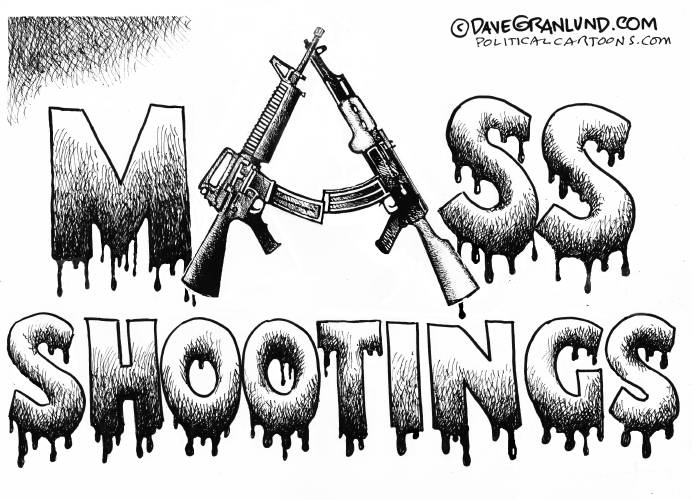
In the wake of today’s horrific shootings at Virginia Tech, some on the Right are calling for looser gun control laws. Although Virginia itself is one of the least restrictive states in the Union regarding guns, the campus was supposed to be a “gun-free” zone.

“Just imagine if students were armed,” writes one. “We no longer need to image what will happen when they are not armed.”

I got to that site from a link on Michelle Malkin’s blog, who quotes one of her readers: “Imagine if sensible CCW [concealed carry weapons] laws allowed people to defend themselves, this tragedy could have been avoided.”

Gun enthusiasts (they do take offense if you call them “gun nuts”) have a pure and transcendent faith that those states that allow citizens to carry concealed weapons for their own protection have enjoyed a dramatic drop in crime. Some of these states have seen a drop in the rate of violent crime, but so have states with stricter gun control laws that don’t allow citizens to carry a concealed weapons. Violent crime rates have been dropping all over for the past several years.

A few years ago I spent some time digging through the FBI’s uniform crime stats by state to see if there was a correlation between violent crime rates and gun laws. There wasn’t one, either way. Some states with lax gun laws had higher violent crime rates than some states with strict gun laws, and some states with strict gun laws had higher violent crime rates than some states with lax gun laws. I assume that’s still true.

For example, Texas, which has allowed concealed carry of weapons since 1995, has a murder/manslaughter rate (per 100,000 inhabitants) of 6.2 and a forcible rape rate of 37.2. Gun-unfriendly New York state has a murder/manslaughter rate of 4.5 and forcible rape rate of 18.9 (FBI, 2005). But, as I said, if you were to compare two other states you might see something very different. There are just too many variables affecting crime rates to say categorically that any particular gun law makes any measurable difference.

That said, if you want an argument for not allowing concealed carry of weapons, just check out Michelle’s previous post. Her theme today is that black people are scary and cause crime. Her link for “the truth about black crime rates” leads to this utterly reprehensible article by a Heather Mac Donald which says, in effect, we can’t blame the NYPD for shooting and killing innocent black men by mistake, since black crime rates are so high.

Her example is Sean Bell, a young man who was gunned down by NYPD last year as he left his own bachelor party. Ms. Mac Donald takes umbrage at the suggestion that the NYPD are “trigger-happy racists.” The neighborhood was a high-crime area, she says, and Mr. Bell and his companions were behaving erratically (having just left a bachelor party, remember).

Mr. Bell was not wanted for a crime and was not armed at the time of his death. He was killed for celebrating while black, in other words.

Ms. Mac Donald says blacks committed 68.5 percent of all murders, rapes, robberies, and assaults in New York City last year, a statistic that seems to her to justify shooting boisterous black men first and asking questions later.

However, did you know that men commit 88.7% of all homicides in the United States? And without looking it up I’ll assume men commit a whopping majority of forcible rapes, too. Does that mean unjustified shootings of men are more forgivable than unjustified shootings of women?

It is true that African Americans commit violent crimes at a higher rate than whites. But Did You Know that if you are ever murdered or assaulted, the odds are that your murderer/attacker will be the same race you are, whatever that is?

Lo (click here for bigger picture):

A stroll through the Department of Justice, Bureau of Justice Statistics, can tell us a lot about people who commit crimes. For example, renters commit more crimes than homeowners. Women are considerably more likely than men to be murdered by a current or former spouse or lover, especially in rural areas. Next time some farmer’s wife offs her husband, she should use that statistic in her defense.

Hmm, rural guys. Texas guys. Ladies, watch out for cowboys.

I’m sure if we kept looking we would find correlations between income, level of education, and several other factors and crime rates. I found a study that claimed children who went to high-quality preschools are less likely to become violent criminals than those who don’t. Information like this is useful if you’re trying to figure out ways to reduce crime.

But when you’re dealing with an individual, you need to look at an individual. It is simply not true that every black man is more dangerous than any white man. Serial killers are nearly always white men, for example.

Which takes us back to gun laws. The NYPD has a sorry history of killing black men who weren’t doing anything wrong. And the cops get training; they get guidelines; they have a chain of command. And they make mistakes. Wouldn’t yahoos carrying concealed weapons to deter crime make mistakes, too? How many mistakes are we willing to tolerate in the name of “safety”?

If someone wants to keep a firearm in his home or behind the counter of his convenience store that’s his business. But people who are frightened or excited make bad judgments. If Virginia Tech students had been armed today, would there be fewer dead? Or more? I think either is possible.

If someone wants to keep a gun in his home or behind the counter of his convenience store for protection, that’s his business. I’ve said many times that if I lived in some isolated cabin in Montana I’d keep a loaded shotgun on the wall, too. But the world is full of guys with Rambo fantasies and poor impulse control. The thought of those guys carrying concealed weapons does not make me feel safer.

~~~~~

On a related note — MSNBC and CNN keep saying that today’s shooting is the “worst massacre” or “worst mass shooting” in American history. It isn’t. If you stipulate “worst massacre/mass shooting with one perpetrator,” then maybe. But there have been many worse massacres with multiple perpetrators. For example, there was a nasty little episode in 1866, in New Orleans. At least 48 men at a peaceful meeting — mostly black men, btw — died at the hands of a gang of white men who broke into the room and started shooting. More than a hundred more were wounded. There were reports that some of the dead were executed after they were found hiding in closets and under floor boards. That counts as a worse mass shooting than today’s tragedy, I’d say.

There have been a number of worse mass killings than that, although all the ones I can think of involved multiple means of killing, such as fires or axes. Wounded Knee might not count because it was called a “battle” even though most of the 300 Sioux killed by soldiers were unarmed and unable to defend themselves.

Of course we all hurt because of what happened today, and I’m not saying the shootings at Virginia Tech were less terrible than past incidents. I just want to set the record straight.

Update: E.J. Dionne provides some more stats in his column today:

According to the U.S. Census, black households in 2005 had a median income of $30,858, compared with $50,784 for non-Hispanic white households. The black poverty rate was 24.9 percent. The white poverty rate was 8.3 percent.

Spotlight

March 22, 2007

“Republican Holy Office of the Inquisition”

Sidney Blumenthal:

In the U.S. attorneys scandal, Gonzales was an active though second-level perpetrator. While he gave orders, he also took orders. Just as his chief of staff, Kyle Sampson, has resigned as a fall guy, so Gonzales would be yet another fall guy if he were to resign. He was assigned responsibility for the purge of U.S. attorneys but did not conceive it. The plot to transform the U.S. attorneys and ipso facto the federal criminal justice system into the Republican Holy Office of the Inquisition had its origin in Karl Rove’s fertile mind.

There’s more evidence of political manipulation of justice this morning. Carol D. Leonnig writes for the Washington Post:

The leader of the Justice Department team that prosecuted a landmark lawsuit against tobacco companies said yesterday that Bush administration political appointees repeatedly ordered her to take steps that weakened the government’s racketeering case.

Sharon Y. Eubanks said Bush loyalists in Attorney General Alberto R. Gonzales’s office began micromanaging the team’s strategy in the final weeks of the 2005 trial, to the detriment of the government’s claim that the industry had conspired to lie to U.S. smokers.

She said a supervisor demanded that she and her trial team drop recommendations that tobacco executives be removed from their corporate positions as a possible penalty. He and two others instructed her to tell key witnesses to change their testimony. And they ordered Eubanks to read verbatim a closing argument they had rewritten for her, she said.

“The political people were pushing the buttons and ordering us to say what we said,” Eubanks said. “And because of that, we failed to zealously represent the interests of the American public.”

If you don’t remember the tobacco case, here’s a June 8, 2005 article by Ms. Leonnig for background. She wrote then,

After eight months of courtroom argument, Justice Department lawyers abruptly upset a landmark civil racketeering case against the tobacco industry yesterday by asking for less than 8 percent of the expected penalty.

As he concluded closing arguments in the six-year-old lawsuit, Justice Department lawyer Stephen D. Brody shocked tobacco company representatives and anti-tobacco activists by announcing that the government will not seek the $130 billion that a government expert had testified was necessary to fund smoking-cessation programs. Instead, Brody said, the Justice Department will ask tobacco companies to pay $10 billion over five years to help millions of Americans quit smoking.

Steve Soto remarked (June 7, 2005):

Well, all those campaign contributions taken by Bush/Cheney (nearly $260,000 in 2000 and 2004) and the GOP from the tobacco industry over the years finally bought a $120 billion payday for Big Tobacco when the Alberto Gonzales Justice Department shocked the industry and anti-smoking advocates alike today by scuttling the government’s own litigation.

Remember when I said of the U.S. Attorney scandal, “this is huge“? If clear ties to President Bush are established, this issue has the potential of putting impeachment back on Nancy Pelosi’s to-do list.

Back to today’s article by Ms. Leonnig:

Yesterday was the first time that any of the government lawyers on the case spoke at length publicly about what they considered high-level interference by Justice officials.

Eubanks, who retired from Justice in December 2005, said she is coming forward now because she is concerned about what she called the “overwhelming politicization” of the department demonstrated by the controversy over the firing of eight U.S. attorneys. Lawyers from Justice’s civil rights division have made similar claims about being overruled by supervisors in the past.

Pay close attention to this part:

Eubanks said Congress should not limit its investigation to the dismissal of the U.S. attorneys.

“Political interference is happening at Justice across the department,” she said. “When decisions are made now in the Bush attorney general’s office, politics is the primary consideration. . . . The rule of law goes out the window.”

In its defense, the Justice Department explains it conducted its own internal investigation and cleared itself of wrongdoing. The JD also says the decision to pull back on the case was vindicated last year when a U.S. district judge said “she could not order the monetary penalty proposed by the government.” So they have an excuse for reducing the amount of damages sought. But changing testimony? Weakening the case?

The political appointees who allegedly interfered with the prosecution were “then-Associate Attorney General Robert D. McCallum, then-Assistant Attorney General Peter Keisler and Keisler’s deputy at the time, Dan Meron.” McCallum is now the U.S. ambassador to Australia

The Clinton Justice Department brought the unprecedented civil suit against the country’s five largest tobacco companies in 1999. President Bush disparaged the tobacco case while campaigning in 2000. After Bush took office, some officials expressed initial doubts about the government’s ability to fund the prosecution, Justice’s largest.

Eubanks said McCallum, Keisler and Meron largely ignored the case until it became clear that the government might win. She recalled that “things began to get really tense” after McCallum read news reports in April 2005 that one government expert, professor Max H. Bazerman of Harvard Business School, would argue that tobacco officials who engaged in fraud could be removed from their corporate posts. Eubanks said she received an angry call from McCallum on the day the news broke.

“How could you put that in there?” she recalled him saying. “We’re not going to be pursuing that.”

Afterward, McCallum, Keisler and Meron told Eubanks to approach other witnesses about softening their testimony, Eubanks said.

Yesterday Bob Barr, of all people, appeared on CNN blasting the Bush Administration’s apparent interference with the justice system. From Think Progress, which has the video:

Barr blasted the White House, saying “the integrity of the Department of Justice is being used as a political football by the administration to prove who’s the toughest hombre in all this.” Rather than fighting accountability, Barr said, “the administration really ought to be going out of its way to do what prior administrations have done, such as the Bush 1 administration and Reagan administrations, and that is take whatever steps are necessary to assure the American people that the integrity of our justice system has not been compromised.”

Last year Barr left the GOP to join the Libertarian Party. One wonders what the Bushies/GOP did to him to piss him off.

Spotlight

March 13, 2007

This Is Huge

A White House document dump has provided new revelations about the U.S. Attorney purge. And the biggest revelation — although not a surprising one — is that the idea to fire U.S. Attorneys and replace them with politically compliant toadies originated in the White House.

I’m piecing together two news stories, one by David Johnston and Eric Lipton in today’s New York Times, and the other by Dan Eggen and John Solomon in today’s Washington Post. The story thus far:

In early 2005, White House legal counsel Harriet Miers asked D. Kyle Sampson, a justice department official, if it would be feasible to fire and replace all 93 U.S. attorneys. It appears the White House was unhappy with the attorneys because Republicans were alleging widespread voter fraud on the part of Democrats, and the attorneys were unwilling to bring indictments against the Democrats, most probably because the allegations were a fantasy. (Josh Marshall provides an archive of his posts on the voter fraud allegations going back to 2001.)

However, as Johnston and Lipton note, the documentation isn’t clear if the voter fraud issue was the real or only reason.

The documents did not provide a clear motive for the firings. Some suggested that department officials were dissatisfied with specific prosecutors, but none cited aggressive public corruption inquiries or failure to pursue voter fraud cases as an explicit reason to remove them.

As has been widely noted in the recent past, the pattern suggests that the White House and the Republican Party generally have been using the Justice Department as part of their election campaign process. In other words, Karl and Co. have been turning our criminal justice system into a Republican Party machine.

Sampson — who resigned yesterday, btw — replied to Miers that filling that many jobs at once would be too big a job. (The Washington Post reports that Attorney General Alberto Gonzales said the same thing at the time.) Instead, Miers and Sampson began working together on a select list of attorneys to replace. As they did this, Karl Rove and other White House officials helpfully relayed the complaints they were getting from Republican officials about the attorneys’ failure to indict Democrats on voter fraud.

Eggen and Solomon, WaPo (emphasis added):

The e-mails [between Miers and Sampson] show that Rove was interested in the appointment of a former aide, Tim Griffin, as an Arkansas prosecutor. Sampson wrote in one that “getting him appointed was important to Harriet, Karl, etc.”

Sampson sent an e-mail to Miers in March 2005 that ranked all 93 U.S. attorneys. Strong performers “exhibited loyalty” to the administration; low performers were “weak U.S. attorneys who have been ineffectual managers and prosecutors, chafed against Administration initiatives, etc.” A third group merited no opinion.

In January 2006, Sampson sent a first list of attorneys to be fired to the White House. Four of the attorneys who would be fired were on this list: Chiara, Cummins, Lam and Ryan (the final list is here). This list also suggested Tim Griffin be one of the replacements.

Eggen and Solomon, WaPo:

In September, Sampson produced another list of firing candidates, telling the White House that Cummins was “in the process of being pushed out” and providing the names of eight others whom “we should consider pushing out.” Five on that list were fired in December; the others were spared. …

… Sampson also strongly urged bypassing Congress in naming replacements, using a little-known power slipped into the renewal of the USA Patriot Act in March 2006 that allows the attorney general to name interim replacements without Senate confirmation.

“I am only in favor of executing on a plan to push some USAs out if we really are ready and willing to put in the time necessary to select candidates and get them appointed,” Sampson wrote in a Sept. 17 memo to Miers. “It will be counterproductive to DOJ operations if we push USAs out and then don’t have replacements ready to roll immediately.

“I strongly recommend that as a matter of administration, we utilize the new statutory provisions that authorize the AG to make USA appointments,” he wrote.

By avoiding Senate confirmation, Sampson added, “we can give far less deference to home state senators and thereby get 1.) our preferred person appointed and 2.) do it far faster and more efficiently at less political costs to the White House.”

[Update: See also Think Progress.]

Note that the Patriot Act provision came into being in March 2006, about a year after Miers and Sampson began work on their list. Coincidence? Not a chance.

Notice this little detail, from Eggen and Solomon:

Iglesias, the New Mexico prosecutor, was not on that list. Justice officials said Sampson added him in October, based in part on complaints from Sen. Pete V. Domenici and other New Mexico Republicans that he was not prosecuting enough voter-fraud cases.

You may remember that in October 2006 — shortly before the elections — Domenici had called U.S. attorney David Iglesias and asked him about the status of an investigation into a Democratic state senator. Domenici also spoke to President Bush. Then Bush spoke to Gonzales “to pass along concerns by Republicans that some prosecutors were not aggressively addressing voter fraud,” Johnston and Lipton write. Thus Iglesias was added to the purge list, even though he had received a “strong performer” rating from Miers and Sampson in the earlier stages of their list-making.

A White House spokeswoman insisted that the President did not call for the removal of any specific attorney. Nor did he know that Miers, Sampson, and Rove had been drawing up a list already. (Bush never seems to know anything that’s going on under his nose, does he? I find it hard to believe that Bush didn’t at least mention Iglesias to Sampson.)

A few weeks after the conversation between Bush and Gonzales, the Justice Department forced out seven prosecutors.

Johnston and Lipton, NY Times:

On Dec. 4, 2006, three days before the dismissals, Mr. Sampson sent an e-mail message to the White House with a copy to Ms. Miers outlining plans to carry out the firings

“We would like to execute this on Thursday, Dec. 7,” Mr. Sampson wrote. Because some United States attorneys were still in Washington attending a conference, he planned to postpone telling them they were being fired. He wrote, “We want to wait until they are back home and dispersed to reduce chatter.”

Eggen and Solomon, WaPo:

On the day of the Dec. 7 firings, Miers’s deputy, William Kelley, wrote that Domenici’s chief of staff “is happy as a clam” about Iglesias.

A week later, Sampson wrote: “Domenici is going to send over names tomorrow (not even waiting for Iglesias’s body to cool).”

Domenici is so busted.

E-mails show that Justice officials discussed bypassing the two Democratic senators in Arkansas, who normally would have had input into the appointment, as early as last August. By mid-December, Sampson was suggesting that Gonzales exercise his newfound appointment authority to put Griffin in place until the end of Bush’s term.

Griffin’s appointment and his connection to Karl Rove was reported in Arkansas newspapers in mid-December. This was one of our first clues that something screwy was going on regarding the U.S. attorneys.

Miers resigned as White House counsel less than three weeks later, in early January.

As for D. Kyle Sampson, in a sidebar story the New York Times reports that he had been using his post as chief of staff to the attorney general to get named U.S. attorney in Utah, his home state, even though he had never worked as a full-time prosecutor. The White House and Justice Department backed Sampson, but Senator Orrin Hatch wanted Brett Tolman, “a one-time Utah federal prosecutor who had spent the previous three years working on antiterrorism issues for the Judiciary Committee staff.”

This suggests to me that Orrin Hatch has known about some of these shenanigans for some time. But let’s go on …

This put Mr. Sampson in an unusual position. As Mr. Gonzales’s chief of staff, he was fielding calls and letters from Mr. Hatch’s office, even though he was vying for the job that Mr. Hatch was writing about, two former officials from Mr. Hatch’s office said. That made at least some Senate officials uncomfortable.

“It was a little like the fox watching the hen house,” said one former Senate staff member, who asked not to be named because he now works in a different job.

Mr. Sampson did not respond to phone calls seeking comment.

Mr. Hatch finally made a personal appeal to Mr. Gonzales to drop his bid to nominate Mr. Sampson. After a four-month delay, President Bush nominated Mr. Sampson’s rival for the job last June.

Sampson — did I mention he resigned yesterday? — is a religious conservative (a Mormon) who “told the Brigham Young University news service that he admired Mr. Bush because the president recognized that politics and religious beliefs could not be separated.” Apparently Mr. Sampson’s religious beliefs didn’t teach him anything about ethics.

This really is huge. The “underlying crime” in the Watergate scandal was the White House’s illegal activities — such as money laundering and breaking into Dem Party offices to look for something incriminating — to ensure Nixon’s re-election in 1972. Now there is mounting evidence that the Bush White House and other Republican officials have been trying to use the entire federal criminal justice system to win elections for Republicans. I say this has Watergate beat all to hell. So far we know thatGonzales has lied to Congress about the reasons for purging the attorneys, and certainly more juicy bits will be revealed as time goes on.

Yesterday Sen. Charles Schumer (D-NY) said he intends to subpoena Karl Rove if he doesn’t testify to Congress voluntarily. Stay tuned.

Spotlight

March 12, 2007

Last Refuge of a Soundrel

Filed under: Bush Administration, Civil Rights, criminal justice, corruption — maha @ 4:09 pm

“Patriotism is the last refuge of a scoundrel,” Samuel Johnson said. Maybe ’twas true then, but we’ve stooped a bit lower since. When all else fails, blame incompetence.

At least, that’s what the Wall Street Journal is doing. Check out this editorial about the FBI’s improper use of national security letters:

Just when President Bush seemed to have beaten back the Congressional defeatists on Iraq, along comes his own Justice Department to undermine some hard-won antiterror policy gains. The incompetence at Justice is getting to be expensive for Presidential power.

Remember, WSJ still believes President Bush has a glorious strategy for victory in Iraq. So for them to have gone from denial to excuses in such a short time is something of a miracle.

It’s true that the Justice Department’s internal investigation on the national security letter issue blamed human error and shoddy record keeping for most of the unauthorized wiretapping. But this tells me that the people at the top — Attorney General Alberto Gonzales and FBI Director Robert Mueller — have been winking at nodding at gross violations of citizens’ 4th Amendment rights. If these two had made it clear that all surveillance would be conducted lawfully, you can bet there’d have been a whole lot less human error and shoddy record keeping.

Dem Senator Chuck Schumer has called on Alberto Gonzales to resign. Republican Senator Lindsay Graham accused Schumer of interjecting “a little politics here.” I guess some righties are still in denial. I also infer that it’s unseemly for a Senator to speak up on a serious lapse if the lapser is a member of the other party. But if Republicans would take responsibility for their problem children, the Dems wouldn’t have to speak up. But Republicans, in effect, let the kids run all over the restaurant screaming and tripping the waiters and stealing food off plates, and when, finally, some adult says stop that, you little brat, the GOP gets all indignant about it.

(On a related note, see the Carpetbagger — “It’s become a fairly common refrain, hasn’t it? The right does something offensive, the left gets mad when there are no consequences, time elapses, and the right, annoyed by lingering resentment, tells the left to ‘get over it.’”)

Meanwhile, the U.S. attorney purge continues to get attention. What we know so far is that some of the U.S. attorneys were fired after Republican officials in their districts complained to Karl Rove– the bleeping White House political director — about the attorneys’ performance.


Paul Krugman wrote today
,

Sources told Newsweek that the list of prosecutors to be fired was drawn up by Mr. Gonzales’s chief of staff, “with input from the White House.” And Allen Weh, the chairman of the New Mexico Republican Party, told McClatchy News that he twice sought Karl Rove’s help — the first time via a liaison, the second time in person — in getting David Iglesias, the state’s U.S. attorney, fired for failing to indict Democrats. “He’s gone,” he claims Mr. Rove said.

After that story hit the wires, Mr. Weh claimed that his conversation with Mr. Rove took place after the decision to fire Mr. Iglesias had already been taken. Even if that’s true, Mr. Rove should have told Mr. Weh that political interference in matters of justice is out of bounds; Mr. Weh’s account of what he said sounds instead like the swaggering of a two-bit thug.

As Digby writes,

The minute I read that the Arkansas replacement was one of Rove’s little minions and that Iglesias had been pressured before the election to indict a Democrat, it was clear that this was Rove deal all around.

The Dems want to question Rove ao I suspect we are going to see some executive privilege claims start flying. Rove seems to have developed a bad case of SMS (Scooter Memory Syndrome) in which he can’t remember a damned thing whenever it becomes clear that he was playing politics in the lowest most obvious way possible. In his case, once the investigations start, the disease will render him braindead so he probably won’t be much use to anyone from this point forward.

And have I mentioned in the last few hours that we are paying this asshat’s salary?

See also Ron at Middle Earth Journal.

Update: Jack Cafferty calls Alberto Gonzales a “weasel.”

Spotlight

March 8, 2007

Pardon?

Filed under: Bush Administration, Valerie Plame, News Media, criminal justice — maha @ 8:42 am

I will be surprised if President Bush pardons Scooter Libby. As Ezra says, Bush’s famous “loyalty” only goes one way —

It’s long been his M.O to cut loose even the most faithful of servants after they outlive their usefulness. And Scooter Libby has definitely outlived his usefulness. To pardon him would refocus the blame onto the presidency, make it clear the administration felt indebted to an underling doing their bidding. That’s all true, of course, save for the indebted part. Libby was doing their bidding and now it is done. End of transaction.

Well, almost. Peter Baker and Carol D. Leonnig report for the Washington Post:

President Bush said yesterday that he is “pretty much going to stay out of” the case of I. Lewis “Scooter” Libby until the legal process has run its course, deflecting pressure from supporters of the former White House aide to pardon him for perjury and obstruction of justice.

Scooter’s lawyers plan to seek a new trial. As long as there is even a possibility of more litigation, the White House can continue to use the “ongoing legal proceeding” excuse not to answer questions about Libby. That’s another reason I don’t believe we’ll see a pardon at least until after the 2008 elections.

Much is being made of Libby juror Ann Redington’s desire to see Libby pardoned. I watched the Hardball segment in which she said this. My impression was that she was still thinking with Juror’s Mind, striving mightily to be fair and impartial. I’d be more interested in what she has to say about six months from now.

So Redington didn’t bother me nearly as much as Kate O’Beirne, sitting next to her, did. Kate thinks the jury tried its best but came up with the wrong verdict. Libby is, of course, innocent, no matter what the jury says. Just as Bill Clinton is guilty, even though Paula Jones lost her suit against him. See, courts are irrelevant. All you need to know to judge guilt or innocent are the political leanings of the accused. Anyone Kate judges to be one o’ hers must be innocent.

Hardball producers could save wear and tear on Kate if they just keep an inflatable Kate doll handy. Inflate it, stuff it into a chair, and play prerecorded talking points. ‘Twould be no better or worse than the real Kate. In fact, they might be doing that already.

At this point I don’t much care if Scooter sees jail time or not. If he were pardoned, it would not be like the pardons of Richard Nixon or Caspar Weinberger, whose pardons saw to it they were never tried. Avoiding those trials amounted to a cover up. But we’ve had Scooter’s trial; we know what happened. And Scooter’s just a factotum. It’s his masters I’m interested in.

Speaking of factotums (factoti?), David Brooks broods over the Libby trial today. He begins –

Three years ago I said some pessimistic things on TV about the war in Iraq. Scooter Libby called the next day. Methodically, though with a touch of wryness in his voice, he ran down a list of the hopeful developments he thought I was ignoring. Then as we were signing off, he interrupted himself and said: “Anyway, that’s the positive spin. I can do the negative spin just as well.”

Of course, Brooks was content with the positive spin.

Over the years, we had two lunches and about a half-dozen phone interviews, and he was more discreet each time. I would sit there — learning nothing — and think, We know the Bushies are not like us Jews because they’re willing to appear less knowledgeable than they really are, but can Scooter Libby be like this, too? [emphasis added]

Is that or is that not a damn weird thing to have written?

Yet it was hard not to like the guy — for his intelligence, his loyalty and his meticulous attention to ethical niceties. (At lunch he wouldn’t let me pick up the tab. He’d lay a $20 bill on the table to cover his half.)

Brooks goes around buying lunches for government officials? (I started to write “cheap lunches,” but I guess that shows I’ve lived in New York City too long.)

Yet that doesn’t begin to cover the sadness that this trial arouses, for the proceedings have revealed the arc of what the administration was and could have been.

Cue the violin music.

When you think back to the White House of 2003, the period the trial explores, you will discover a White House consumed by a feverish sense of mission.

Staff members in those days went to work wondering whether this would be the day they would die. There was a sense that any day a bomb might wipe out downtown Washington.

Hold that thought.

Senior officials were greeted each morning by intense intelligence briefings. On June 14, 2003, for example, Libby received a briefing with 27 items and 11 pages of terrorist threats. Someone once told me that going from the president’s daily briefing to the next event on Mr. Bush’s schedule, which might be a photo-op with a sports team, was like leaving “24” and stepping into “Sesame Street.” No wonder administration officials were corporate on the outside but frantic within.

The White House culture was also defined by the staff’s passionate devotion to the president. Bush’s speeches after 9/11 inspired a sense of intense connection, and the emotional bonds were kept perpetually aroused by the onset of war, by the fierce rivalries with the State Department and the C.I.A., and by the administration’s core creed, that everything it does must be transformational.

It was a time, in short, of grand goals but also of discombobulating and repressed emotion. [emphasis added]

But those intense emotions, especially the fear, not to mention a stew of underlying character pathologies, were driving the “grand goals.”

Today, the White House culture is less intense. The staff’s relationship to the president has simmered down, from devotion to mere admiration.

How precious.

Today, the White House staff is less disciplined but more attractive. There is no party line in private conversations. The trick now is to figure out what administration policy really is, because you can now talk to three different people and get three different versions on any topic. There’s more conversation and more modesty. The vice president has less gravitational pull, and there has been a talent upgrade in post after post: Josh Bolten as chief of staff, Henry Paulson at Treasury. If Bob Gates had been the first defense secretary, the world would be a much better place today. [emphasis added]

Then in the next paragraph, Brooks writes,

The administration has also lost its transformational mind-set. After cruel experience, there’s a greater tendency to match ends to means, and to actually think about executing a policy before you embark upon it.

Wow, thinking. Just imagine anyone in the White House actually thinking. But they can’t be thinking real hard, since no one has any idea in hell what Bush’s policies actually are.

There’s much more tolerance for serious freethinkers — the Johns Hopkins scholar Eliot Cohen was just hired at State.

In his book Fiasco, Thomas Ricks identified Eliot Cohen as a supporter of Paul Wolfowitz. (See p. 16.) He was one of the military experts assembled in December for the purpose of telling Bush the Iraq War is still “winnable” and that it was OK to ignore the Iraq Study Group recommendations. So much for serious freethinking. The Bushies are drawing the same tainted water from the same old well.

In short, this administration’s capacities have waxed as its power has waned. And you can’t help but feel that today’s White House would have been much better at handling the first stages of the war on terror. But that’s the perpetual tragedy of life: the owl of Minerva flies at dusk. Wisdom comes from suffering and error, and when the passions die down and observation begins.

I picture Brooks with a three-day beard, crying into a gin bottle in some seedy Washington watering hole. How tragic it is — the Bush White House, after six years of bleeping up the planet, is finally getting its act together, even though no two of them can agree on what the act is. If only they’d done it sooner. Like six years ago. But now that they have embarked on the serious mission of governing — thinking about it, even — it’s too late, and the owl of Minerva has flown off with the mouse of accomplishment in its beak. And Brooks has the sorry task of having to write a column about it. Where be your gibes now? your gambols? your songs? your flashes of merriment, that were wont to set the table on a roar?

Yes, so tragic. Pass the gin.

Spotlight
Next Page »