
I don’t know if Iranian president Mahmoud Ahmadinejad is worried about us, but we’re scaring the socks off Europe. Ian Traynor and Jonathan Steele write for the Guardian:
Senior European policy-makers are increasingly worried that the US administration will resort to air strikes against Iran to try to destroy its suspect nuclear programme.
As transatlantic friction over how to deal with the Iranian impasse intensifies, there are fears in European capitals that the nuclear crisis could come to a head this year because of US frustration with Russian stalling tactics at the UN security council. “The clock is ticking,” said one European official. “Military action has come back on to the table more seriously than before. The language in the US has changed.”
As the Americans continue their biggest naval build-up in the Gulf since the start of the Iraq war four years ago, a transatlantic rift is opening up on several important aspects of the Iran dispute.
The Bush administration will shortly publish a dossier of charges of alleged Iranian subversion in Iraq. “Iran has steadily ramped up its activity in Iraq in the last three to four months. This applies to the scope and pace of their operations. You could call these brazen activities,” a senior US official said in London yesterday.
Although the Iranians were primarily in Shia areas, they were not confined to them, the US source said, implying that they had formed links with Sunni insurgents and were helping them with booby-trap bombs aimed at Iraqi and US forces, new versions of the “improvised explosive devices”.
Let’s say I’m way skeptical the Iranians would be helping the Sunnis. This would work against their own interests, assuming that their interest is to make Iraq a Shia-controlled nation.
… diplomats in Brussels and those dealing with the dispute in Vienna say a fissure has opened up between the US and western Europe on three crucial aspects – the military option; how and how quickly to hit Iran with economic sanctions already decreed by the UN security council; and how to deal with Russian opposition to action against Iran through the security council.
Also at the Guardian, Francis Fukuyama chides his former comrades-in-neoconism.
Neoconservative theorists saw America exercising a benevolent hegemony over the world, using its enormous power wisely and decisively to fix problems such as terrorism, proliferation, rogue states, and human-rights abuses. But even if friends and allies were inclined to trust America’s good intentions, it would be hard for them not to be dismayed at the actual execution of policy and the amount of broken china this particular bull left behind. …
… What I find remarkable about the neoconservative line of argument on Iran, however, is how little changed it is in its basic assumptions and tonalities from that taken on Iraq in 2002, despite the momentous events of the past five years and the manifest failure of policies that neoconservatives themselves advocated. What may change is the American public’s willingness to listen to them.
Francis Fukuyama seems to have learned a few things since he wrote that “end of history” claptrap back in the 1980s. In his Guardian op-ed he admits that the use of force in Iraq has been counterproductive and that “preventive war” is not a sustainable foreign policy. It’s actually worth reading.
Speaking of war and idiots — here’s another headline to love:
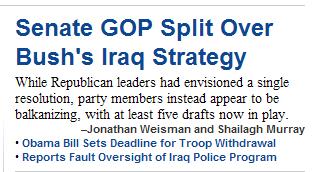
Whatever happened to Democrats being split on Iraq War strategy? Hmmm?
The story, by Jonathan Weisman and Shailagh Murray, is in today’s Washington Post.
Even granting the war fever set their premises–that Iran is an imminent danger to US security and that military tactics are the easiest and best way to deal with Iran–there’s still George Bush and his utter incompetence. He can’t be trusted to do anything. Whatever he wants to do, whether we approve or no, he just has to be kept still. It’s quiet time for McFuck-Up. First, do no harm.
Reading this snippet from the Guardian makes me re-think what the so-called ‘surge’ is actually for. Perhaps the surge is to prepare for any possible Iranian reaction to a strike on its nuclear program. Yes, I know, sounds like typical ‘liberal/lefty’ paranoia, but after 6 years of Bush such fears seem justified.
I’m not sure Iran’s goal is solely to make Iraq a Shia controlled nation. Iran’s goal is to become a, perhaps THE, regional power in the middle east. Not just a power in the Shia world, ya know? Helping Iraq become a Shia dominated puppet state would certainly go far towards that goal … but they have to try and do a balancing act here, and make it so that whichever group eventually comes out on top in Iraq and forms a stable government has good ties with Iran, preferably owes Iran a favor or six.
It would not surprise me all that much to know Iran is helping Sunnis, and hell even Kurds for that matter. It would very much surprise me if they are being as “brazen” as is suggested… They need to keep their activities at low enough levels that no one group decides Iran is their enemy.
-me
I’ll start giving administration ‘dossiers’ credibility just as soon as I see one that undermines a previously-announced policy position. It just seems funny that the ‘intelligence’ is telling them that we need to be doing what they want to do already.
Meanwhile, I’m wondering what it says about our training of Iraqis that they are saying the Iranians had to be involved in Karbala because it was too sophisticated for the Iraqis? Iraqis are too naive or stupid to get access to US equipment or something?
The ultimate projection: IRAN is interfering in Iraq.
Sorta like somebody pre-emptively invaded and occupied Canada for four years. Canada then becomes endangered by instability and the USA got involved in a self-protective stance as Canada’s neighbor.
BTW, as regards those ‘permanent bases’ in Iraq, I am wondering whether they were planned to include nuclear missile housing with which to cow the whole region.
Crying wolf over and over will most certainly lead to no one listening. There is that aspect of this but the fact is that gwbushit and his cabal are liars, bold liars, liars with malice aforethought, brazen bullying in your face liars. Little boots will cock his head slightly at an angle, look intently into the camera and dictate the smooth and war like words chinney is putting into his head.
LIARS…LIARS…LIARS…LIARS…LIARS George W. Bush is a liar. His regime uses lies to start wars. These are facts. No one, and I mean no one should hear anything they have to say.
Under W and his cabal, America has become a Rogue Nation.