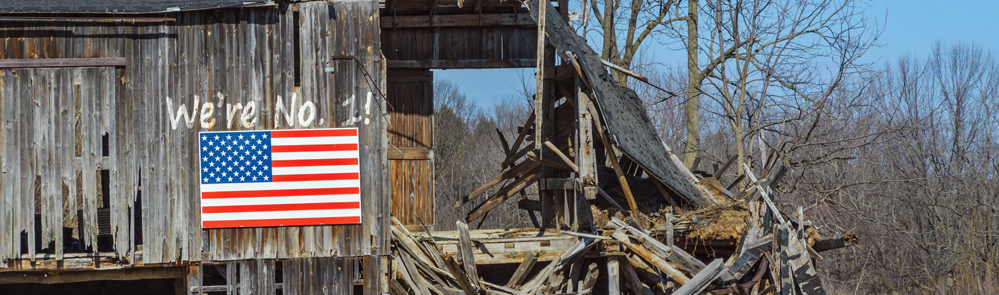
We Haven’t Hit Bottom Yet

I want to talk about something Paul Waldman said yesterday — “…  that Trump got within 100 miles of the White House to begin with represents a massive failure of the system.” Yes, the entire system, public and private. And all political parties. Ain’t nobody innocent.

The system has been dysfunctional for a long time. The Obama Administration was like a coat of nice paint covering rotten wood; it was “normal” enough to help us all maintain the fiction that the system still worked, even if the Republican Party was obstructing getting anything done. I say we haven’t hit bottom yet because there are still too many people who think the system is fine and just needs some more paint. And a lot of those people are Democrats.

I’m not saying that both parties are just alike and just as guilty. Republicans have been wallowing in the rot, but Democrats have been entirely too accommodating to it. For the sake of civility, you know.

For example: A couple of days ago I ranted about white-collar crime. Later the same day Matt Yglesias published a post that covered the same points in more detail. And then Eric Levitz wrote,

In 1991 The New Yorker’s Mark Danner wrote the following elegy for the American republic:

Perhaps the most disquieting legacy of Iran-Contra, in which extremely serious political crimes were exposed and then left largely unexorcised, is a kind of pervasive moral lassitude, in which charges that the integrity of the 1980 Presidential election was compromised with the help of the Iranian government evoke an almost bored reaction. It now appears that the charges will be left to linger, unanswered and uninvestigated, because no one with any power sees it to be in his personal political interest to confront them. The dictum that we live in a nation of laws can also be understood ironically-that ours has become a nation only of laws. For laws without the will to enforce them and confront the consequences remain simply words on paper.

Trump’s immediate Republican predecessor reaffirmed Danner’s insight, by overseeing the systematic violation of both domestic and international laws against military torture — while Trump’s immediate Democratic predecessor did so by refusing to bring any of that criminal conspiracy’s masterminds to justice.

This culture of elite impunity has not been confined to the political realm. America’s economic elites avail themselves of its benefits even more routinely. The 2008 financial crisis revealed myriad acts of financial and foreclosure fraud — almost none of which was criminally prosecuted. Barack Obama’s Justice Department explicitly endorsed the principle that some individuals and institutions are simply too economically powerful to be bound by criminal law, when it decided not to prosecute HSBC for laundering hundreds of millions in drug money.

Meanwhile, America’s garden-variety plutocrats escape punishment for white-collar crimes on a daily basis, and pay only a small fraction of the taxes that they owe Uncle Sam. Our government has responded to this well-known phenomenon by spending orders of magnitude more on punishing misdemeanor immigration offenses than policing white-collar felonies, and making international cooperation on combating tax havens one of its lowest diplomatic priorities (far below, say, making life-saving pharmaceuticals more expensive for people in the developed world).

Few American voters fully grasp the extent of the rot, or understand how it happened, but they feel it instinctively. They know the system doesn’t work for them. They just don’t understand why, and neither party explains it, because both parties — to differing degrees — are in on it. So it was that the blatantly dishonest and corrupt Donald Trump, who should have been in jail years ago, got away with painting Hillary Clinton as “crooked.” While I do not believe she ever did anything indictable (although it wouldn’t shock me to learn otherwise), voters instinctively knew that Clinton would have protected the system and do nothing to clean it up. Because if you have power, you don’t have to do anything illegal to benefit from the corruption; the system will reward you for protecting it. And, unfortunately, she lacks Donald’s Trump talent for salesmanship. He got away with pitching himself as a reformer because the network television news (never mind Fox News or talk radio) lacked the guts to tell the truth about him. So here we are.

Democrats intend to use corruption as a midterm campaign issue. I question whether that will work for them, especially if the same old establishment faces (Pelosi, Schumer et al.) are delivering that message. And, again, I’m not putting Pelosi and Schumer in the same pot with Duncan Hunter. But they’ve both been in Washington a long time. They may not be in bed with the corruption, but they are certainly on a cordial first-name basis with it. Meanwhile, the urban professional class — the people not left behind by the global economy — continue blindly to defend the Democratic Party establishment and fervently believe that racism alone made Trump president.

That’s why I say we haven’t hit bottom yet.

As far as the Trump Administration goes, I don’t think it’s hit bottom yet, either. But it’s falling faster now.  What went on with Manafort and Cohen on Tuesday was just a start. (FYI, National Enquirer publisher David Pecker was just granted federal immunity. )

Trump isn’t going to be impeached and removed from office until the Republican Party wants him gone. If the GOP goes down in flames in the midterms, that could happen. But assuming the Dems at least take back the House, here are some more things they could do. Paul Waldman:

* Use their control of the Ways and Means Committee to obtain and release Trump’s tax returns so that we finally learn what he has been hiding.

*Hold hearings on the ways Trump is personally profiting off the presidency and potentially violating the Constitution’s emoluments clause.

*Mount a serious, comprehensive investigation into the Russian attack on the 2016 election and the Trump campaign’s cooperation with that attack.

*Investigate accusations of wrongdoing that have been leveled at Cabinet officials such as Wilbur Ross and Ryan Zinke.

*Demand answers from the administration on the decision-making process and effects of controversial administration policies, such as adding a citizenship question to the census, relaxing rules for power plant emissions, making it easier for private “universities” to scam students, and tearing children from their parents’ arms at the border.

In other words, bleep civility. Bleep reaching across the aisle. They’ve got to be as hard on Trump as the GOP has been on Hillary Clinton and every other Democrat they’ve tried to destroy.

Beyond that, see also Charles Pierce, Elizabeth Warren Just Laid Out an Indictment of Our Political System in All Its Corruption and Sleaze.

Manafort Guilty on Eight Counts; Cohen Implicates Trump

We’re having a clearinghouse on criminal justice today. The Washington Post is reporting that Paul Manafort has been convicted on eight counts and that the judge has declared a mistrial on ten other counts. “Manafort was convicted on five counts of filing false tax returns, one count of not filing a required IRS form, and two bank fraud counts.”

Manafort’s guilty verdict may strengthen Mueller’s hand as he continues to investigate possible conspiracy and seeks an interview with the president; an acquittal could have led to a broader effort by conservatives to shut down the special counsel’s office. …

… When the jurors were brought into the courtroom, Ellis told them only that if they failed to agree on a verdict, the case would be “left open and undecided,” and that there was no reason another 12 jurors could decide the case “better or more exhaustively” than they could.

It’s not clear to me what charges they “split” on, and of course we don’t know yet of Mueller will try Manafort again on those charges, just that he could.  Manafort’s other trial, on allegations about lying to the FBI, money laundering and foreign lobbying, is scheduled to begin September 17.

Earlier today, there were news reports that Michael Cohen had pleaded guilty, yet there were no details of a deal. Now we have some more information. The New York Times:

Michael D. Cohen, President Trump’s former fixer, pleaded guilty on Tuesday to campaign finance and other charges. He made the extraordinary admission that he paid a pornographic actress “at the direction of the candidate,” referring to Mr. Trump, to secure her silence about an affair she said she had with Mr. Trump.

Mr. Cohen told a judge in United States District Court in Manhattan that the payment was “for the principal purpose of influencing the election” for president in 2016.

I’ll come back to that.

Mr. Cohen also pleaded guilty to multiple counts of tax evasion and bank fraud, bringing to a close a monthslong investigation by Manhattan federal prosecutors who examined his personal business dealings and his role in helping to arrange financial deals with women connected to Mr. Trump.

Now, here’s a critical part:

The plea agreement does not call for Mr. Cohen to cooperate with federal prosecutors in Manhattan, but it does not preclude him from providing information to the special counsel, Robert S. Mueller III, who is examining the Trump campaign’s possible involvement in Russia’s interference in the 2016 campaign.

If Mr. Cohen were to substantially assist the special counsel’s investigation, Mr. Mueller could recommend a reduction in his sentence.

In other words, there’s no deal yet. The deal is still being negotiated.

Now, let’s go back to the first part of Cohen’s plea, about paying a pornographic actress at the direction of a candidate. Doesn’t this implicate Trump in direct violation of campaign finance law? Cohen may not have named Trump. But who else was he working for?

Big news day, folks.

Update: Here’s one more:

A judge in Washington, D.C., has thrown out a lawsuit against former British intelligence officer Christopher Steele, who had been sued by Russian oligarchs claiming he defamed them in his dossier about the Trump campaign’s alleged links with Russia.

This feels like three for three.

Update: 13 legal experts weigh in on the Michael Cohen plea. Can we say “unindicted co-conspirator”? Yes, I believe we can!

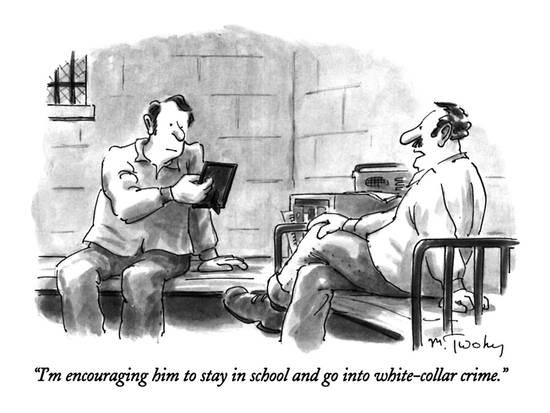
#AllCrimesMatter, a Rant on White Collar Crime

Talking Points Memo has a feature up about Paul Manafort’s financial problems that’s pretty good, although I don’t know that it provides any ground-breaking insight. Yeah, we know Manafort was broke and unwilling to live within his newly restricted means. I mostly want to link to one of the comments:

One of the things that the whole sorry, sordid mess that is Trump-swampia is showing is what the true price is for our collective failure to aggressively prosecute white collar money crimes. Preet Bharara was ask on Bill Maher’s Real Time how Trump could have operated as he did in NYC real estate for so long without triggering any serious criminal investigation. His answer of “my bad” should have been “our bad” since the public has not really cared about such crimes. Until we insist that law enforcement and DA’s pursue these types of criminals with the same zeal that we insist that they pursue a convenience store robber we are going to continue to breed a class of crooks that not only believe that they can game the system to their financial advantage but that they are entitled to do so. #AllCrimesMatter {steps down from soap box}

Bernie Madoff paid for this crimes because he ripped off other rich people. Madoff himself said in a prison interview that the banks and hedge funds he dealt with demonstrated “willful blindness” to what he was up to. They had to know, he said. As long as they were making money, it was okay, I guess.

In 2009, Business Insider published a list of high-profile white-collar criminals who were in jail at the time. It strikes me that some of them, like the dudes who went down with Enron, probably only went down because they failed. Their schemes didn’t pay off fast enough, and it all came crashing down. But before that, especially as they became useful to the political class, they could get away with anything. Until they couldn’t keep up the facade any more, that is.

It’s kind of a sad thing to read this article from 2002 on the lessons of Enron — “Houston, We Have Problem.” It’s sad because the lessons clearly were not learned.

See also “Why Only One Top Banker Went to Jail for the Financial Crisis” from the April 30, 2014 New York Times.

Over the past year, I’ve interviewed Wall Street traders, bank executives, defense lawyers and dozens of current and former prosecutors to understand why the largest man-made economic catastrophe since the Depression resulted in the jailing of a single investment banker — one who happened to be several rungs from the corporate suite at a second-tier financial institution. Many assume that the federal authorities simply lacked the guts to go after powerful Wall Street bankers, but that obscures a far more complicated dynamic. During the past decade, the Justice Department suffered a series of corporate prosecutorial fiascos, which led to critical changes in how it approached white-collar crime. The department began to focus on reaching settlements rather than seeking prison sentences, which over time unintentionally deprived its ranks of the experience needed to win trials against the most formidable law firms. By the time Serageldin committed his crime, Justice Department leadership, as well as prosecutors in integral United States attorney’s offices, were de-emphasizing complicated financial cases — even neglecting clues that suggested that Lehman executives knew more than they were letting on about their bank’s liquidity problem. In the mid-90s, white-collar prosecutions represented an average of 17.6 percent of all federal cases. In the three years ending in 2012, the share was 9.4 percent.

The article points out that the one financial sector professional who did jail time for his role in the crisis, Kareem Serageldin, was more of an enabler than an instigator.

One of the striking things about Trump and his associates is how many of them should have been in jail already.  Trump, certainly. Steve “Foreclosure King” Mnuchin, on principle. Wilbur Ross is dirty as sin. If white-collar crime were taken as seriously as it should be, Trump would never have become president. Instead of going after the real criminals, we scapegoat and punish illegal immigrants. And politicians of both parties have been in on it.

See also, from the Maha Archives:

A Conspiracy So Immense

Save Us from CEOs

I Bet Trump Is Nervous About McGahn

Nancy LeTourneau writes that a White House counsel, which is what Don McGahn is, does not work for the president but for the government. This means there is no attorney-client privilege between Trump and McGahn. She quotes Bob Bauer at Lawfare:

A White House counsel is not in a position to reject or ignore a special prosecutor’s request for information relevant to an ongoing criminal investigation. The law on the fundamental point is clear. Precisely as the Times describes McGahn’s understanding of his role, the White House counsel is a government employee, not personal counsel to the president. Courts presented with the question have ruled that, in a criminal investigation, the attorney-client privilege does not shield a White House counsel from providing his or her evidence. Neither is executive privilege a safe harbor if the government can demonstrate need for the information and its unavailability from other sources.

LeTourneau:

Since Trump believes that the FBI and the Attorney General are there to protect his interests rather than serve the cause of justice, it should come as no surprise that he would assume the same thing about the White House counsel’s office. McGahn’s job, however, is to defend the presidency, not the president. If Trump had tried to stop him from talking to the special prosecutor, Mueller could have compelled him to do so.

In this morning’s tweetstorm, Trump claimed he had given his approval to McGahn to testify and accused Bob Mueller of trying to interfere with the midterm elections.

There are differing opinions being offered in the nation’s op ed pages about whether McGahn would try to protect Trump or not, but he testified for 30 hours. That’s an awfully long time to testify and not say something.  See also David Graham, Are Trump’s Lawyers an Asset or a Liability? and Paul Waldman, The most intense and dangerous period of the Trump presidency is about to begin.

Elsewhere: The more information that comes out about Bret Kavanaugh, the scummier he looks. See Josh Marshall, Bret Kavanaugh Is A First Rate Hypocrite and Political Judge and Brett Kavanaugh, the man who created the super PAC.

Trump’s Stable Genius Legal Team

This just in …

President Donald Trump’s lawyer Rudy Giuliani on Sunday claimed “truth isn’t truth” when trying to explain why the president should not testify for special counsel Robert Mueller for fear of being trapped into a lie that could lead to a perjury charge.

“When you tell me that, you know, he should testify because he’s going to tell the truth and he shouldn’t worry, well that’s so silly because it’s somebody’s version of the truth. Not the truth,” Giuliani told Chuck Todd on NBC’s “Meet the Press” on Sunday morning.

“Truth is truth,” Todd responded.

“No, no, it isn’t truth,” Giuliani said. “Truth isn’t truth. The President of the United States says, “I didn’t …”

A startled Todd answered: “Truth isn’t truth?”

Giuliani: “No, no, no.”

Todd said: “This is going to become a bad meme.“

Brilliant. See also:

emptywheel, THE NYT’S LATEST MCGAHNOBSTRUCTAPALOOZA: SOMETIMES “COOPERATION” IS JUST COVER YOUR ASS

David Atkins, No Honor Among Thieves in the Trump White House

Isaac Chotiner, What John Dean Has to Say About the NYT’s Blockbuster Don McGahn Story

Meanwhile, What Congress Is Up To

Paul Waldman:

Despite all the attention we in Washington pay to the Russia scandal and the Trump administration’s immigration policies and the president’s latest antics (for perfectly good reasons), polls have repeatedly shown that when you ask voters what they care about most in considering their vote for Congress this fall, the most-commonly-mentioned issue is health care.

And Republicans have set a health-care time bomb that is going to explode in their faces just in time for the November elections.

Oral arguments are now scheduled in federal court for Sept. 10 in a lawsuit brought by a group of conservative states, led by Texas, that seeks to strike down the Affordable Care Act. You’d think that after the debacle they suffered last year when Republicans in Congress tried to repeal the ACA, they would have learned their lesson. But they’re storming ahead, and Republicans running for Congress are going to pay the price.

In the age-old question about whether wingnut politicians are really stupid and/or crazy enough believe the lies they peddle, or whether they know it’s all a scam, I think this move counts as evidence of the stupid and/or crazy theory.

The lawsuit makes a claim that could charitably be called audacious. Since Congress eliminated the ACA’s penalty for not carrying health insurance coverage, it says, the individual mandate has become invalid. (Right now the mandate is still in place, but the penalty for violating it is $0.) And if the mandate is invalid, they argue, then the entire law must be struck down, including the ability of people to stay on their parents’ insurance, the protection for people with pre-existing conditions, the expansion of Medicaid that is now providing coverage to millions, the ban on yearly and lifetime limits on coverage — everything. (If you want details, there’s an explanation here.)

Several high-profile GOP candidates for Senate are supporting this lawsuit, even though these are state lawsuits and U.S. senators could be excused for staying out of it. Burgess Everett writes in Politico,

“Sure, anything that’s going to actually get rid of it, yes,” said Indiana GOP Senate nominee Mike Braun of the GOP lawsuit to gut the law in an interview in Mishawaka. “And then be ready to come back and talk about what you’re ready to do about pre-existing conditions and no limits on coverage. That’s where you don’t hear much conservative talk.”

The problem? Congress has shown no ability to pass new health care legislation under Republican rule or work across party lines, raising severe doubts that the GOP would be able to fulfill its promises to kill the law and yet maintain its popular provisions.

Missouri is one of those states in the lawsuit, and the Attorney General of Missouri, Josh Hawley, is Claire McCaskill’s GOP opponent for her Senate seat. She’s been bringing up the lawsuit in her television ads, but I’m not sure the ads explain it very well. However, if this gets in the news a lot in September, that could make a difference. Right now, polls say the race is a toss-up.

Back to Politico:

In interviews, several GOP senators said the party is unprepared to act if the GOP lawsuit, which is supported by the Trump administration, is successful. Senate Majority Whip John Cornyn (R-Texas) said, “It may be good to have an exit strategy and I’m not sure there’s one in place.”

Of course there’s not one in place. They had years to come up with an Obamacare replacement, and they failed.

Paul Waldman:

You don’t have to be a political-consulting genius to write the ads. “This is Darcy Cutebutton. She’s 9 years old. She survived cancer, and she’s still fighting. But now Donald Trump and our congressman, Hal Heartless, want to take away her health coverage. Tell Congressman Heartless that if he wants to do that to Darcy, come election day we’re going to stop him.”

Yeah, that’s what they’re going to do. They should blow this up into a big deal even if the lawsuit fails.

In other news, do read about the weird blowup between some vets and the so-called president over Agent Orange.  This happened more than a year ago, but accounts of it are just now coming out. This is from Daily Beast:

The meeting included President Trump and the envoys of nearly a dozen major vets groups—including the American Legion, Vietnam Veterans of America, American Veterans, Veterans of Foreign Wars, and the right-leaning Concerned Veterans for America—as well as  senior staffers such as Stephen Miller, Kellyanne Conway, Sean Spicer, and Manigault-Newman surrounding the large table.

The president began going around the room asking the different representatives what they were working on and how his administration could help, having made veterans’ issues a cornerstone of his 2016 campaign rhetoric.

Soon, he got to Rick Weidman, co-founder of Vietnam Veterans of America (VVA), who was one of Vietnam vets in the room that day, having served a tour of duty in 1969 as a medic. …

… During the course of the meeting, Weidman brought up the issue of Agent Orange, an extremely notorious component of the U.S. herbicidal warfare on Vietnam. Weidman was imploring the president and his team to permit access to benefits for a broader number of vets who have said they were poisoned by Agent Orange.

Trump responded by saying, “That’s taken care of,” according to people in the room.

His reply puzzled the group.

Attendees began explaining to the president that the VA had not made enough progress on the issue at all, to which Trump responded by abruptly derailing the meeting and asking the attendees if Agent Orange was “that stuff from that movie.”

They eventually figured out he was talking about the “napalm in the morning” scene from Apocalypse Now. The veterans tried to explain to Trump that they were talking about Agent Orange, not napalm.

Trump refused to accept that he was mistaken and proceeded to say things like, “no, I think it’s that stuff from that movie.” …

… He then went around the room polling attendees about if it was, in fact, napalm or Agent Orange in the famous scene from “that movie,” as the gathering—organized to focus on important, sometimes life-or-death issues for veterans—descended into a pointless debate over Apocalypse Now that the president simply would not concede, despite all the available evidence.

Finally, Trump made eye contact again with Weidman and asked him if it was napalm or Agent Orange. The VVA co-founder assured Trump, as did several before him, that it was in fact napalm, and said that he didn’t like the Coppola film and believed it to be a disservice to Vietnam War veterans.

According to two people in attendance, Trump then flippantly replied to the Vietnam vet, “Well, I think you just didn’t like the movie,” before finally moving on.

My brother, who died in 2014 after multiple cancer diagnoses, believed his cancers were the result of exposure to Agent Orange in Vietnam. Since cancer is very rare in my family (it’s usually cardiovascular disease that gets us first), I suspect he was right.


Manafort and Trump Have No Good Options

The case will go to the jury today in Paul Manafort’s first trial. There was some buzz yesterday when the defense team declined to make a defense and opted to go straight to closing arguments. I understand that lawyers do this when neither the client nor the client’s witnesses are likely to stand up to cross examination.

Here are two articles to read together: Paul Waldman, “Why Trump will pardon Paul Manafort” and Martin Longman, “Pardoning Manafort Wouldn’t Work.”

Question One: Why didn’t Manafort flip? From what I’ve read about this trial, on the current charges the paper evidence has him dead to rights. It’s most likely Manafort will never be free again. But keep in mind there are scarier people in the world than Donald Trump. Like, Russians.

Waldman says, “Manafort may have decided that it’s better to take his chances with a jury than to find a strange substance smeared on his door handle one day.” One assumes Manafort does care about his wife and children, also.

Longman: “He still owes Oleg Derispaska somewhere around twenty million dollars–and he has no prospect of repaying that debt in cash. All he can do is keep his mouth shut and hope that’s enough to get some forgiveness on the debt.” So there’s that.

Back to Waldman: “It’s also possible Manafort really has nothing to offer special counsel Robert S. Mueller III about Trump, that his activities, criminal though they might have been, never actually involved the president. That would mean he has no one to flip on.” That’s possible, but seems to me to be unlikely. We know Manafort was involved in the June 2016 Trump Tower meeting, for example. And wasn’t Manafort most likely behind the change in the 2016 Republican platform that backed off arming Ukraine? Trump may not have known about that, but it certainly points to corruption in the campaign organization while Manafort was in charge of it.

Next, is Manafort counting on a Trump pardon? Waldman again:

Trump has spent the past 15 months since Mueller was appointed trying to discredit the investigation, in a campaign designed less to persuade the broader public than to convince his base that it is a witch hunt from start to finish and therefore everything it produces, no matter how factual and supported by evidence, should be ignored and discounted. He has obviously calculated, and rightly so, that if he can keep that base firmly behind him, Republicans in the House will never vote to impeach him, and even if Democrats took control of the chamber and did so, Republicans in the Senate would never vote to convict.

You can already see the argument he’ll make: The whole thing is a witch hunt, the charges are bogus, the jury was a bunch of Angry Democrats, and I’m intervening in the interests of justice. Trump also seems to genuinely believe that the investigation is unfair, and pardoning Manafort would be a great way for him to both assert control and stick it to Mueller.

It’s important to remember that no matter what the jury in this case decides, it’s only the first of two trials Manafort faces. The next one, in a federal court in Washington, will deal more directly with Manafort’s relationships in the former Soviet Union. That’s when Trump may start feeling the heat and feeling oppressed, and look for a way to let everyone know who’s really in charge. And that’s the day Manafort, sitting in his jail cell, is fervently hoping for.

Since there’s nothing Trump can do to stop the second trial, Waldman appears to be proposing that Trump will wait until after the second trial to pardon Manafort. But remember, once he’s pardoned, he can’t incriminate himself.

Longman:

Waldman thinks Trump will ultimately pardon Manafort, but only after the second trial, which will cover his dealings with Ukrainians and Russians. The problem with this prediction is that Manafort needs charges hanging over him to invoke his right against self-incrimination. If he’s pardoned for most of what he could conceivably be charged with, he could be compelled to tell the special counsel what he knows or face fresh charges of contempt and obstruction of justice. Is he really going to count on either Mueller to give up or Trump to counter every new charge with a fresh pardon?

Maybe things really will get this weird and broken, but I think the reason Manafort hasn’t already been preemptively pardoned is that it would not solve Trump’s problems. In fact, it probably would exacerbate them. Even for congressional Republicans, there’s a limit to how nakedly Trump can obstruct the investigation and get away with it. He has not fired Jeff Sessions or Rod Rosenstein, for example, and he’d run into similar problems if he started pardoning Manafort for refusing to cooperate with investigators when he faces no prospect of self-incrimination.

Probably most people expect Trump to pardon Manafort, but people advising Trump may be telling him not to.

And here’s another kicker Longman brings up: “Manafort can still face state charges, particularly in New York, and I don’t see the pardon card as much of an option for Trump.”

The second trial, which promises to be juicy, begins in mid-September.

Hot Enough for You?

Glacier National Park is on fire. It caught fire on Saturday, a day on which the temperature in the park reached 100 degrees F. That was the hottest day in recorded history for the park. It was partly evacuated and closed.

It’s clear that Montana is already becoming a vastly different place. In recent decades, warmer winters have helped mountain pine beetles thrive, turning mountains red with dead pines. In 1850, there were 150 glaciers in the area now known as Glacier National Park. Today there are 26. They’ve been there for 7,000 years — but in just a few decades, the glaciers of Glacier National Park will almost surely be gone. By then the park will need a new name. Glacier Memorial Park doesn’t have the same ring to it.

And, of course, the maladministration is in denial about it.

After a tour of wildfire-ravaged California on Sunday, Montana-born Ryan Zinke, President Trump’s Secretary of the Interior, proposed a more controversial cause: The reason there are too many fires is because there are too many trees.

“It doesn’t matter whether you believe or don’t believe in climate change. What is important is we manage our forests,” Zinke said, adding a shot against environmental groups that have curtailed logging on public lands. While forest management is important, Zinke’s comments made some worry that the Trump administration was hoping to use fires as an excuse to open more public lands for logging.

I suppose it’s true that if one cuts down all the forests there will be fewer wildfires. You might still have prairie fires and grass fires, however, until the dry conditions turn the entire West into a desert. So much winning!

In other environmental news, do enjoy the sight of migratory birds while you can.

 For the past 100 years, the Migratory Bird Treaty Act (MBTA) has, among other things, incentivized industries to avoid the intentional or unintentional slaughter of North America’s native birds, primarily using fines. But now, President Trump’s Interior Department has announced that it will no longer enforce prohibitions on “incidental takes” — the unintended, though still perhaps foreseen, killing of birds, as in open waste pits, uncovered oil spills, lit communication towers and low-visibility power lines.

It’s a bizarre, novel interpretation of the law, as the Audubon Society has pointed out, but it was well-received only by those who stand to benefit financially. The American Petroleum Institute, for instance, praised the decision for providing regulatory “certainty,” which it no doubt does for those eager for one less troublesome chore per toxic waste pit. Where companies would have previously been expected to place nets over poisonous waste pits to discourage birds from landing in their deadly waters, the Trump administration’s decision removes any penalties for failure to do so. Some firms might still bother; others probably won’t.

Whooping cranes, Texas

This is what happens when you allow industry, rather than science, to make environmental law.  Keep in mind that industry doesn’t need a lot of extra poor people around, either.