The Singapore Summit: No Ponies

The Summit in Singapore is going so well that Trump is leaving early:

Donald Trump has decided to leave his historic summit with Kim Jong-un 15 hours earlier than expected, flying back to Washington on Tuesday night instead of Wednesday morning. The White House says that this change of plans is a product of talks moving more quickly than expected. But there’s reason to suspect that it is because they are barely moving at all.

Basically, before the face to face begins they’ve agreed to not agree. Everything is off the table. Human rights are off the table. Denuclearization is off the table. I’m not sure there is a table.

On May 30, Pompeo met with North Korean spy chief Kim Yong-chol in New York; their discussion concluded two hours earlier than expected, as Kim refused to make any commitment whatsoever on denuclearization, according to the Washington Post. Days earlier, in the North Korean village of Panmunjom, negotiations between diplomats from Washington and Pyongyang stalled when North Korea’s vice–foreign minister Choe Son-hui said that denuclearization “should not be on the table for the Singapore summit” — a demand that would nullify the meeting’s purpose from the White House’s perspective.

Now, both sides appear prepared to let Tuesday’s historic face-to-face between the sitting leaders of the U.S. and North Korea function as more of an ice-breaker (and photo op) than a high-stakes diplomatic showdown. “We are hopeful this summit will have set the conditions for future successful talks,” Pompeo said during his remarks Monday.

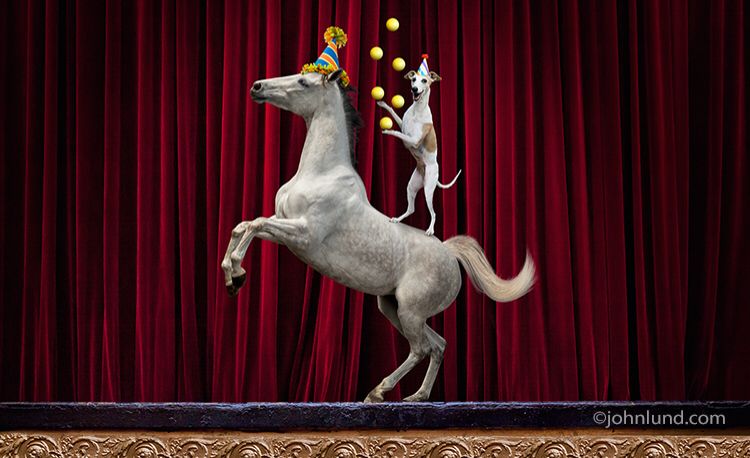
As it is, I’m not sure this summit will even rise to the level of a dog-and-pony show, but I suppose there’s hope. I’ll let you decide which one is the dog and which one is the pony.

The summit will open at 9 a.m. Tuesday in Singapore (which is 9 p.m. tonight in Washington) with Kim and Trump shaking hands and taking a walk in the view of the media, according to an official who spoke with Bloomberg News.

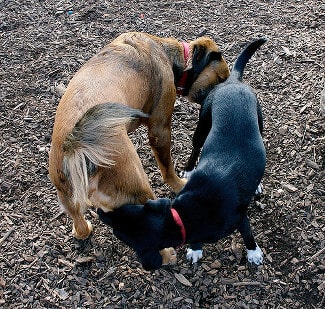
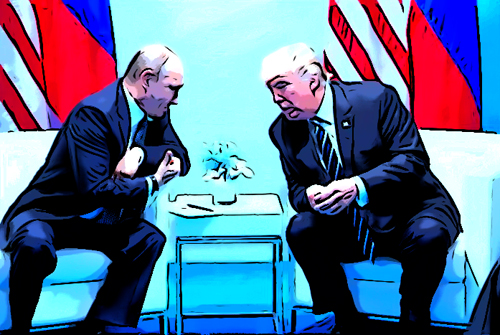
Then the two leaders, accompanied only by translators, will meet one-on-one, an event I imagine will go something like this:

Okay, so they’re both dogs. There are no ponies.

Among those flanking Trump will be Pompeo and national security adviser John Bolton, whose belligerent rhetoric toward North Korea briefly derailed the summit last month.

At least, I hope they keep a muzzle on Bolton. But however the talk(s) go, it appears Kim has already won:

For Pyongyang, the summit is itself an affirmation of its nuclear program immense value. It is inconceivable that the world’s leading superpower would make time for an isolated, impoverished Chinese client state if said state did not have weapons of mass destruction. In leveraging the threat of its nuclear program, by contrast, Kim’s regime has secured Washington’s ostensible endorsement of its right to violate human rights in perpetuity.

Given the tangible benefits of retaining its nuclear weapons; the dearth of reasons to trust America’s promises; the high likelihood that Washington isn’t actually willing to risk a mass-casualty war to force denuclearization; and the fact that one of North Korea’s chief security demands — the withdrawal of American troops from the region — is something that Trump has suggested that he wants to do regardless,for “America first” reasons, it is hard to understand why Pyongyang would ever commit to total denuclearization.

As I see it, Trump has no leverage whatsoever. After his stunt in Quebec he can’t even claim to be able to lead a coalition of nations to do something about North Korea. Trump only wanted this  meeting because he heard people praising him for it.

Update: There are reports Larry Kudlow had a heart attack.

News from the World of Stupid: Larry Kudlow Edition

Best quote I’ve seen so far about Trump at the Charlevoix Fiasco: “He’s like Heath Ledger’s Joker–but without the operational excellence.” That was from a senior G7 official.

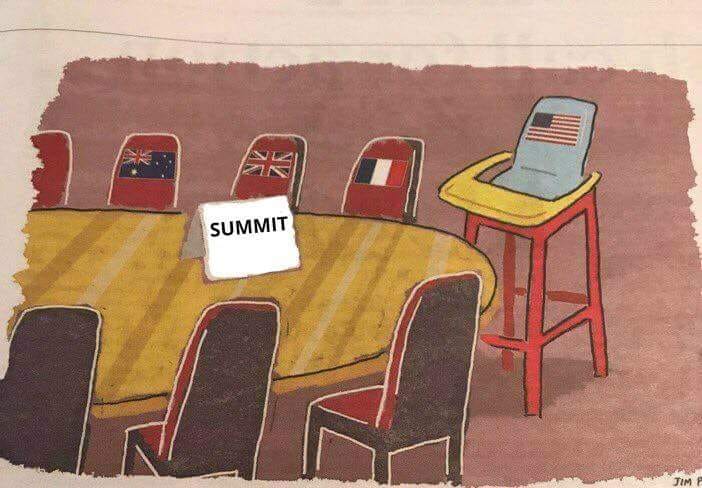
Larry Kudlow was on the morning bobblehead shows today complaining that no one is congratulating Trump for his “successful” G7 Summit. I suppose it was successful in the sense that Trump remembered to put on his pants. I’m not aware that he actually fell out of his high chair at any point. But that’s about all one can say for it.
Before going on to the postmortem of the Fiasco, let us review the economic genius of Larry Kudlow, who became a right-wing media pundit in the 1990s after cocaine and alcohol addiction destroyed his Wall Street career.

It was the eve of the biggest economic collapse since the Great Depression. Many on Wall Street worried that a recession loomed and that the housing bubble was bursting.

And then there was Larry Kudlow, the man President Trump just tapped to be his top economic adviser.

“Despite all the doom and gloom from the economic pessimistas, the resilient U.S. economy continues moving ahead,” Kudlow wrote on Dec. 7, 2007, in National Review, predicting that gloomy forecasters would “wind up with egg on their faces.” Kudlow, who previously derided as “bubbleheads” those who warned about a housing bubble, now wrote that “every positive” news in housing should “cushion” falling home sales and prices.

“There’s no recession coming. The pessimistas were wrong. It’s not going to happen,” wrote Kudlow. “ . . . The Bush boom is alive and well. It’s finishing up its sixth consecutive year with more to come. Yes, it’s still the greatest story never told.”

If that was the greatest story, this should be a close runner-up: Trump has just put the country’s economic fate in the hands of the man who has arguably been more publicly and consistently wrong about the economy than any person alive.

To be fair, the honor of being “publicly and consistently wrong about the economy” more than any person alive might arguably go to Jim Cramer of “Mad Money” on CNBC, but it’s close.

On one of the bobblehead shows this morning, Kudlow was indignant that the world wasn’t singing Trump’s praises for the successful G7 meeting. But what about the joint statment that Trump refused to sign? Kudlow said this on Face the Nation this morning:

LARRY KUDLOW: Well to be honest with you, Prime Minister Trudeau, who by the way, I respect. I’ve worked with him in good faith. Getting through a good communique on Friday and Saturday. So he holds a press conference. President is barely out of there, on the plane to North Korea and he starts insulting us. You know he starts talking about, U.S. is insulting Canada. We’re not- we, Canada, are not going to be pushed around.

MARGARET BRENNAN: He was talking about the U.S. tariffs?

LARRY KUDLOW: That’s correct- well, and in general, OK was an attack on the president. We’re going to have retaliatory tariffs. Now, these are things that Prime Minister has said before basically, but he didn’t say them before after a successful G-7 communique where President Trump and the others all worked in good faith to put a statement together- which by the way almost nobody expected to happen. In fact, reporters were asking me before the trip whether the president was going to show up at all. He did. He negotiated. He directed his team, myself and others. We worked it out. We used good language that was acceptable–

MARGARET BRENNAN: And then the president reneged on that G7 statement.

LARRY KUDLOW: No! No- I’m sorry. And then Trudeau decided to attack the president. That’s the key point. And yes, you know if you attack this president he’s going to fight back. But here’s the key point Margaret, president is going to negotiate with Kim of North Korea and Singapore. It is a historic negotiation and there is no way this president is not going to stand strong. Number one he’s not going to allow the people to suddenly take pot shots at him. Hours before that summit and number two Trudeau should’ve known better.

Kudlow also has been saying that Trudeau “stabbed us in the back.” Never mind that Trump stabbed Trudeau in the back first with his stupid tariffs. Basically, nobody messes with Trump, or he’ll break all your toys and take his ball and go home.

Jennifer Rubin:

Trump — after departing the G-7 meeting early — reversed his earlier decision to sign on to the joint statement with other member nations. He no doubt was reacting to the public tongue-lashing from Canadian Prime Minister Justin Trudeau, who told the press, “I highlighted directly to the president that Canadians did not take it lightly that the United States has moved forward with significant tariffs on our steel and aluminum industry.” Trudeau continued by declaring that the Trump administration’s decision to invoke “national security” to justify tariffs was “insulting” given Canada’s alliance with the United States in multiple wars. As Trudeau put it, “Canadians, we’re polite, we’re reasonable, but we also will not be pushed around.” Trump can never tolerate criticism, let alone such public and direct criticism, so he accused Trudeau of making “false statements” and reneged on the decision to sign the joint communique.

That’s a good point about national security. Remember, Trump has assumed the power to impose tariffs without going through Congress, even though the Constitution gives exclusive powers to impose tariffs to Congress, because of an exception created during the Cold War that allows presidents to impose tariffs when national security is on the line. So Trump is imposing tariffs through executive power based on some vague national security interest. And, yeah, one could see how that would be taken in Canada as an insult.

Back to David Frum:

Remember, Trump holds authority to impose tariffs on steel and aluminum because—and only because—of a Kennedy-era special exemption to normal trade law for national-security purposes. Trump has signed documents attesting that he imposed tariffs to protect vital defense interests of the United States. Now he has changed his story. The tariffs on steel and aluminum from Germany, the U.K., Mexico, and all the others were not a national-security measure, but a retaliation for Canada’s restrictions on dairy imports. Whatever you think of Canada’s milk protectionism (and few Canadians who don’t directly profit from it will defend it), it is not a threat to U.S. national security.

Wait, what? Trump is afraid of Canadian milk cows?

Trump has attacked Canada’s protected dairy industry before, calling it a “disgrace” and blaming it for widespread hardship among US farmers. Although the entire trade in dairy products between the two countries is worth less than US$600m, ideological division has sharpened the ongoing dispute. His negotiators have demanded the dismantlement of Canada’s openly dirigiste system of supply management in agriculture – a complicated nexus of production quotas and import tariffs designed to ensure Canadian dairy, egg and poultry farmers receive fair prices for their products.

Actual Canadian with potential weaponized terrorist bovine.

But the Canadians are no less determined to retain one of the last vestiges of their otherwise-abandoned collectivist traditions. Canadian cows are sacred, and the farmers who care for them enjoy outsized influence in national politics. Expert observers have said that Justin Trudeau’s government would abandon the treaty altogether before sacrificing supply management.

“It’s just too sensitive for the Canadians,” Kevin Carmichael, a senior fellow at the Centre for International Governance Innovation in Waterloo, recently told CNBC news.

Jocularity aside, it’s true that Canadian dairy protectionism has been hard on the U.S. dairy industry, but IMO the reasonable thing for the U.S. to do is consider internal policies to give U.S. dairy farmers a break, not tryng to bully Canada into changing policies it’s not going to change.

It appears that France, Britain and Germany are siding with Trudeau.

Diplomacy cannot be dictated by “fits of anger”, French President Emmanuel Macron has warned after the G7 summit in Canada ended in acrimony.

In tweets, US President Donald Trump described host Justin Trudeau as “dishonest and weak” and retracted his endorsement of the joint communique.

That statement sought to overcome deep disagreements, notably over trade.

Mr Macron’s office said France and other EU countries would maintain their support for the final G7 communique.

“Let’s be serious and worthy of our people. We make commitments and keep to them,” a statement from the French presidency quoted by AFP news agency said.

I wouldn’t want to be Shinzo Abe for anything today. He knows that Kim Jong Un and his silent partner, Xi Jinping, are going to try to maneuver Trump into withdrawing ships and troops from Japan and the Korean Peninsula during the Singapore Summit. But even Shinzo Abe released an anti-tariff and anti-protectionism statement. Only the new PM of Italy seems a bit squishy, clearly not wanting to piss anybody off.

According to Bloomberg this morning, a German official just said this about Trump:

“Donald Trump has dealt a further heavy blow to the Western community of states with his behavior after the G-7 summit,” said Johann Wadephul, a deputy caucus leader of Merkel’s bloc. “Despite the completely incomprehensible reaction of the American president, Germany remains a close partner and ally of the USA. We know that a non-partisan majority in Congress and the Senate and above all in the U.S. public feels just the same.”

So, as far as I can tell this Sunday morning, Trump is still refusing to sign any joint statement. But maybe there are still negotiations going on about the joint statement.

According to David Frum, Trump’s behavior while he was at the summit wasn’t quite as bad as how it came across at a distance.

Not even the president’s testy Saturday morning attack-CNN press conference shook the assembly. On his way to the podium, he winked and joked—a performer about to mount a show. “Trump’s gonna Trump,” an official from another G7 government quipped to the official to whom I spoke.

The G6 leaders felt that at least a facade of normal had been maintained. But  it all fell apart after plus one Trump left.

From Air Force One, the president emitted a vituperative series of tweets aimed at his Canadian counterpart. What had triggered him? Had he belatedly seen that photograph of Angela Merkel looming over him? As many have said: Trump thinks in images, not ideas. Who could ever know? Trump probably does not know himself.

Ominously too: Once Trump started tweeting out abuse, the snakepit of hissing, warring aides around the president suddenly competed to amplify and deepen the quarrel. At 6:56 pm, National-Security Adviser John Bolton tweeted out his own version of the offending image of Merkel topping Trump—only with a caption reinterpreting the scene as proof of Trump’s strength and defiance. “Just another #G7 where other countries expect America will always be their bank. The President made it clear today. No more.” On pro-Trump Twitter—and then on pro-Trump TV and radio—that would almost instantly consolidate the new message line. The allies had tried to muscle the strong-willed president. But he had held firm.

You’ve probably seen the image being talked about, which is from Angela Merkel’s Instagram account. It appears that Principal Merkel is giving Trump two weeks’ detention for setting fire to the 2nd floor boys’ bathroom. FYI, here’s a post of other photographs of the same scene.
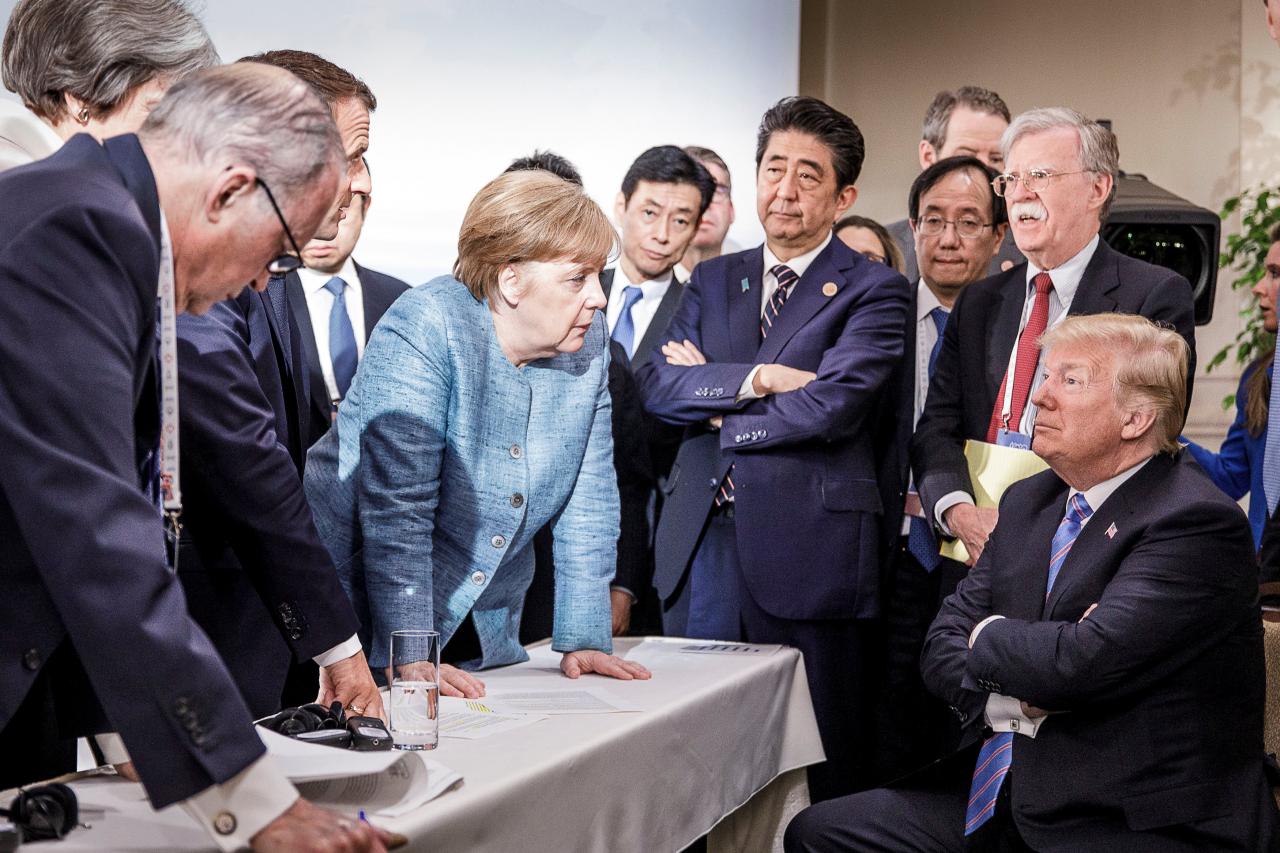
German Chancellor Angela Merkel speaks to U.S. President Donald Trump during the second day of the G7 meeting in Charlevoix city of La Malbaie, Quebec, Canada, June 9, 2018. Bundesregierung/Jesco Denzel/Handout via REUTERS

The most recent news is that one of Trump’s eager little sycophants, White House trade adviser Peter Navarro, is ingratiating himself with his boss by going even further than Kudlow.

“There’s a special place in hell for any foreign leader that engages in bad diplomacy with president Donald J. Trump and then tries to stop them in the back on the way out the door,” Navarro told “Fox News Sunday”’s Chris Wallace. “And that’s what bad faith Justin Trudeau did with that stunt press conference.”

“That’s what weak, dishonest Justin Trudeau did, and that comes right from Air Force One.”

So if we end up at war with Canada over dairy prices, this is why.
News from the World of Stupid

First item — right-wing news outlets are worked up into a tizzy over a link between Iran and the 9/11 attacks. The usual suspects — Breitbart, Gateway Pundit, Townhall, RedState, Washington Free Beacon, Jihad Watch, etc.  — are running screaming headlines about it with photos of the burning towers. I’m not linking to most of these bozos because it just encourages them.

What is this link between Iran and 9/11? If you carefully pick through the thickets of overheated verbiage, it turns out that some politician stated that Iranian authorities had allowed the 9/11 perps to change planes in an Iranian airport without stamping their passports. Whether these Iranian authorities had any idea of what the perps were planning, the articles do not say. I rather doubt it, though. A couple of the articles say that Iran often didn’t stamp Saudi passports in those days if people were just passing through, for complicated reasons that don’t involve the U.S.

This is from the Washington Free Beacon:

Mohammad-Javad Larijani, an international affairs assistant in the Iran’s judiciary, disclosed in Farsi-language remarks broadcast on Iran’s state-controlled television that Iranian intelligence officials secretly helped provide the al Qaeda attackers with passage and gave them refuge in the Islamic Republic, according to an English translation published by Al Arabiya.

“Our government agreed not to stamp the passports of some of them because they were on transit flights for two hours, and they were resuming their flights without having their passports stamped. However their movements were under the complete supervision of the Iranian intelligence,” Larijani was quoted as saying.

The remarks represent the first time senior Iranian officials have publicly admitted to aiding al Qaeda and playing a direct role in facilitating the 9/11 attacks.

Several of the articles tell us triumphantly that this detail confirms something in the 9/11 Commission report. And, indeed, it does. I looked it up. The 9/11 Commission expressed the opinion that al Qaeda operatives from Saudi Arabia, including the 9/11 perps, routinely traveled to and from Afghanistan through Iran to avoid getting their passports stamped. Mohammad-Javad Larijani was just saying “yeah, but we were keeping tabs on them.” This is hardly an admission that Iran played a direct role in the 9/11 attack.

The 9/11 Commission report also states, “We have found no evidence that Iran or Hezbollah was aware of the planning for what later became the 9/11 attack. At the time of their travel through Iran, the al Qaeda operatives themselves were probably not aware of the specific details of their future operation.” In other words, if Iran was guilty of “facilitating” the 9/11 attacks, so were the U.S. airlines who sold the perps their tickets. They “facilitated” the attack, but they weren’t in on it.

Try as I might, I can’t work myself into a state of alarm over this. Or even mild concern, at this point. It’s not even really news. Watch the Creatures from the Fever Swamps try to use it to whip the Right into a foaming-at-the-mouth determination to invade Iran, however.

Item #2: Donald at the G6 plus 1 meeting in Quebec. Where do I start? Reading between the lines of this Politico article, one gets the impression that the G6 leaders spent most of their time yesterday trying to explain to the plus 1, Trump, what a “trade deficit” is.

During the private gathering, Europe’s major economic powers pushed back hard against Trump’s repeated assertions that the U.S. is a victim of unfair trade practices.

“We should at least consider no tariffs, no barriers — scrapping all of it,” Trump said, according to officials who were listening and taking notes.

Trump floated the idea — which was received as somewhat rhetorical — as the meeting was breaking up and was quickly challenged by Canadian Prime Minister Justin Trudeau, who asked, “What about subsidies?”

The other G7 leaders — from Britain, Canada, France, Germany, Italy and Japan, as well as the presidents of the European Commission and European Council — have been trying to impress upon Trump the complexity of trade issues, insisting that his oft-repeated complaint about the trade imbalance between the U.S. and allies on many manufactured goods is only part of the picture. …

… The leaders came armed with an array of their own statistics aimed at demonstrating to Trump that he was not right to view the U.S. as a victim. Macron, in particular, implored Trump to understand that tariffs alone were not a cause of trade imbalances. He explained that France runs trade deficits with Germany and the United Kingdom on manufactured goods, even though all three countries are part of the EU single market and have zero tariffs between them.

“Why is this happening?” Macron asked, according to an official. “Because French like German cars.”

To everyone’s relief, Trump is leaving early. There are indications that the participants will skip the traditional joint statement at the end of the meeting rather than ask Trump to sign anything. See also Trump hits the world stage, Day 1: Come late, leave early, offend host, alienate allies.

Trump’s next stop is, of course, Singapore, where he is to meet with Kim Jong Un. Since Trump is totally unprepared for such a meeting and too stupid to realize it, the Singapore Summit promises to be a Cavalcade of Derp.

Related to all of this, I urge you to read “We’ve Got a Problem. A Big Problem.” by Josh Marshall at TPM. A snip:

Over the course of 16+ months, President Trump has acted consistently and with some success to destabilize and break up the western alliance (both its formal manifestation in NATO) but also its less formal dimensions in trade and other partnerships. He has also worked consistently on really every front to advance the interests of Russia.

Less obviously to many Americans, he’s been doing something similar in East Asia. The U.S. alliance with Japan and South Korea, which in recent years we’ve taken steps to extend to other states on the periphery of the East Asian landmass (which is basically to say, China) is not simply to protect against North Korea. It is to build a series of security relationships with countries on that periphery to act as a counterweight to the regional (perhaps world) great power, China. Allies in the region are closely watching President Trump’s apparent desire to remove U.S. troops from South Korea for that reason, among others.

The last twenty four hours of attacks on our closest allies capped by President Trump’s seemingly out of the blue demand to bring Russia back into the G-7 (making it again the G-8 which it was for most of the post-Cold War era until Russia was expelled over the annexation of Crimea) simply brings the matter into a newly sharp relief. If candidate Trump and President Putin had made a corrupt bargain which obligated President Trump to destabilize all U.S. security and trade alliances (especially NATO, which has been Russia’s primary strategic goal for 70 years) and advance the strategic interests of Russia, there’s really nothing more remotely realistic he could have done to accomplish that than what he has in fact done.

As Josh Marshall says, let that sink in.

Update:

So This Happened

The news this morning is that a Senate Intelligence Committee staffer was arrested for lying to the FBI about leaking to reporters, and prosecutors also secretly seized years’ worth of a New York Times reporter’s phone and email records. Trump is very happy.

As near as I can tell, most of the leaks were related to Carter Page. The Right is furious about the “deep state” leaks; not so much that a foreign policy advisor to the Trump campaign appears to have been a Russian asset. Go figure.

Lying to the FBI is a bad thing, but I’m concerned that the Justice Department is going after reporters.

The IG Report: Watch Out for Escalating Hypocrisy

I mentioned the upcoming Inspector General report on the FBI investigation into Hillary Clinton awhile back. It seems it is about to be released. Mike Levine at ABC News got some leaks about what’s in it.

The Justice Department’s internal watchdog has concluded that James Comey defied authority at times during his tenure as FBI director, according to sources familiar with a draft report on the matter.

One source told ABC News that the draft report explicitly used the word “insubordinate” to describe Comey’s behavior. Another source agreed with that characterization but could not confirm the use of the term.

In the draft report, Inspector General Michael Horowitz also rebuked former Attorney General Loretta Lynch for her handling of the federal investigation into Hillary Clinton‘s personal email server, the sources said.

That much, the Right will be happy with. But mostly what they’re blasting Comey about is the infamous Comey letter.

The draft of Horowitz’s wide-ranging report specifically called out Comey for ignoring objections from the Justice Department when he disclosed in a letter to Congress just days before the 2016 presidential election that FBI agents had reopened the Clinton probe, according to sources. Clinton has said that letter doomed her campaign.

Before Comey sent the letter to Congress, at least one senior Justice Department official told the FBI that publicizing the bombshell move so close to an election would violate longstanding department policy, and it would ignore federal guidelines prohibiting the disclosure of information related to an ongoing investigation, ABC News was told.

Of all the things that Clinton has claimed doomed her campaign, the Comey letter is one she’s got a legitimate complaint about. Her poll numbers dipped as soon as the letter was made public, and that was just a week before the election.

Nevertheless, ABC News has confirmed that Horowitz’s draft report went on to criticize senior FBI officials, including Comey and fired FBI deputy director Andrew McCabe, for their response to the late discovery of a laptop containing evidence that may have related to the Clinton investigation. …

… It took weeks for the FBI to start analyzing the laptop’s contents, and Horowitz’s draft report criticized senior FBI officials for how long the laptop languished inside the bureau, sources told ABC News.

In other words, Anthony Weiner’s laptop had been sitting around in the bureau unexamined for months, and then a week before the election somebody looked at it and saw that it had a bunch of Clinton emails on it that had been forwarded by Huma Abedin. And before they had even looked at the emails Comey rushed to Congress and said they were reopening the investigation into Clinton. A week before the election.

Loretta Lynch is getting called out for the meeting with Bill Clinton on the tarmac while HRC was still under investigation. The meeting was stupid on both of their parts, yeah, but I think if they were really plotting something they would have met somewhere less public.

The best comment on this is from Kevin Drum:

This is going to be such a clusterfuck when it’s released. Comey obviously deserves censure for influencing the election in the face of nearly unanimous advice to the contrary. At the same time, I’m really not sure I can stand to watch as Trump and his fellow Republicans pretend to be outraged over the fact that Comey was responsible for making Trump president. Maybe the IG can give me a heads up about the release date so that I can plan to be at the North Pole that day photographing penguins. Or polar bears. Or vast expanses of ice. Or whatever they have there. Anything would be better than paying attention to the news that day.

Trump and his minions have been impatiently waiting for a report that will reveal the FBI went easy on “crooked Hillary” and that the FBI was acting out of animus for Trump. A report that says the FBI was unfair to Clinton and helped elect Trump is not what they are waiting for, but they’ll manage to blow it up as a victory for their side anyway. Just watch.

Getting Their Stories Straight

Not that they’re doing a good job of keeping their stories straight, as the stories tend to devolve from “that didn’t happen” to “well, it happened, but it’s not what you think” to “okay, maybe it’s what you think, but it wasn’t illegal” to “HILLARY’S EMAILS, DAMMIT.” Even so, before we get around to wallowing in schadenfreude about Manafort’s possibly getting his bail revoked any minute now, let us consider what appears to be one hell of a coincidence about the stories.

This relates to the infamous Trump Tower meeting of June 2016. One of the tidbits we learned from the letter from Trump’s lawyers to Bob Mueller that was leaked to the New York Times is that yeah, okay, the statement released in Donald Junior’s name that the meeting was really about Russian adoptions had been dictated by Trump. They’d been denying it for months, even though everybody pretty much knew the statement was Senior’s and not Junior’s.

Now, here’s the coincidence.

In July 2017 Trump and Putin both attended the G20 Summit in Hamburg, Germany. Per Josh Marshall, on July 7, while Trump was en route to Germany, the New York Times contacted the White House for comments on a story it was preparing about the Trump Tower meeting (here’s the original story, dated July 8). The White House asked for some time to respond, since Trump was literally up in the air at the time. A conference call was arranged for the next day, but then the White House canceled. The Times then sent a list of questions to the White House, but I take it the White House didn’t respond.

This happened during the G20 meeting (you’ll probably remember this) on July 8, the day the Times‘s article came out. Josh Marshall:

During the day Trump had his first meeting as President (and apparently ever) with Vladimir Putin. They discussed various issues including U.S. charges of Russian interference in the 2016 election. As is normally the case, they were accompanied by key aides on both sides. But the two men met a second time that evening during a gala dinner for the heads of state at the summit. This meeting was unplanned and reportedly included only Trump, Putin and Putin’s translator. No Americans. (This left everyone gobsmacked last year. But it was before these other details and thus the full context of the meeting became clear.) There were different accounts of the meeting. The President later said it was only about 15 minutes. A senior White House officials told CNN it lasted as long as an hour. What did the two men talk about? Two weeks later, the President sat for an interview with The New York Times and said he and Putin talked about Russian adoptions.

Here’s the passage.

TRUMP: She was sitting next to Putin and somebody else, and that’s the way it is. So the meal was going, and toward dessert I went down just to say hello to Melania, and while I was there I said hello to Putin. Really, pleasantries more than anything else. It was not a long conversation, but it was, you know, could be 15 minutes. Just talked about — things. Actually, it was very interesting, we talked about adoption.

HABERMAN: You did?

TRUMP: We talked about Russian adoption. Yeah. I always found that interesting. Because, you know, he ended that years ago. And I actually talked about Russian adoption with him, which is interesting because it was a part of the conversation that Don [Jr., Mr. Trump’s son] had in that meeting. As I’ve said — most other people, you know, when they call up and say, “By the way, we have information on your opponent,” I think most politicians — I was just with a lot of people, they said [inaudible], “Who wouldn’t have taken a meeting like that?” They just said——

The “adoption” story may have pre-dated the dinner meeting, however, because this appeared in the Times’s original story:

In his statement, Donald Trump Jr. said: “It was a short introductory meeting. I asked Jared and Paul to stop by. We primarily discussed a program about the adoption of Russian children that was active and popular with American families years ago and was since ended by the Russian government, but it was not a campaign issue at the time and there was no follow up.”

He added: “I was asked to attend the meeting by an acquaintance, but was not told the name of the person I would be meeting with beforehand.”

Given that Hamburg is several hours ahead of the U.S. east coast, it’s hard to know which came first — the dinner meeting or the initial statement. In any event, one does wonder if Donald and Vlad were whispering to each other about keeping their stories straight.

Now I draw your attention to this handy dandy timeline from FactCheck.org. It tells us that by July 9 the Times was reporting that Junior had been “promised damaging information about Hillary Clinton before agreeing to meet with a Kremlin-connected Russian lawyer during the 2016 campaign.” And on July 11,

The New York Times reports that “the president signed off” on Donald Trump Jr.’s initial statement to the Times “that was so incomplete that it required day after day of follow-up statements.”

(See also Donald Trump Jr.’s evolving statements.)

If you keep going with the timeline, you see a series of media reports saying Trump dictated the response to Junior, and the White House — through lawyers and Sarah Sanders — denying this. But now the lawyers have admitted yeah, he dictated this. And the Trumpettes haven’t even bothered to stick to the Russian adoption story; the next version of the story was that yeah, they expected dirt on Hillary but the Russians didn’t dish any. So no collusion, see?

Anyway — the Manafort story is that Mueller has strong evidence that Manafort has been involved in witness tampering while out on bail, and he has asked a federal judge to revoke his bail. So stay tuned.

Did the Right Throw Hayek Under the Bus?

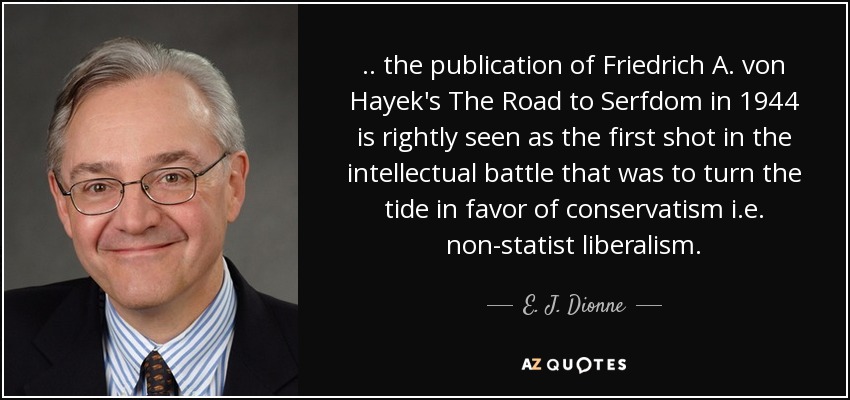
Friedrich Hayek was, of course, the author of the book The Road to Serfdom, first published in 1944, which was enormously influential in the last half of the 20th century. Hayek’s basic arguments would become a cornerstone of movement conservatism and libertarianism.

For those who don’t remember: Hayek was certain that the ultimate evil that would destroy democracy and individual liberty is central planning of the economy. Free markets equal free people. The key to maintaining individual liberty is to support the free exercise of capitalism and markets. Conversely, it was self-evident to conservatives that capitalism and tyranny cannot co-exist, and that if (for example) Communist countries would become more capitalist, individual liberty for their citizens would follow closely behind.

These days, of course, a lot of serious thinkers are asking if capitalism and democracy can co-exist, but let’s put that aside for now.  Eric Levitz at New York magazine points out that Trump is assuming the role of Central Economic Planner, and the Right seems to not be objecting.

On Friday, President Trump formally endorsed a plan to keep struggling coal power plants open — by forcing energy-grid operators to purchase power from them at uncompetitive rates — for the sake of “national security.”

This proposal is bonkers for a variety of reasons. The notion that it is in America’s national-security interest to prop up the coal industry is patently absurd. Our nation’s power grid has plenty of alternative sources of reliable energy — and keeping coal plants in business exacerbates climate change, which is itself a major national-security threat (if you believe those tree huggers at the Pentagon, anyway). Further, the costs of subsidizing inefficient, dirty energy will fall partially on consumers in the form of higher electricity bills. Which is to say: The administration has found a way to combine the (supposed) short-term economic costs of environmental protection with the long-term ecological risks of laissez-faire.

Where is the principled outraged from conservative intelligensia? Oh, wait … is there a conservative intelligensia any more?

The libertarian crew at Reason magazine do object (mildly) to Trump’s tariffs, but they haven’t gotten around to the coal power plan yet. I checked at National Review — nope, although their site search engine isn’t working so I couldn’t look past the front page. I checked at the American Conservative, which does occasionally make sense and seems to be the last refuge of conservatives who haven’t utterly sold out. Nothing. Maybe they need more time.

You know that if Hillary Clinton or Barack Obama had proposed the coal power plan, Republicans would all be screaming about Communism at the top of their lungs and hauling out their dog-eared copies of Hayek to frantically point at relevant paragraphs. But with the Right, the evil of an act does not depend on what is done but who is doing it. Just as white evangelicals threw Jesus and the Gospels under the bus to support Trump, the American Right in general seems ready to turn a blind eye to a blatant violation of Hayek’s principles, for the sake of … what? Their tribe? Or are they all in on the take?

Back to Levitz:

But the craziest aspect of the Energy Department’s proposal isn’t that it puts the profits of coal magnates above the survival of the planet. That much, we have learned to expect. The wild thing about Trump’s plan is that it rests on an interpretation of executive authority that is incredibly dangerous to the conservative movement.

Generally speaking, the president is not supposed to be able to unilaterally direct subsidies at his favorite industries; that’s Congress’s job. But Trump’s attempt to pay back his coal-magnate donors would never survive on Capitol Hill — it is that rare energy policy that is opposed by wind power, solar energy, and oil companies, alike.

There is absolutely no justification for it, except that Trump wants to do it. Somewhere in his developmentally arrested brain he may dimly remember that he promised to save coal miner jobs, and maybe this is his plan to save them. Or else his company is poised to exploit the coal industry somehow. That’s all I can figure.

Thus, the administration has decided to simply deliver the handouts itself — by invoking the Defense Production Act, a Cold War-era law that empowers the president to “effectively nationalize private industry to ensure the U.S. has resources that could be needed amid a war or after a disaster.”

As Bloomberg notes, this authority was most famously exercised by Harry Truman, who used it to cap wages and impose price controls on the steel industry during the Korean War.

The steel thing happened in 1952, and conservatives at the time threw a fit about it.

If our current president can wield this power to prop up coal plants, it’s hard to see why a future one couldn’t use it to shut them down:

This takes us to Levitz’s argument, that a future president with socialist leanings (the article is illustrated with photos of Bernie Sanders) could use the same presidential authority to shut down fossil fuel industries altogether, because how will America defend itself if its major coastal cities are underwater?

Similarly, one could imagine the Warren-Sanders administration finding a progressive use for the expansive trade powers that Trump has claimed. Creatively abusing another Cold War-era law, Trump has assumed the right to unilaterally impose tariffs on any nation he chooses — so long as he offers a specious national-security justification for doing so. After the next Democratic president uses the Defense Production Act to rapidly reduce America’s carbon emissions, it could threaten massive tariffs on any (developed) foreign nation that refuses to aggressively pursue its own emission-reductions targets — thereby turning America’s coveted consumer market into a force for climate justice.

Levitz says there are arguments that, under existing law, a president could override pharmaceutical patents to provide low-cost drugs to beneficiaries of federal programs. A president might also use executive power to turn post offices into public banks. And perhaps, if the next Democratic president is saddled with an obstructionist Republican Congress, that sort of thing could happen.

But if Trump’s plan for propping up the coal industry isn’t challenged by Republicans in Congress, I think we can officially declare that Hayek is dead. I can’t say I’m sorry, since his arguments were way too simplistic. Unregulated industrial capitalism in the 19th century created Communism, after all. And the young folks today are far more open to socialist ideas than their parents were. If there are still any Republicans who believe Hayek was right, let them speak now or forever hold their peace.

Update: Arghh — the SCOTUS ruled in favor of the homophobic wedding cake baker.

L’état, ce n’est pas Trump

The letter from Trump’s lawyers to Bob Mueller that the New York Times published is a bit of a slog, so if you want to skip it just go straight to this analysis by David Kris at Lawfare that refutes the letter’s legal claims.

First, per David Kris, Trump can’t argue that he doesn’t need to be interviewed because other evidence is available.

I’m not going to try to sum up this paragraph:

Second, even if Trump did order Comey to drop the investigation, the letter says, his defense lawyers have identified a criminal statute, 18 U.S.C. § 1505, that couldn’t have been violated because (they say, as have some courts) it doesn’t apply to FBI investigations. In connection with this legal argument, the letter seems to argue several fallback positions, although they are presented in ways I found a bit hard to follow. Among them are claims that there was no FBI investigation; that if there was an investigation it was closed (or at least was thought to be closed by certain members of the White House staff) by the time the president spoke to Comey about Flynn; that Flynn didn’t lie to the FBI; that Flynn did lie to the White House about various matters (and was fired for it); and that in any event he ultimately pleaded guilty so there could not have been any obstruction. I am not sure how the special counsel will react to all of this, except that he and his team will likely get at least as far as Charlie Savage of the New York Times did in noting that there are several statutes that may have been violated, see, e.g., 18 U.S.C. § 1512, and that obstruction need not succeed to be a crime.

Third — well, I’ll go to the letter from Trump’s lawyers here —

Many in the media have relied on mischaracterizations of the President’s remarks in a May 11, 2017, interview with Mr. Lester Holt of NBC News, to claim or suggest that in that interview, the President stated that the real reason he fired Comey is the Russia investigation.49 Unfortunately, so has Mr. Comey. He testified that: “I [take] the president, at his word, that I was fired because of the Russia investigation.”50 Regrettably, no one asked Mr. Comey when he thought the President had actually said any such thing because, in fact, the President did not ever say such a thing.

We all know what Trump said in the Lester Holt interview, but here it is for the record.

Trump actually started out to make the argument that Comey was incompetent, but he did say the fatal words —

But regardless of recommendation, I was going to fire Comey knowing there was no good time to do it

And in fact, when I decided to just do it, I said to myself — I said, you know, this Russia thing with Trump and Russia is a made-up story. It’s an excuse by the Democrats for having lost an election that they should’ve won.

In the continuing interview, Trump did say he expected the investigation to continue, which Trump’s lawyers claimed supported Trump’s support for the investigation. But since then there have been copious reports — a regular plethora of reports — about all the ways Trump has had to be talked down from shutting down the investigation by firing anybody involved in it. And how many times has he badmouthed the investigation on Twitter?

Here’s another bit from the letter —

There have also been press reports — citing anonymous sources — about comments the President allegedly made during a May 9, 2017, meeting with Russian government officials that Comey was a “real nut job’’ and that “great pressure because of Russia” has been “taken off” him.54 Assuming arguendo the President said any such things, it (i) does not establish that the termination was because of the Russia investigation (regardless of the validity of such an opinion, presumably any President would not want someone he considered a “nut job” running the FBI); and (ii) in any event would be irrelevant to the constitutional analysis. A short, separate, classified response addressing this subject will be submitted to the Office of Special Counsel.

They are arguing that Trump didn’t say this; that if he did say it, it doesn’t necessarily mean the termination had anything to do with the  Russia investigation; if he did say it, that doesn’t necessarily mean Comey is a “nut job”; but would you want a “nut job running the FBI?; and none of this is unconstitutional, so screw you.

Back to the David Kris analysis:

Finally, the letter says, although Trump may have helped Donald Trump, Jr. lie about the meeting at Trump Tower in which a purported Russian government official was supposed to provide dirt on Hillary Clinton, that was just “a private matter with the New York Times,” not an interview with the FBI, and therefore not a crime about which he can be questioned. As arguments for Trump’s innocence despite his prior statements, these arguments are strained. As arguments against even asking him about the statements, they strike me as pretty silly.

The final sentences of the letter are perhaps the most meaningful, albeit unintentionally. They say that Trump’s lawyers are prepared to “provide . . . the answers” to the Special Counsel’s questions, apparently instead of having Trump do so himself, in order to help “preserve the dignity of the Office of the President of the United States.” I spent a moment wondering, but in the end I think they didn’t mean this the way it sounds.

A large part of the rest of the letter is given over to arguments that boil down to “if the President does it, it’s not illegal.” Yeah, somebody tried that one already.


Jonathan Chait writes,

Should Trump’s legal case prevail in the courts — and the legality of such broad claims remains largely untested — it would confer upon any president, but immediately Trump, the ability to open charges against anybody the president wants to charge, and prevent investigations of anybody the president wants to protect, beginning with himself. This is l’état, c’est moi rendered as a formal legal case.

I can’t believe that any court would support the position of Trump’s lawyers. But I’ve been wrong before.

Lots of Blame to Spread Around in Puerto Rico

The problem with the current administration is that there are more atrocities coming out of it than I have time to comment on. But I do want to say a couple more things about Puerto Rico.

First, was obvious even just days after Hurricane Maria devastated Puerto Rico that the death could would continue to climb because of conditions on the island. And, not surprisingly, the Harvard study is reporting that many people died because they lacked access to medical services.

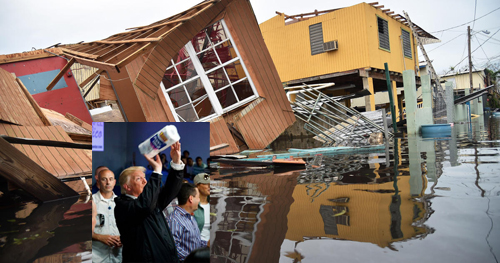
When Trump strutted around San Juan as if he’d just won a world championship title it ought to have been his “heckufa job, Brownie” moment. The tossing of paper towels to a crowd after such massive devastation was a perfect metaphor for Trump’s incompetence. But there was so little follow up news coverage of what was happening on Puerto Rico that the point was never driven home.

And what isn’t being discussed on Fox & Friends, Trump doesn’t know about.

Alvin Chang reported at Vox:

This week, we learned that Hurricane Maria may be the deadliest natural disaster on US soil in the past 100 years, according to a new study published in the New England Journal of Medicine. The study found that most of the estimated 4,600 deaths were because of delayed medical care.

But on cable news, the top story by a wide margin was ABC canceling Roseanne after a racist tweet from its star, Roseanne Barr. In the New York Times, Roseanne was on the front page and Puerto Rico was on A13.

This was yet another example of the media putting the Puerto Rico story on the back burner — something it’s been doing for a long time now. We analyzed the amount of airtime the major cable news networks devoted to Puerto Rico and found that after the first month, coverage has been virtually nonexistent….

I can see how an average American who is not a news junkie might have assumed that Puerto Rico was being taken care of, since few ever said anything otherwise. But it really wasn’t. And New Orleans got covered much more thoroughly.

I don’t blame reporters. I think those reporters assigned to Puerto Rico were doing their best:

Kaur: Has it been frustrating to see other stories instead dominate much of the news cycle? Have you felt like the story hasn’t gotten the attention it deserves?
Sutter: I do find that frustrating. I’m not sure people on the mainland realize how severe the crisis has been — and continues to be.
In March, I was reporting a story on people in a remote town, Maunabo, where people were dying because they lacked basic services like electricity. Breathing machines weren’t working. People couldn’t get medical help. There was just this cloud of despair that hung over the place.
I worried that our readers might not get it — or might not care, that they’d be focused on a Trump tweet. PR is part of the United States — but it can feel like living on another planet down here. The experiences people are having, and that we’re reporting, don’t translate for many Americans.
The problem is, I think, that if a story isn’t being hammered by several news outlets, it gets drowned out by the noise machine. An occasional feature here or there isn’t going to get attention. And it still isn’t getting attention.

The other surprise is that the new death estimate was not front page news and is not at the top of Google News or news aggregation sites.

What is?

Roseanne Barr’s firing over Islamophobic and racist remarks (with the racist remarks getting most of the attention rather than the Islamophobic ones).

Many on social media, as I mentioned yesterday, are flabbergasted by this inequity.

They are right to be.

Maria has turned out to be the most deadly natural disaster in U.S. history, and discovery of this ought to have been the leading news story coming out of every news outlet. But it wasn’t. And while some may opine that Puerto Rico will be an enduring stain on Trump’s legacy, It’s more like the ketchup spot between the grease splatter and the smudge where the dog threw up, and after awhile the mind numbs …

How the Trade Talks Broke Down

The Washington Post is running a story that says the NAFTA re-negotiation that Trump insisted on broke down because Mike Pence, who was the one negotiating for the White House, insisted that any new treaty contained a five-year sunset clause. Mexico and Canada took the position that the sunset clause was a non-starter because it left business in the dark about planning for trade rules in the future.

Why in the world would the Trumpettes have insisted on a sunset clause? That makes no sense.

See also Trump’s Tariffs Threaten National Security and Trump has officially put more tariffs on U.S. allies than on China. Of course he has. Canada should hustle and offer Ivanka some trademarks, already!