Britain: Just Stay in the EU

The “president” is eager to make a trade deal with the UK in the event it leaves the EU. If this doesn’t scare Brits into putting a decisive end to Brexit, it should.

Brits: Trump is not your friend. He is more like a big, nasty vulture who just wants to pick over your corpse.

From the Financial Times:

The US president, on the second day of a UK state visit, claimed that transatlantic trade between the two countries could be “two and even three times what we’re doing now” after Brexit, but made it clear that it would involve painful choices for Britain. “Everything will be on the table — the NHS, everything,” Mr Trump said at a joint conference with UK prime minister Theresa May, as he looked ahead to a post-Brexit trade agreement.

Trump saying that the NHS must be “on the table” was not the smartest negotiating tactic. Let’s face it; Mr. “Art of the Deal” couldn’t negotiate his way out of a wet paper bag.

From the New Statesman:

Absent a free trade agreement, American healthcare providers already compete to deliver services in the UK where the NHS puts out contracts to competitive tender. This is not without its own controversy, but was a unilateral decision made by a British government seeking value for money.

However, US demands regarding reimbursement regimes for pharmaceuticals and medical devices give greater cause for thought. The US has long taken issue with the fact that the NHS’s approach to drug procurement — where it makes its own assessment as to the fair value of the drugs it buys — pulls down prices worldwide. Previously, in negotiations with Australia and New Zealand, the US backed away from trade asks on drug pricing in order to get agreements over the line, but due to the NHS’s global significance and market power, the incentives for the US to push the UK harder are more pronounced.

The idea of opening up the taxpayer-funded NHS to more US medical companies — the health service already buys in some capabilities from the private sector, including US groups — is highly controversial in Britain. A trade deal with the US could also potentially involve the NHS having to pay higher prices for drugs made by American companies. The NHS currently pays significantly less for medicines from US companies than American healthcare purchasers.

Such a deal, Britain. You, too, can watch your loved ones die because insulin and supplies cost up to $1,300 per month.

The U.S. also wants the UK to lower its agricultural standards so that we can sell them our famous chlorinated chicken and our soon-to-be uninspected pork. Some guy named Woody Johnson, identified in The Guardian as “a close friend of the US president,” suggests that Brits don’t have to buy the stuff.

Johnson was also pressed on whether the US would seek a loosening of agricultural standards, including the importation of chlorinated chicken. He said the products should be offered to British consumers who could decide whether to buy them.

“There will have to be some deal where you give the British people a choice,” he said. “American products can come over and be allowed to come over. Agriculture is extremely important to the president and to any American president … but if the British people like it, they can buy it; if they don’t like it, they don’t have to buy it.”

Johnson said complaints about US food standards were ill-informed. “It’s completely safe. They can have a choice, we have five million Brits coming over every year and I’ve never heard a complaint about anything to do with chicken,” he said.

And I’m sure Woody interviews every one of those five million and asks what they thought of the chicken. The issue is that the U.S. is really good at mass producing chicken very cheaply. For that reason we Americans eat more chicken than any other meat, in spite of the fact that our chicken carries more diseases like salmonella than any other meat. What would cheap American chicken do to the British poultry industry, hm?

In other stable genius news, some congressional Republicans actually are talking about taking away Trump’s tariff privileges.

Congressional Republicans have begun discussing whether they may have to vote to block President Trump’s planned new tariffs on Mexico, potentially igniting a second standoff this year over Trump’s use of executive powers to circumvent Congress, people familiar with the talks said.

The vote, which would be the GOP’s most dramatic act of defiance since Trump took office, could also have the effect of blocking billions of dollars in border wall funding that the president had announced in February when he declared a national emergency at the southern border, said the people, who spoke on the condition of anonymity because the talks are private.

Trump’s plans to impose tariffs on Mexico — with which the United States has a free-trade agreement — rely on the president’s declaration of a national emergency at the border. But the law gives Congress the right to override the national emergency determination by passing a resolution of disapproval.

I say the only possible reason Republican lawmakers would even think about overriding Trump is that they are hearing from big-ticket corporate Republican donors who are losing money because of Trump’s tariffs and trade wars.

You might remember that Congress already passed one resolution disapproving the so-called emergency, but Trump vetoed it and there weren’t enough votes to override the veto. Maybe they’ll try again?

This time around, some GOP lawmakers and aides say there could be the votes in the Senate to overturn a presidential veto, because of the intense GOP opposition to tariffs. Such an outcome would be an embarrassing rebuke to the president by members of his own party — even if the veto override vote ultimately failed in the House, where Republicans have shown scant willingness to oppose the president. It takes two-thirds support in the House and Senate to overturn a presidential veto.

Traditional pro-business Republican groups have also announced strong opposition to the tariffs, and some are urging Congress to act. The Koch-backed group Americans for Prosperity sent a letter to congressional leaders on Tuesday calling the proposed tariffs “the largest tax hike in modern history” and urging “it’s time for Congress to do its job.”

Seems to me Trump has put the GOP between a rock and his own hard head. They’re going to have to choose between their deep-pocket donors like the Kochs or Trump and his rabid voter base.

(Photo credit should read TOLGA AKMEN/AFP/Getty Images)
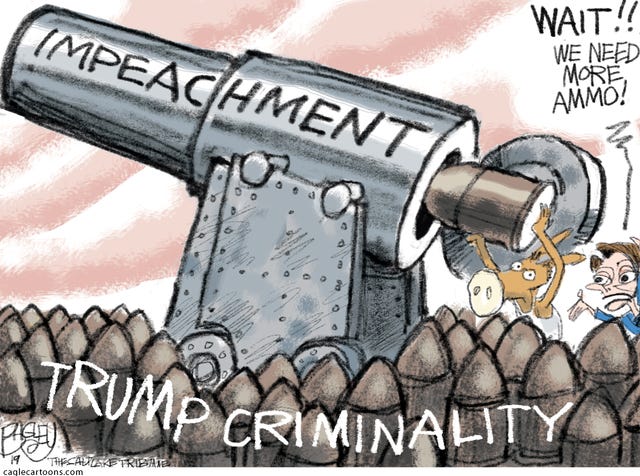
Not Impeaching May Be the Bigger Risk

I’m pleased to note that Digby also thinks the Dems should go ahead and officially start the impeachment process.

…the Democratic party should probably pay a little bit more attention to their own base on this. 76% of Democrats favor impeachment! And a whole bunch of college-educated white people, many of whom used to vote Republican, are also on board. This is not a static opinion.

I don’t know if the leadership has some grand plan to wait for support to rise before they impeach. But Pelosi insists that she wants to know in advance that the Senate would convict, which means she doesn’t care if 100% of Democrats and Independents back impeachment, Republicans must be there too. Maybe she’ll change her mind. I hope so.

But what if the Senate doesn’t convict?

I don’t know if Pelosi and company have a grand plan. But if they believe what they are saying, which is that you can’t impeach Trump because Republicans won’t convict him, then I think they are playing with fire.

Trump may survive impeachment through the partisan solidarity of Republican Senators who are happy to show themselves to be shameless toadies to their 40% president. He will say he “”won.” But if they fail to impeach him in the House, he will run by saying that it was Democrats who exonerated him. After all, if they really thought he was guilty they would have done it, right?

Trump will run as the strongman who all alone defeated the Democratic House with his gigantic bare hands.

I don’t think this is a decision that should be made on political terms. But if it is, it seems to me that the Democrats have the political argument all wrong. They actually have a better chance of winning in the long run by forcing the Republican Senate toadies to save him.

Public hearings that bring out all the dirt that isn’t being reported on Fox News will damage Trump, and with him any Republican who tries to cover for him, enormously with independent voters. Not holding public impeachment hearings or making any attempt to impeach Trump will hurt the Dems among independent voters and leftie voters who think the Democratic Party is a spineless waste of time and there’s no point voting for those people.

Bottom line, there’s a good argument that not iimpeaching Trump is a bigger risk than going ahead with it, Senate conviction or no Senate conviction.

See Greg Sargent on what we can learn from polling on impeaching Nixon in 1973 and 1974:

Right now, independents are a key reason public support for impeachment is low. A recent Post-ABC News poll, which found that only 37 percent of Americans support beginning impeachment proceedings while 56 percent oppose it, also found that among independents, those numbers are 36 percent to 59 percent.

The Gallup numbers on Nixon suggest that big shifts among independents are possible and show that a substantially larger percentage of independents now support impeachment hearings than at the outset in Nixon’s day.

In other words, it might be possible to build majority support for an impeachment inquiry on Trump, even if Republican voters don’t ever move much on this question.

See also:

The House Is Right to Move Toward an Impeachment Inquiry by Quinta Jurecic at Lawfare.

Yet, there stands Nancy like a stone wall. At CNN, Ross Garber writes,

As an impeachment defense lawyer, I often warn about the perils of initiating impeachment proceedings. I emphasize that they should be undertaken only where there is credible information of egregious misconduct that would affect an official’s ability to continue in office, and in full recognition of the incredibly high standard for impeachment, the rigorous process involved, the inevitable disruption in governing and the potential political costs.

But House Speaker Nancy Pelosi has set a bar for an impeachment process that even I haven’t dared advocate. And while she may believe an impeachment process would hurt Democrats in 2020, she has sought to justify her aversion to impeachment with statements that are unsupportable and erroneous. This undermines the public’s trust and could have consequences for future impeachment efforts.

For example, apparently Pelosi as argued that if Trump is aquitted by the Senate, criminal charges couldn’t be brought against Trump when he’s out of office. But that’s bogus, Garber says. Nancy also says that impeachment would “divide the country.” Uh, hello? We’re already divided Impeachment might bleeping bring us together.

I very much doubt that any evidence brought against Trump in an impeachment hearing would budge enough Republican senators to convict the Creature. But if the case has been made to the public, these same senators will pay a bigger price than the Democrats.

Back to Ross Garber:

The whole point of an impeachment process is to conduct a fair evaluation of the facts and constitutional standard. Initiating an impeachment process also provides a forum for the public to learn about the relevant facts and the constitutional burdens….

…Partisanship is to be expected, especially at the outset; it is the default posture in Washington. But let’s take a look at some history. The impeachment process involving President Nixon began as a largely partisan effort, but eventually members of the President’s own party came around, resulting in his resignation. Here too, Speaker Pelosi is wrong to suggest that uniform opinion be required about the result before even initiating an evaluation of the facts through the impeachment process.

The purpose of this piece is not to advocate for impeachment. It is to urge that the topic be approached responsibly. And it’s not just about Donald Trump. Someday a different House leadership will confront potential misconduct by a different president and will look for guidance to the words and actions of this speaker and this House of Representatives.

This is about protecting the integrity of the Constitution. If impeachment isn’t used against this walking cesspool of a president, when will it be used? That makes the Constitution even weaker.

Sometimes, you just have to do the right thing.

(Photo: Pat Bagley/The Salt Lake Tribune/PoliticalCartoons.com)

The Dirty, Filthy, Disgusting I Word

To impeach, or not to impeach — that is the question.

I have been of the school of thought that we must investigate Trump with everything we’ve got, but that impeachment itself is futile as long as Republicans hold the majority in the Senate. But I’m changing my mind.

James Reston, Jr., recalls a Republican congressman, Rep. Lawrence Hogan of Maryland, who wrestled with the impeachment question back in 1974.

“This is an occasion when party loyalty demands too much,” the elder Hogan said. “To base this decision on politics would not only violate my conscience but it would be a breach of my oath to uphold the Constitution. Those who oppose impeachment say it would weaken the presidency. In my view, if we do not impeach this president after all he has done, we would be weakening the presidency even more.”

That’s where I’m coming out, although I’m more concerned with the Constitution than with the presidency. Yes, Republicans in Congress are even crazier and more partisan now than they were then. But Reston makes the point that Republicans in Congress,, who held a majority in the Senate then also, stood solidly behind Nixon in 1974 — until they didn’t.

What happened in Washington in the summer of 1974 is a template for what could and perhaps should happen in the summer of 2019. The behavior of Republicans back then holds important lessons for the current situation. Hogan and his like-minded colleagues did not step forward at the outset of the impeachment process, but only at the very end, when historic votes loomed, votes that would force upon them the most profound personal consideration about what they valued and what they stood for.

Yet today’s House leader, Nancy Pelosi, and her group are demanding that Republicans step forward now, at a preliminary stage in judging President Trump, as a condition of proceeding with impeachment. No formal process should even be initiated, she says, without significant Republican buy-in. This position is untenable. It forecloses the possibility, strange as it may seem to some, that there are decent and thoughtful Republicans who are deeply troubled by the revelations of the Mueller report, but who would come forward only when they were forced to do so because of a vote to decide the president’s fate.

Whether there are decent and thoughtful Republicans who would, in the end, put principle before party is not something I would bet the house on. However, I sincerely believe that if even what we know to be true about Trump really came to the attention of the public and is not buried behind William Barr’s double-speak, there would be a lot of Republicans who would look hard at their own political futures and rethink their position.

And what do we not know? We don’t know what’s in Trump’s tax returns. We don’t know what’s in his Deutsche Bank records. We don’t know how Mr. Multiple Bankruptcies came to be flush with cash in 2006 and was still getting funded by somebody after the 2008 financial crisis. We don’t know what went on with the inauguration money. We don’t know a lot of things. But these things are know-able. Well, if court orders and subpoenas can be enforced.

This happened yesterday:

Federal prosecutors rebuffed a judge’s order to release by Friday highly classified transcripts of discussions that Michael T. Flynn, the president’s former national security adviser, had with the Russian ambassador during the presidential transition.

So what’s that about?

Impeachment is a process, and it’s a process with many steps. Voting on articles of impeachment comes at the end of the process. Pelosi speaks of it as if it’s the only part of the process. It’s true that congressional investigations don’t have to be called impeachment investigations, but there’s a widely held belief that doing so would give subpoenas and court orders more weight. Ignoring subpoenas related to an impeachment inquiry would be, seems to me, obstruction on its face and an impeachable offense in itself.

Of course, there’s  Alan Dershowitz, still on his sad journey from respected legal mind to punchline, embarrassing himself with an op ed claiming the Supreme Court could overrule an “unconstitutional” impeachment. He notes that all the other lawyers hoot at this idea, but cites a serious legal source — himself, in a book he wrote.

“This is all complete nonsense,” writes Paul Campos at Lawyers, Guns & Money. “It would warrant a failing grade if put forward in a first-year law student’s Con Law final.”

Voices claiming the impeachment process would backfire and turn into a debacle that will hurt the Democrats tend to be … conservative. For example, there’s David Frum (citing the Clinton impeachment as an example) and George Will (citing a bunch of irrelevant legal opinion that makes it sound as if he doesn’t believe Trump did anything that wrong). But now even Bill Kirstol says that it’s time for impeachment inquiries, which makes me wonder if the solar system is about to implode.

I believe we’ve reached a point that the entire Trump Administration is such a threat to the Constitution that there is no choice but to begin the impeachment process. Indeed, if the process can’t be used on this president, we might as well erase the procedure from the Constitution.

(Credit: www.dailykos.com)

Stop Trump Before He Tariffs Again

Trump and his tariffs are like a kid with a new toy. Except that it matters that Trump has no idea how tariffs actually work. He apparently believes that imposing a 5 percent tariff on goods from Mexico will punish Mexico, with no consequencess to U.S. business and consumers. And it appears his own advisers have been unable to explain to him that’s not how it works. See “DISASTROUS”: DOW SINKS AS MARKETS REALIZE TRUMP REALLY IS THIS STUPID at Vanity Fair.

My question is, why isn’t anyone taking real action to stop him? He isn’t supposed to have the power to impose tariffs, anyway, the Constitution says. He is assuming power a president doesn’t constitutionally have by taking advantage of an “emergency powers” law. From CNN:

One key thing to know is that the emergency powers he is using evolved from the need for the President to act with decisive authority during war, specifically World War I. The Great Depression prompted the expansion of emergency powers to include economic emergencies, according to an analysis by the Congressional Research Service. (This piece uses many facts from that analysis, which is worth reading.)

These powers were used throughout the Cold War until the 1970s, when, according to CRS, Congress basically realized the US had been in a state of emergency for 40 years and put new restrictions on the President, including requirements to track the cost of any emergency and justify it each year.

The law by which Trump can impose sanctions like the tariffs, passed in the wake of Watergate and Vietnam, is the 1977 International Emergency Economic Powers Act. This authority has actually been used quite frequently; there have been 54 national emergencies, 29 of which are ongoing. …

… The law has never, before now, been used to impose tariffs, according to CRS. And Mexico is a neighbor and ally, from which we bought $345 billion in stuff last year because we are joined together in the North American Free Trade Agreement.

I understand that people did try to explain to Trump that the new tariff could screw up his NAFTA 2.0 deal. Some business groups are considering a lawsuit.

They’ll [the tariffs] affect the supply chain for the US auto industry, machinery, medical instruments, not to mention the avocados and tomatoes in American salads, fruit, vegetables. All of it.

And it’s a two-way street. Americans sold just shy of $300 billion in goods to Mexico in 2018 — cars, machinery, pork and beef. Billions and billions dollars worth of many different type of goods that might be subject to retaliatory tariffs from Mexico.

As Bess Levin wrote,

Tariffs, of course, are usually used to counter trade violations as opposed to being a blunt instrument to deal with border security, but reason and logic have no place in this administration. If they did, someone would have likely been able to get it through Trump’s head that this move will badly damage the U.S. interests, a point that has thus far eluded him.


Congress could shut down Tariff Man by tomorrow, seems to me, One assumes the Senate doesn’t act because of the Republican majority, but what about the House? What about the several hundred Democratic presidential candidates? I see Julián Castro has spoken out; not sure about anyone else. Why aren’t there many very loud voices saying that Trump is using a power he’s not supposed to have, and it’s hurting people?

Meuller Lite

I woke up to headlines about how Robert Mueller was about to make some big, substantive statement. Then the next headlines were just about how he was closing the special counsel’s office and leaving the Justice Department. I thought he had already done those things, but whatever.

He actually said a little more, but not a lot more. He won’t comment further on Russian interference allegations because there are pending indictments. Once again, he said there was insufficient evidence to prove conspiracy. Then he said,

When a subject of an investigation obstructs that investigation, or lies to investigators, it strikes at the core of the government’s effort to find the truth and hold wrongdoers accountable.

Indeed.

And in a second volume, the report describes the results and analysis of our obstruction of justice investigation involving the president. The order appointing the special counsel authorized us to investigate actions that could obstruct the investigation. And we conducted that investigation and we kept the office of the acting attorney general apprised of the progress of our work. And as set forth in the report after that investigation, if we had had confidence that the president clearly did not commit a crime, we would have said so. We did not, however, make a determination as to whether the president did commit a crime.

Again, not news.

The introduction to the volume two of our report explains that decision. It explains that under long-standing department policy a president cannot be charged with a federal crime while he is in office. That is unconstitutional.

Actually, a whole lot of constitutional scholars say otherwise. But let’s go on.

The department’s written opinion explaining the policy makes several important points that further informed our handling of the obstruction investigation. Those points are summarized in our report and I will describe two of them for you. First, the opinion explicitly permits the investigation of a sitting president, because it is important to preserve evidence while memories are fresh and documents available. Among other things, that evidence could be used if there were co-conspirators who could be charged now.

And?

And second, the opinion says that the constitution requires a process other than the criminal justice system to formally accuse a sitting president of wrong doing.

And that would be Congress, I believe.

Now I hope and expect this to be the only time that I will speak to you in this manner. I am making that decision myself. No one has told me whether I can or should testify or speak further about this matter. There has been discussion about an appearance before congress. Any testimony from this office would not go beyond our report. It contains our findings and analysis and the reasons for the decisions we made. We chose those words carefully and the work speaks for itself.

You’ve probably heard that the House Judiciary Committee has been asking Mueller to testify publicly, and he has said he would only testify privately. Mueller has also been saying he would not testify to anything beyond what is already in the report. Just now Chairman Jerrold Nadler said that Mueller has “clearly demonstrated that President Trump is lying about the Special Counsel’s findings.”

“Although Department of Justice policy prevented the Special Counsel from bringing criminal charges against the President, the Special Counsel has clearly demonstrated that President Trump is lying about the Special Counsel’s findings, lying about the testimony of key witnesses in the Special Counsel’s report, and is lying in saying that the Special Counsel found no obstruction and no collusion,” he [Nadler] said.

If I were Jerry Nadler, as soon as Mueller is no longer a Justice Department employee I would serve Mueller with a big, fat subpoena requiring him to appear publicly before the Judicial Committee to reaffirm that Trump was not exonerated of obstruction, and that Trump might still face indictments when he leaves office or impeachment even sooner.

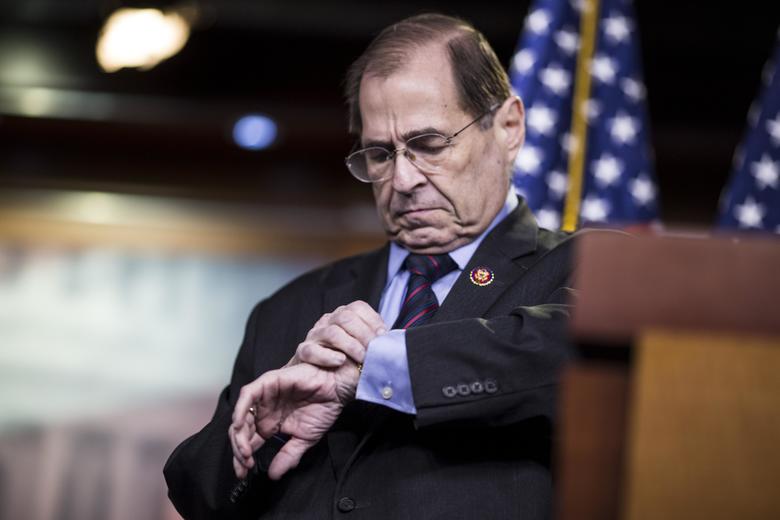
Jerry Nadler, waiting for Bob Mueller to stop being such a bleeping hothouse violet and testify publicly, already.

Another Episode of Why We’re Screwed

Nobel laureate economist Joseph Stiglitz is not a fan of neoliberalism.

Three years ago, President Donald Trump’s election and the United Kingdom’s Brexit referendum confirmed what those of us who have long studied income statistics already knew: in most advanced countries, the market economy has been failing large swaths of society.

Nowhere is this truer than in the United States. Long regarded as a poster child for the promise of free-market individualism, America today has higher inequality and less upward social mobility than most other developed countries.

After rising for a century, average life expectancy in the U.S. is now declining. And for those in the bottom 90% of the income distribution, real (inflation-adjusted) wages have stagnated: the income of a typical male worker today is around where it was 40 years ago.

Meanwhile, many European countries have sought to emulate America, and those that succeeded, particularly the U.K., are now suffering similar political and social consequences.

The recent European elections do not give me hope that Europeans are learning from our mistakes, although Josh Marshall argues it’s not as bad as it looks. But let’s go on …

Urban Americans who have profited from globalism are still oblivious to what Reaganomics and its cousin, neoliberaism, have done to large parts of the country. Indeed, I still run into people who insist neoliberalism isn’t even a real thing. They should hang out with me for a while.

The New York Times has one of those “reports from Trump’s America” articles focusing on one laid-off auto plant worker adjusting to life without a job. I found the article compelling, because I know this guy. Not the individual in the article, but his many counterparts. I went to high school with this guy. I run into him at family reunions and funerals. He comes around to mow the lawn and fix the plumbing.

The local variation of this guy is somewhat different in that he may never have had the union job his father had, since the union jobs moved out of here in the 1980s and not just last year. But he knows he doesn’t have the same range of opportunities that his father did. He’s able to maintain a middle-class standard of living by cobbling together more than one job, and his wife works, too, but they do without much of a benefit package. On paper, it may look as if he’s doing all right, but he worries about retirement. HIs dad had a pension and benefits; this guy doesn’t.

This guy blames NAFTA, and both parties, for the loss of union manufacturing jobs that have changed his economic reality. This guy voted for Donald Trump in 2016, big time, but he realizes now that Trump hasn’t actually done anything and probably won’t. He says he’s open to supporting any candidate, of any party, gender, or race, who can give him his old life back, or something similar.

And here’s the part where it’s important for Democrats to talk to this guy, and listen to this guy. In 2016 Clinton didn’t reach this guy, and Trump did, and that’s why he’s president and she isn’t.

Back to Stiglitz:

We can thank former President Ronald Reagan and former British Prime Minister Margaret Thatcher for our current state of affairs. The neoliberal reforms of the 1980s were based on the idea that unfettered markets would bring shared prosperity through a mystical trickle-down process.

We were told that lowering tax rates on the rich, financialization, and globalization would result in higher standards of living for everybody. Instead, the U.S. growth rate fell to around two-thirds of its level in the post-war era — a period of tight financial regulations and a top marginal tax rate consistently above 70% — and a greater share of the wealth and income from this limited growth was funneled to the top 1%.

Instead of the promised prosperity, we got deindustrialization, polarization, and a shrinking middle class. Unless we change the script, these patterns will continue — or worsen.

This is a big deal, and it’s not going to be solved by tweaks to the existing system. The system needs a radical overhaul. And, frankly, I think a big chunk of white guy America is ready to consider a radical overhaul in ways they were not in 1972 or 1980 or 1993 or 2000, and Democrats who still insist on running to the center need to adjust. The center, even assuming there is one, ain’t gonna hold.

I don’t know who Umair Haque is, but he wrote an interesting essay —

Now, at this point, sometimes, Americans interject?—?“our society’s not collapsing!” Sorry, yes it is. Longevity’s falling, incomes are shrinking, happiness is plummeting, suicides are skyrocketing. These mega trends aren’t true anywhere else in the world, apart from maybe North Korea. Then there are the other trends, the sociocultural ones, the weird and gruesome ones?—?school shootings, murder-suicide epidemics among the elderly, old people working at Walmart. I read the other day that 20% of American kids don’t drink water at least once a day. What the? You get the point. America is as close a thing to a collapsing society as a rich country has ever been in human history.

(And yet the truth is that nobody forced that fate on America. American collapse is a self-inflicted tragedy. The Soviets didn’t do it. A bullet didn’t need to be fired. It’s a thing made of capitalism, of supremacy, of patriarchy. Supremacy made Americans?—?enough of them?—?say: “I won’t pay for their schools and hospitals! Those dirty, filthy people are beneath me! Why, they used to be my grandparents’ slaves!” Capitalism made Americans believe that everything could be solved with greed, selfishness, markets, and corporations. And patriarchy made it impossible for anyone but pedigreed white dudes who repeated all the above, ad nauseam, the old refrains of “self-reliance” and “individual responsibility” and “free markets” and so on, to get any kind of attention or influence whatsoever.)

The fact?—?and you’re not going to like this?—?is that while the rest of the rich world, notably Europe, modernized, America never did. It never went anywhere?—?and so today, it’s going backwards, having reached the limits of its old paradigms and attitudes of capitalism, supremacy, and patriarchy.

So here we are, in the allegedly Richest Country in the World, and our infrastructure is crumbling from neglect, our maternal and infant mortality rates get worse and worse, school children go hungry if they don’t have lunch money, the water in many areas isn’t fit to drink, many cities have extreme housing shortages, people die because insulin is too expensive, etc. Our state legislatures can’t bring themselves to address these problems but trip all over themselves rushing to ban abortions and loosen restrictions on firearms. And the federal government is completely frozen because the party that controls the Senate functions only to protect the corrupt president. Brilliant.

Oh, and, in the meantime, our planet is dying.

I am paying no attention to polls until after we’ve had a couple of debates. And I am hoping — possibly foolishly — that major news media will have learned a lesson from 2016 and will bleeping report on the candidates, backgrounds and all, and not just cover politics as a horse race.

And I suspect this guy will listen to a candidate who says that we can’t force GM to re-open its auto plant, but we are hiring crews to fix infrastructure, and we pay good wages and benefits. And we’ll see to it your daughter with cerebral palsy can get the health care and services she needs. We can tax rich people to pay for it.

Why is that so hard?

Trump’s Wrecking Crew Goes After Press Freedom

In dot connecting mode — This week Julian Assange was indicted on violating 17 counts of the Espionage Act for his role in publishing classified State Department and other files sent to him by Chelsea Manning. Whatever one might thing of Assange, this is worrisome because it touches on an important privilege of news media, which is the ability to publish classified informatioin received as a third party that the American people need to know.

Consider, for example, the Pentagon Papers. Daniel Ellsberg leaked the top-secret study of how the U.S. had gotten itself into the Vietnam War to the New York Times in 1971, and the Times decided to publish it in segments. After the first segment came oout the Nixon Administration sought a court order barring the paper from publishing the rest of it.

According to Wikipedia,

Section 793 of the Espionage Act was cited by Attorney General John N. Mitchell as cause for the United States to bar further publication of stories based upon the Pentagon Papers. The statute was spread over three pages of the United States Code Annotated and the only part that appeared to apply to the Times was 793(e), which made it criminal for:

Whoever having unauthorized possession of, access to, or control over any document, writing, code book, signal book, sketch, photograph, photographic negative, blueprint, plan, map, model, instrument, appliance, or note relating to the national defense, or information relating to the national defense which information the possessor has reason to believe could be used to the injury of the United States or to the advantage of any foreign nation, willfully communicates, delivers, transmits or causes to be communicated, delivered, or transmitted, or attempts to communicate, deliver, transmit or cause to be communicated, delivered, or transmitted the same to any person not entitled to receive it, or willfully retains the same and fails to deliver it to the officer or employee of the United States entitled to receive it [shall be fined under this title or imprisoned not more than ten years, or both]. [6]

A second lawsuit was brought against the Washington Post after that paper began publishing portions of the Pentagon Papers also. The Supreme Court heard both cases and decided the newspapers had a right under the First Amendment to publish the study. Very simply, the Court decided that the government did not prove that publication of the Pentagon Papers was actually detrimental to national security.

The precedent here, I believe, is that while a media outlet may not have absolute discretion to publish classified information that falls into its lap — if the information really is critical to national security, and if publishing it could bring harm to someone, that might still be a violation of the Espionage Act. But if the government is just sitting on something because it would be emarassing to elected officials, and this something falls into the hands of news media, its publication is protected speech.

But now the Trump Administration has swooped in to indict Julian Assange — rather ungrateful of it, I think — for publishing the information given him by Chelsea Manning. This all happened in 2010, and while the Obama Administration prosecuted Manning it chose not to bring charges against Assange.

But now the Trump Justice Department does want to prosecute Assange under the Espionage Act, saying that Assange is not a journalist. Well, he isn’t, but that shouldn’t matter.

Assange is being charged under the Espionage Act, a law passed during World War I to punish spies and traitors. But in recent years, the law increasingly has been used against government employees who leak classified information to the media. The Obama administration brought eight prosecutions for media leaks — more than all previous administrations combined — and the Trump administration has upped the ante, bringing seven prosecutions in the space of two years. Alarmingly, many of the defendants have been whistleblowers: They disclosed information indicating waste, fraud or abuse on the part of the government. National Security Agency employee Thomas Drake, for instance, was charged with disclosing information about an illegal N.S.A. surveillance program to a Baltimore Sun reporter.

Nonetheless, until now, the Justice Department distinguished between government employees who leak classified information (deemed prosecutable), and outlets that publish it (considered to have First Amendment protection). The Obama administration flirted with erasing that line: In court documents, it described a Fox News chief Washington correspondent, James Rosen, as “an aider, abettor and/or co-conspirator” in an Espionage Act case. (Rosen has since left Fox.) And the administration reportedly considered bringing charges against Assange. But ultimately, Obama’s Justice Department decided that prosecuting publishers of leaked information would be a bridge too far.

That was the right decision. Although the Espionage Act does not recognize a line between leaker and publisher, the First Amendment, as interpreted by the courts, does. The Supreme Court has long held that government employees may be required to relinquish some free-speech rights as a condition of their employment. Officials with access to classified information sign nondisclosure agreements in which they agree to be subject to criminal penalties for leaking. Publishers, obviously, sign no such waivers. While the Supreme Court has not directly addressed whether they can be prosecuted for publishing classified information (because no such prosecution has previously occurred), it has held that the government may not enjoin a newspaper from publishing information based solely on government claims of national security harms.

Now, why would the Trump Administration give a hoo haw about the documents published by Assange back in 2010? Here’s some speculation — are they doing this to send a warning to U.S. media outlets about publishing classified documents that might embarrass Donald Trump?

Consider that they pulled this trick just before Trump gave Attorney General/Trump consigliere William Barr carte blanche to comb through and declassify anything he wants to publish to make Trump look good. What would happen if the Washington Post received classfied files pointing to clear Trump corruptions? What would happen if someone slipped a thumb drive to a journalist containing the unredacted Mueller Report with all underlying evidence? And a media outlet chose to publish it?

Under the Pentagon Papers precedent, probably the media outlet that published those files would not face charges, assuming the documents didn’t compromise any ongoing intelligence operations. But the Trump Justice Department seems to be looking to change the precedent. Otherwise, why are they bothering with Assange?

There is also a Russian connection, naturally. Josh Marshall wrote yesterday,

This level of power basically gives Barr a whip hand over the entire Intelligence Community. And he seems to want to get his hands on the Russia desks especially. As the Times notes, “Mr. Barr wanted to know more about what foreign assets the C.I.A. had in Russia in 2016 and what those informants were telling the agency about how President Vladimir V. Putin of Russia sought to meddle in the 2016 election.” These are likely among the most closely held secrets the US government has. They will all but certainly be communicated directly to the President.

And from there to Trump’s good buddy Vladimir Putin?

Current and former intgelligence officials are horrified at Barr’s newfound privilege, saying that lives are on the line. It puts Barr in the position of weaponizing the Justice Department against the FBI and other intelligence agencies.

Jamil Smith writes for Rolling Stone,

I listened Thursday to President Trump, after a reporter reminded him that the treason of which he’d been accusing his many adversaries is an actual crime punishable by death, and he merely nodded. When asked who might suffer that penalty, he named the former head of the FBI, his ex-deputy, and “people probably higher than that.” There aren’t too many people higher than that.

Hours later, that dystopian rhetoric began transforming into authoritarian reality. Trump signed a directive allowing attorney general William Barr broad, unprecedented powers to conduct a review of the intelligence community’s investigation into the 2016 Trump campaign, ordering the CIA and the other 15 federal intelligence agencies to essentially to give Barr everything he needs. Whatever Barr wants declassified, he’ll declassify — which we can anticipate, given our experience with the Mueller report, to be a nightmare of misinformation tailored to the president’s narrative.

It is carte blanche for his attack dog to comb through a mountain of intelligence and craft a story to punish whomever Trump wants punished. Without any restraints, we can expect mockeries of justice unlike things we’ve seen since, well, trials of police officers for killing black people. It will almost certainly be disgraceful. Trump lackey Corey Lewandowski already was on the airwaves Friday alleging that former Vice President (and potential general election rival) Joe Biden was behind the Steele dossier and that Comey, McCabe and others would all be on trial by “March or April of the next year.”

I am honestly frightened for this country.

The Further Shredding of Everything the Founders Tried to Accomplish by Donald J. Trump

Trump has given William Barr, one of his principal toads, the power to declassify anything he wants. Allegedly, this is so Barr can investigate how the investigations that led to the Meuller investigation got started. Paul Waldman explains why this is a big deal.

Barr is not trying to learn more about whether there was something fishy about that investigation. He’s looking for information that can then be selectively declassified in order to help Trump and undermine his perceived enemies. If that involves compromising sensitive intelligence, he won’t hesitate for a moment.

We can be pretty sure of what’s going to happen. Barr will scour every record he can to learn as much as possible about the Russia investigation. Whenever he comes across something that can be spun to make the FBI or anyone Trump has decided is his enemy look bad, he’ll put it in the “Declassify” pile. Then he’ll release it all to the public and hold a news conference where he suggests that there was a conspiracy to take down Trump. The president will then take to Twitter to proclaim that he was indeed the victim of a vile witch hunt that has at last been exposed. The news media, in possession of only the materials Barr has chosen to give them, will struggle to avoid amplifying and reinforcing Barr’s claims.

In case you were wondering what happens when an infinitely corrupt president decides to use the powers of the federal government for his own self-interest with the help of lackeys he has installed to protect him, this is it. Now just wait until he tells Barr to go after the Democratic nominee for president.

Yep, that’s how it will go down. Kind of amazing the United States lasted as long as it did, consideringa circus clown is doiing such a bang up job destroying it.

Trump Throws Temper Tantrum; World Yawns

(Photo by Tolga AKMEN / AFP/Getty Images)

So this just happened:

President Trump abruptly ended a meeting with Democratic leaders on Wednesday, saying he was unable to work with them on legislation following comments by House Speaker Nancy Pelosi (D-Calif.) that he was “engaged in a coverup.”

Trump made an unscheduled appearance in the Rose Garden shortly afterward and in a meandering 10-minute address said he had left the meeting with Pelosi and Senate Minority Leader Charles E. Schumer (D-N.Y.) at which they were supposed to talk about working together on a $2 billion infrastructure plan.

“Instead of walking in happily to a meeting, I walk in to look at people who said I was doing a coverup,” Trump said, adding that he can’t work on infrastructure “under these circumstances.”

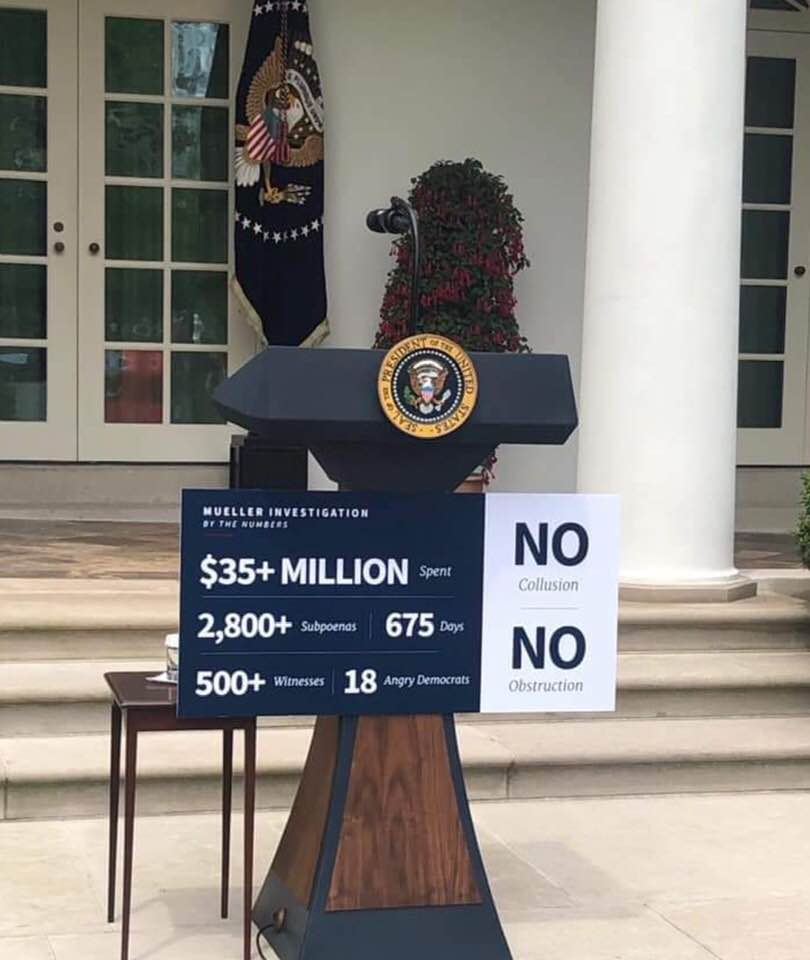
Here was the scene for the completely unscheduled and spontaneoous appearance that he hadn’t at all planned on making this morning:

Very early this morning Trump was tweeting about witch hunts already. BTW, it’s not clear what the Mueller investigation cost, but there are estimates it could have paid for itself through collected settlesments, mostly from Paul Manafort.

Anyway — I’m sure nobody on the Democratic side had any illusions there was a real chance Trump would keep any commitment to a $2 billion infrastructure plan. So nothing was lost here.

Also, before the infrastructure meeting had broken up, Greg Sargent wrote,

Trump is set to meet with House Speaker Nancy Pelosi and Senate Minority Leader Chuck Schumer to discuss their previous agreement-in-principle to a $2 trillion infrastructure package.

But Trump has now blown up these negotiations with a new broadside — a letter demanding that Democrats pass his renegotiated North American Free Trade Agreement, and insisting he will not consider infrastructure until that’s done.

“Before we get to infrastructure, it is my strong view that Congress should first pass the important and popular USMCA trade deal,” Trump wrote in the letter to Pelosi and Schumer, in a reference to the United States-Mexico-Canada Agreement, which is NAFTA 2.0. After this is passed, Trump continued, “we should turn our attention to a bipartisan infrastructure package.”

Sargent points out that on both NAFTA 2.0 and infrastructure, Trump needs the House Democrats a lot more than they need him. Democrats want an infrastructure package, but only if it is paid for through progressive taxation and not through some cockamamie tax incentive plan to corporations. But anything paid for by taxes is not going to get through the current Senate. Of NAFTA 2.0, Waldman says, “Many congressional Democrats won’t support it without changes strengthening its labor protections, and view its intellectual property protections as a giveaway to Big Pharma.”

Trump, on the other hand, needs to be able to brag about accomplishing a better trade deal and an infrastructure plan as he runs for re-election.  But now Trump says he can’t work on those things because those mean, nasty Democrats are investigating him.

“I walked into the room and I told Sen. Schumer and Speaker Pelosi, ‘I want to do infrastructure’ … but we can’t do it under these circumstances,” Trump said at a last-minute Rose Garden event.

Trump’s anger appears to have been sparked by comments Pelosi made earlier in the day when she said, “We believe the president of the United States is engaged in a cover-up” by blocking White House aides from giving testimony and responding to document requests from ongoing congressional investigations.

“I don’t do cover-ups,” Trump insisted Wednesday.

Dude — you’re blocking testimony and ignoring subpoenas. That’s covering up on its face. And then he turned it around and claimed the Democrats can’t be serious about working on legislation while they are also investigating him, not realizing that most  people really can walk and chew gum at the same time. If he thinks he somehow has leverage over the Dems and can scare them into not investigating him, or something … what leverage? I’m not seeing any leverage. He’s the one who needs to be able to say he did something about infrastructure. He’s the one who needs NAFTA 2.0 to not go down in flames.

Martin Longman advises Dems to just go ahead and write their own bill and then campaign on it next  year.

I think the House should hold extensive hearings on the country’s infrastructure needs and how they can use a major bill to address climate change. They should pass the bill at the end of the year and then campaign on the issue when the Republican-controlled Senate inevitably lets the infrastructure issue die in Congress.

There are a lot of voters out there who will take the Democrats side in that debate.

Sounds like a plan.

The Democratic Message Deficit

The usually insightful Greg Sargent praised Pete Buttigieg’s Sunday night appearance on Fox News, possibly only see by people who don’t have HBO subscriptions. But Sargent had some criticism, too.

Buttigieg has been pilloried for going on Fox News in the first place, something Sen. Bernie Sanders (I-Vt.) has done but that Sen. Elizabeth Warren (D-Mass.) has refused to do. Buttigieg addressed the criticism by saying: “I get where that’s coming from,” and referencing the anti-immigrant rhetoric of some Fox News personalities. He added:

There is a reason why anybody has to think twice and swallow hard before participating in this media ecosystem. But I also believe . . . there are a lot of Americans who my party can’t blame for ignoring our message, because they will never hear it if we don’t go on.

Buttigieg insisted that this is another reason the candidates must spend more time “going into places where Democrats haven’t been seen much. We’ve got to find people where they are — not change our values, but update our vocabulary so that we’re truly connecting with Americans from coast to coast.”

No, that cannot be right, says Greg Sargent. How can it be that Democrats haven’t been reaching out to and speaking to all voters? “One can and should argue for speaking to all voters without adding the notion that other unnamed Democrats don’t actually try to do this,” Sargent says.

Let me deliver this sermon one more time.

No, people in large parts of the United States don’t hear Democratic Party messages very often, if at all. Democrats do show up and speak to these voters, but when they do they use carefully vague Republican Lite rhetoric. For decades they’ve avoided discussing hot-button issues like abortion. They also avoid discussing any new initiatives that might require raising taxes. When they run for office, most of their television ads are designed to reassure voters they really aren’t like those liberals.

I am living in a Missouri county that went more than 70 percent for Donald Trump in 2016. I grew up here; it’s a community that had a lot of union jobs 50 years ago, but no longer. The kind of boldly progressive ideas many of the current Dem presidential candidates are proposing haven’t been spoken out loud here since the 1960s. I am serious. Republican talking points are all anyone ever hears, and the few Democrats who do have a voice in the region — the recently deposed Claire McCaskill is a good example — tend to run for office on how pragmatic and centrist they are. 

The only specific issue I can remember that McCaskill emphasized in her many television ads was reducing presciption drug costs. She didn’t say how she was going to do that, except by “standing up to the pharmaceutical companies.” But  in a state where rural hospitals are shutting down faster than Sears, she did not address the wider issue of health care costs, I assume to avoid being put on the spot to defend Obamacare.

Gun control? Nope. Infrastructure? Nope. Abortion? Nope. Opioids? Nope. It’s true progressive ideas on this issues may not play well in rural areas, but in Kansas City, St. Louis, and more urban areas people are more receptive, and to win a statewide election here a Democrat has to run up a big margin in urban areas.

I know people in this area. It’s true a lot of them have been so saturated with Fox News and Rush Limbaugh, and little else, for so many years they are impervious to any other sort of message. But I also sincerely believe a lot of folks in these parts would be receptive to progressive, New Deal style ideas if they ever heard them. But they don’t. At least, they don’t hear about them from local news or from the states’ politicians of either party.

This is an example of how the Democratic Party’s hyper-cautious run-to-the-center strategy has so eroded the Democratic brand that nobody knows what the party stands for. Or if it stands for anything.

For a guy like Pete Buttigieg to win elections in right-wing Indiana is, IMO, damn impressive. It may be that South Bend is more liberal than the rest of the state; I wouldn’t know.  But when he says things like “there are a lot of Americans who my party can’t blame for ignoring our message, because they will never hear it if we don’t go on” and “We’ve got to find people where they are — not change our values, but update our vocabulary so that we’re truly connecting with Americans from coast to coast,” I know exactly what he’s saying, and I agree entirely.