Elon Musk and the Art of the Deal

Let’s see if I’ve got the story straight — in late April, Elon Musk signed a contract to buy Twitter for $54.20 per share. He offered to pay $43 billion for it. Musk thought he could make Twitter more profitable than it is. He also called himself a “free speech absolutist” and dropped big hints that he wouldn’t censor anybody or block accounts because they wrote outrageous things, which made Musk a hero on the Right.

Most people thought Musk was nuts and that he’d be better off putting his money into more charging stations for his electric cars. Most people thought that attempting to run an uncensored Twitter would be a galaxy-class headache. There was also much weeping and wailing over the possible death of Twitter as a reasonably useful social media platform, because Musk was expected to screw it up.

Since April the deal has been off again, on again. I confess I haven’t followed the saga that closely and don’t know what all the problems were; nor do I care.

Now Elon Musk has decided he does not want to buy Twitter. Part of the reason for that may be that tech stocks, including Twitter stock, have dropped like a rock since April. Twitter stock as I write this is $36.81. But Musk is still locked into that $54.20 share price. Not a good deal.

Musk is making noise about Twitter misleading him about how many Twitter users are actually bots. Some observers think this is just an issue Musk is trying to use to break the contract. Twitter is determined to make Musk stick to the contract.

Alex Kirshner wrote at Slate,

Musk started searching for ways to not buy Twitter at $54.20 per share. His fundamental problem was that he had signed a contract to buy Twitter for that amount, and that contract, according to most qualified people who looked at it, gave him almost no wiggle room to exit the deal before closing. Absent proof that Twitter had misled him in a major way—one that had a “material adverse effect” on the company’s value, a high standard to meet—he would need to pay a $1 billion breakup fee to walk away. And even that might not do it, as the contract established that Twitter could take Musk to court and try to get a judge’s order to make him pay every red cent of his $44 billion bid.

Musk had his answer: He did not want to buy Twitter for what he agreed. But he needed a question that could make that answer work in public and in court, and his lawyers settled on, “Hey, Twitter. How many fake accounts do you really have?” Twitter has estimated that less than 5 percent of its users are fake accounts or bots. The company has been transparent (including, recently, CEO Parag Agrawal doing a big thread about it) that the 5-ish percent figure is just its best estimate. Musk has kept raising the subject. In June, Twitter gave Musk a big ol’ chunk of tweet data, nominally so he could do his own investigating but really so that he’d have less of an opening to claim, in service of nuking the deal, that Twitter was withholding crucial information. And you will never believe this, but it is now July, and Elon Musk’s camp is still claiming that Twitter has not gone along with his fact-finding mission about spam.

Sounds about right. And Musk will probably spend a ton of money on lawyers before he finally bites the bullet and pays the $1 billion to Twitter.

And now Trump has turned on Musk, calling him a bullshit artist. I can’t tell if this is because Musk not buying Twitter after all or because he said publicly recently that he never voted for a Republican. Trump had believed Musk was one of his voters. So I guess Musk isn’t the sweetheart of the MAGA crowd any more.

Republicans Try to Be Relevant

Here are a couple of articles to read together.

The first is by Mark Leibovich at The Atlantic, The Most Pathetic Men in America. Want to guess who it’s about? This is a nice piece of writing, btw. If you run into a subscription firewall, try opening it in a a private or incognito window in your browser.

It begins by explaining that the only place Trump would ever eat out while in Washington was in his hotel down the street from the White House.

Each night, assorted MAGA tourists and administration bootlickers would descend on the atrium bar on the small chance they’d get to glimpse Trump himself in his abundant flesh—like catching Cinderella at the castle, or Hefner at the mansion.

The hotel gave every impression of being a tight and well-managed operation, in contrast to the proprietor’s side hustle down the street. Lots of Washington reporters would hang around the establishment, too. We could always pick up dirt that Trump and his groveling legions tracked in. The place was crawling with them, these hollowed-out men and women who knew better. You might catch Rudy rushing out to smoke a cigar, red wine staining his unbuttoned tuxedo shirt (that was the night of the Mnuchin wedding, I think). Or see Trump’s favorite pillowy-haired congressmen—fresh off their Fox “hits”—greeting the various Spicers, Kellyannes, and other C-listers who were bumped temporarily up to B-list status by their White House entrée.

But the guests who stood out for me most were Republican House Leader Kevin McCarthy and the busybody senator from South Carolina, Lindsey Graham. 

Apparently these two liked to work the room and brag about all the good things they were doing for their president. They “proved themselves to be essential lapdogs in Trump’s kennel,” Leibovich writes.

“You know what I liked about Trump?” Graham asked last month during a speech at a Faith and Freedom Coalition conference in Nashville. “Everyone was afraid of him. Including me.” Laughter!

That’s … pathetic. Frankly, I can imagine some Nazi hanger-on saying the same thing about Hitler, ca. 1932. Of course Trump is pathetic, and Leibovich gives us some rich paragraphs describing how pathetic Trump is before turning back to Graham and McCarthy.

It’s been said before, but can never be emphasized enough: Without the complicity of the Republican Party, Donald Trump would be just a glorified geriatric Fox-watching golfer. I’ve interviewed scores of these collaborators, trying to understand why they did what they did and how they could live with it. These were the McCarthys and the Grahams and all the other busy parasitic suck-ups who made the Trump era work for them, who humored and indulged him all the way down to the last, exhausted strains of American democracy.

The bottom line, as described by Leibovich, is that these two crave relevance. They want to be in the center of things; they want to be in the room where it happens. And once Trump became the center of power in Washington, those two were drawn in like moths to a lamp. “There was always a breathless, racing quality to both men’s voices when they talked about the thrill ride of being one of Trump’s ‘guys,'” Leibovich writes. At one point he asked McCarthy about his “legacy,” and McCarthy shows him photos of himself with various celebrities. One gets the impression that service and accomplishment are alien concepts to these two.

Again, this is a great piece of writing and worth reading. But the other piece is at the New Yorker — again, you can read an article or two every day using private or incognito windows, which is how I read it. And this is by Jonathan Chait, Scenes From the Republican Surrender to Trump.

This article is a review of a book by Tim Miller, Why We Did It: A Travelogue From the Republican Road to Hell. Miller is a writer and political consultant who has worked for “normal” Republicans, people like John McCain, John Huntsman, Mitt Romney, and Jeb Bush. Unlike some others he was a never-Trumper all along and left the Republican party at some point. But it took him a couple of years after Trump’s election to do so. Chait:

After concluding his self-examination, Miller turns his lens onto several of his colleagues whose breaks with Trump took longer, or, in some cases, did not occur at all. He finds a subtle blend of rationalizations. And while the specifics of every Trump-supporting Republican differ, one motif of his subjects is a failure to summon the imagination and moral courage to break free from their career path and social identity. By the time you have attained a job in Republican politics that carries enough influence to matter, you have enough at stake professionally and socially that truly abandoning the party becomes as difficult to imagine as a fish leaving the water for land.

That sounds right. If being a Republican insider is the thing you’ve built your adult life around, and from which you draw most of your self-identify, walking away from that must seem like suicide. So they don’t walk away. They adapt.

Perhaps the most surprising factor Miller identifies in his subjects, very much including himself, is their profound cynicism. One would expect any seasoned political operative to exhibit some level of detachment from their field given that the work inevitably requires sanding down complex truths into slogans and taglines. But Miller reveals that he and his colleagues considered the whole enterprise fundamentally bullshit. Nearly to a person, they thought of politics as a game, and they considered the absence of ethics a mark of sophistication.

And I don’t doubt the same is true of some Democrats; I hope not all of them. But it was that cynicism that made the rise of Trump possible. It’s all bullshit, so just go with the flow.

One doesn’t need to see these Republicans as monsters to grasp their untrustworthiness. Miller presents them as achingly human. It is their humanness that renders them so terrifyingly weak and vulnerable in the face of evil. The only thing standing between the Republican Party and a second death blow is a soft pink wall of timorous apparatchiks. Miller’s tell-all should make us far more afraid.

Hannah Arendt got it, or got close to it.

“For when I speak of the banality of evil, I do so only on the strictly factual level, pointing to a phenomenon which stared one in the face at the trial. Eichmann was not Iago and not Macbeth, and nothing would have been farther from his mind than to determine with Richard III ‘to prove a villain.’ Except for an extraordinary diligence in looking out for his personal advancement, he had no motives at all… He merely, to put the matter colloquially, never realized what he was doing… It was sheer thoughtlessness—something by no means identical with stupidity—that predisposed him to become one of the greatest criminals of that period. And if this is ‘banal’ and even funny, if with the best will in the world one cannot extract any diabolical or demonic profundity from Eichmann, this is still far from calling it commonplace… That such remoteness from reality and such thoughtlessness can wreak more havoc than all the evil instincts taken together which, perhaps, are inherent in man—that was, in fact, the lesson one could learn in Jerusalem.” ? Hannah Arendt, Eichmann in Jerusalem: A Report on the Banality of Evil

I’m not sure whether it’s a failure to think as much as a failure to give a shit about anything beyond one’s personal ambitions, although maybe that’s the same thing.

Now I’m thinking about Josh Hawley, a man who must have a brain but who has chosen to check it at the door because brains aren’t in now, you know? Hawley would give himself a lobotomy if it would make him president. Possibly he’s done that already.

And speaking of banality, get a load of Eric Schmitt’s television campaing ad —

If machine gunning corn fields on television worked for Eric Greitens in 2016, why not?  It’s not like any of these people have any clue how to solve the nation’s problems. They just want to be relevant.
It’s Time for Righteous Anger

First, some housekeeping: The January 6 panel has a “deal” for an interview with Pat A. Cipollone, which seems to be that he will testify only behind closed doors. Better than nothing.

The next hearing will be televised Tuesday morning, July 12.

The Fulton County, Georgia, grand jury investigating Trump’s election fraud has subpoenaed Rudy Giuliani, John Eastman, Cleta Mitchell, Kenneth Chesebro, Jenna Ellis, and Lindsay Graham. I hope they have a witness waiting room with padded walls. Graham is fighting the subpoena. And see What Lindsey Graham Did In Georgia To Keep Trump In Power at TPM.

Now on to new news — in 2020, I believe a lot of people voted for Joe Biden for POTUS because they were exhausted with the endless Trump drama and just wanted some normal. That’s very understandable. However, we don’t live in a normal country or in normal times. And even Joe Biden cannot provide enough warmth, comfort, and reasonableness to make it so.

Today’s links:

From Politico, ‘Be absolutely furious’: Dems want more from Biden after Highland Park. The takeaway: Biden is not rising to the moment. He’s not reflecting the mood of Democrats, which is angry. Very angry. People don’t want to hear the Preisdnet console them by saying we did just pass a gun bill. They want fire and brimstone.

Ashley Parker and Matt Viser write at WaPo, As some Democrats grow impatient with Biden, alternative voices emerge. In contrast to Biden, they write,

J.B. Pritzker, Illinois’ Democratic governor, delivered a fiery response that took direct aim at those blocking gun control legislation. “If you are angry today, I’m here to tell you to be angry,” he said, seething while Biden was consoling. “I’m furious. I’m furious that yet more innocent lives were taken by gun violence.”

There are multiple headlines right now about how Democrats are angry, about guns, about abortion, about Republicans, and President Biden is just not reflecting what they feel.

Of course, it’s also the case that (in some quarters) Democrats are not among the group privileged to be angry. The Daily Beast is running an article headlined Democrats Abroad Slammed for ‘Kavanaugh’s a C*nt’ July 4 Party, in which a bunch of American abroad gathered to express their anger in front of the Place du Trocadéro, the monument to the dead of World War I, in Paris. I’m not sure what Justice Kavanaugh’s many character flaws have to do with World War I, but naturally righties are making a Big Deal out of it, like they would never, ever associate some vulgarity with a politician they don’t like. Right?

Anyway — I do wish we had someone able to fight fire with fire. The Republic is under attack. The usual political processes no longer work. A lot of voters don’t get how Dems could hold the House, Senate, and White House and still be blocked from accomplishing much. In a normal world Joe Manchin wouldn’t have veto power over his own party.

But, yes, I think Democrats need to own their anger again.


Politics and Guns in Illinois

The 4th of July felt bittersweet even before the news of the mass shooting in Highland Park, Illinois. The “person of interest” alleged shooter — I don’t know if he’s been upgraded to “suspect” yet — seems to be one of those perpetually adolescent, useless, pissant young men we seem to produce a lot of these days. In an earlier age he would have gotten a job in some factory instead of making mediocre rap videos on the Internet. That might have kept him out of trouble.

Also in Illinois, the Republican nominee for governor, Darren Bailey, did not exactly handle the news about Highland Park gracefully. After leading some supporters in prayer, he said, “Let’s move on and celebrate the independence of this nation.”

People weren’t ready to move on. Bailey got slammed up one side and down the other.

The Bailey-Pritzker general election contest came about in part because incumbent governor J.B. Pritzker helped him win. The Chicago Tribune explained, “His victory was assisted by more than $40 million in advertising by Pritzker and the Pritzker-supported Democratic Governors Association, which ran ads attacking Irvin while labeling Bailey as ‘too conservative for Illinois.'” Aurora Mayor Richard Irvin was considered the front runner in the GOP primary for a while.

But you should see the ad the Democrats paid for; it accused him of being “100 percent pro life” and “protecting gun owners and the second amendment.” And Bailey got Donald Trump’s endorsement and “stands with the Trump agenda.” It used language to appeal to right-wing voters, in other words, even while presenting itself as an anti-Bailey ad. Richard Irvin saw the nomination slipping away and accused Democrats of “interfering” in the race. Bailey won easily.

J.B. Pritzker reckoned that Bailey would be the easiest of the Republican candidates to beat in the general, so he helped Bailey win. Pritzker may be right. Bailey has no discernible personality and apparently isn’t the sharpest crayon in the box. Let’s hope; if Bailey wins Illinois will be stuck with a right-wing nudnick as governor.

Stuff to Read on the 4th

I hope you enjoy the 4th of July.

Summer Concepcion, Talking Points Memo, Jan. 6 Panel Members Say New Witnesses Have Come Forward After Hutchinson’s Testimony.

Dan Balz, Washington Post, Why Republicans should be nervous about their candidates for governor

Dana Milbank, Washington Post, Et tu, Alito? Murder of stare decisis creates legal circus maximus.

Jamelle Bouie, New York Times, Will Reactionaries Impose a Red-State Social Order on the Rest of Us?


We’re Not Having the Best of Times

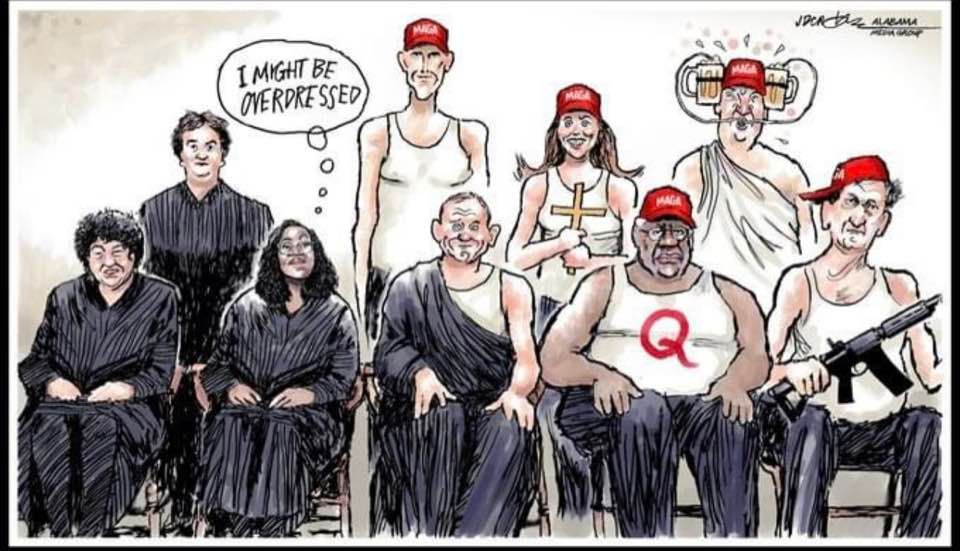
Today’s cartoon —

These past few days have been really discouraging. The one bright spot has been that the January 6 committee is deliving on what was promised.

The Washington Post editorial board thinks that We can no longer avoid a criminal investigation into Donald Trump. David Rohde writes at The New Yorker that A Potential Criminal Prosecution of Donald Trump Is Growing Closer. See also the Boston Globe editorial board.

We can dream.

SCOTUS Threatens the Planet

As previously predicted, the SOTUS has issued a ruling today that cripples the EPA and limits its power to fight climate change.

Hey, they didn’t have greenhouse gas emissions in the 18th century, right?

Here is the decision, West Virginia et al. v. Environmental Protecction Agency et al. I haven’t had time to read it, and most of the commentary online right now was written before the decision was released. But Ja’han Jones at MSNBC anticipated that the decision “will likely threaten the very concept of a federal government.”

So, at the very moment we really ought to be having an all-hands-on-deck response to our looming planetary disaster, the SCOTUS doesn’t want fossil fuels regulated, because reasons.

Dahlia Lithwick: “This term, the high court has proved itself to be a kind of lethal combination of the History Channel and bazooka—if you’re taking the bar exam this summer, I would suggest that the answer to every constitutional law question is, quite reasonably, ‘facepalm.'”

Republicans, naturally, are very pleased. See Adam Liptak in the New York Times.

Ketanji Brown Jackson is being sworn in today. I’m really sorry she has to deal with this crap.

In other court corruption news, see Wisconsin Court Validates a Republican Strategy to Preserve Power.

Vintage illustration French cartoon, Caricature of an old Judge, 19th Century


Surprise Mystery J6 Hearing Today! 1 pm EST!

Also, today there are primaries in Colorado, Illinois, Mississippi, Nebraska, New York, Oklahoma, South Carolina, and Utah. See Steve Benen for analysis. Getting Illinois over with will be a particular relief for me, I must say. The television ads for the Republican candidates have been disturbing.

Politico is reporting that the mystery witness is Cassidy Hutchinson, a onetime top aide to former White House Chief of Staff Mark Meadows. She knows a lot about what was going on in the White House before, during, and after January 6. This could be juicy.

Politico also says that “Hutchinson replaced her attorney earlier this month as the select committee’s hearings began; her former attorney was the Trump White House’s chief ethics lawyer, and her new attorney is a longtime ally of former Attorney General Jeff Sessions.”

As ever, this is an open thread for commenting before, during and after the hearing.

See Trump reporters react to January 6 hearings. Your brain will hurt.

Update: Well, that was fun. But I want to know if we can make Trump pay for all the White House dishes he smashed while throwing temper tantrums.

We learned that Trump supporters attending the January 6 rally at the Ellipse came heavily armed. “Trump supporters gathering at the Ellipse for the president’s speech had been seen by law enforcement and Secret Service agents carrying guns, including AR-15s and Glocks,” it says here.

But Trump was upset because he wanted more people crammed into the Ellipse — better optics! — and apparently people were hesitating to go through the metal detectors. Understandably.

Trump was described by Hutchinson as similarly unworried about his supporters carrying firearms; he was mostly angry that magnetometers used to screen rallygoers were blocking some of his armed supporters from getting inside the rally grounds. And that would hurt Trump’s larger aim: creating a photo op of a very large crowd gathered to hear him speak.

So, it says here, Hutchinson testified that Trump said something to the effect of, “‘I don’t fucking care that they have weapons. They’re not here to hurt me. Take the fucking [magnometers] away. Let my people in. They can march to the Capitol from here.”

So he was okay with armed people marching on the Capitol. They weren’t going to hurt him, after all.

Trump also apparently did intend to go to the Capitol and presumably show up in the room where the Electoral College votes were being tallied. He was advised this would break several laws, but he didn’t care. He ordered the presidential limo to be driven to the Capitol, and when he was refused he started to tussle with the driver and with a Secret Service agent.

I personally am sorry they didn’t let him go. Imagine how much trouble he would have gotten himself into.

Can Secret Service agents be forced to testify? Clinton’s was.

Mark Meadows (and Rudy Giuliani) asked for a presidential pardon. Mark Meadows is not looking good right now.

Liz Cheney produced evidence of attempts at witness tampering of the January 6 committee witnesses.

I think those were the highlights.

More Atrocities from the Supreme court

I am just now learning that on Thursday the Supreme Court issued a ruling that limits Miranda rights. Thursday was the same day they struck down New York’s concealed carry law, which of course got all the headlines. In a normal world, however, a change to Miranda would have been huge news.

The Miranda case was Vega v. Tekoh. The decision did not eliminate the Miranda rule outright, but it seems to me that it does eliminate it in effect. As Justice Kagan explained in her dissent, defendants now have no way to seek remedy if an un-Mirandized statement is used against them in court. Law enforcement cannot be sued for failing to respect Miranda. A court still is not supposed to use a statement obtained by abuse of the defendant without a lawyer present, but if it does, well, tough.

Kagan wrote,

“Today, the Court strips individuals of the ability to seek a remedy for violations of the right recognized in Miranda. The majority observes that defendants may still seek ‘the suppression at trial of statements obtained’ in violation of Miranda’s procedures. But sometimes, such a statement will not be suppressed. And sometimes, as a result, a defendant will be wrongly convicted and spend years in prison. He may succeed, on appeal or in habeas, in getting the conviction reversed. But then, what remedy does he have for all the harm he has suffered? The point of § 1983 is to provide such redress—because a remedy ‘is a vital component of any scheme for vindicating cherished constitutional guarantees.’ The majority here, as elsewhere, injures the right by denying the remedy.”

I’m guessing that stripping Miranda of teeth is something from the Federalist Society’s wish list.

Still to come: In a decision that could be issued this coming week, SCOTUS is expected to put limits on the ability of the EPA to limit carbon emissions at power plants. And that’s possibly not all.

Legal experts are waiting to see if the ruling in West Virginia v. EPA begins to chip away at the ability of federal agencies — all of them, not just EPA — to write and enforce regulations. It would foreshadow a power shift with profound consequences, not just for climate policy but virtually everything the executive branch does, from directing air traffic to protecting investors.

Imagine. The SCOTUS would be weakening government from doing much of anything that protects citizens. It’s as if we are not supposed to be able to govern ourselves. We’re living in an imperium per iudices, I tell you.

So at a time when gun violence is a huge national concern, SCOTUS limits the government’s powers to regulate firearms. When climate change threatens to destroy the planet, SCOTUS is expected to limit the government’s powers to reduce greenhouse gases. Let’s hope they don’t do that, but we’ll see. It seems we’re not allowed to use our government to address 21st century problems

Back in 2010 I wrote a post titled Constitutional Trial and Error that argued for a living Constitution, not a dead one. The Founding Fathers gave us an outline of government that succeeding generations could apply to their own circumstances to govern themselves, I said. And making the Constitution work in the real world involved a lot of trial and error even in the early years of our republic, when the guys who wrote it were still alive. The Constitution didn’t explicitly give government power to do a lot of things it does now, like build highways and print paper money. It didn’t even explicitly say the Supreme Court was the final arbiter of what the Constitution meant; that came about through the Marbury case in 1803, and the notion didn’t completely take hold until much later in the 19th century, Eventually people figured out what worked and what didn’t, and precedents developed.

When the Constitution was written there were no railroads, no airlines, no energy grid, no Internet, no such thing as outsourced jobs, and people didn’t know what germs were. Yet the “originalists” on the Court insist we are limited to addressing only conditions that existed in the 18th century? See my 2020 post on Originalism, A Tyranny of the Dead.

In fact, the Originalists are crappy historians. Do see The Supreme Court’s Faux ‘Originalism’ by Joshua Zeitz at Politico; it’s excellent. The Court’s decisions on firearm rights from Heller (2006) on are based on historical ignorance. The right to bear arms was very much tied to service in the militia, which from the Colonial period and through the time of the Articles of Confederation and in the early constitutional republic was the main defense from invasion and insurrection.

At the time the Constitution was written the entire U.S. regular military consisted of a standing army of maybe 600 officers and men and a naval fleet of six wooden frigates. And it had a huge territory to defend. Were it not for the buffer created by the Atlantic Ocean just about any European power could have crushed us. The militia was created by Congress under the authority given it in the Constitution (Aticle I, Section 8, clauses 15 and 16) to provide defense. And it really was well regulated. It wasn’t just any collection of meatballs wearing camo and waving assault weapons around. Per the Militia Acts passed in 1792 all white men between the ages of 18 and 45 were required to enroll in the militia, and they were also required to obtain and maintain their own regulation arms so they would be ready to fight. If you know this, the militia clause in the 2nd Amendment makes some sense. Obviously, if someone could stop citizens from being armed, this would weaken the millitia.

And since the militia eventually became the National Guard, which is not self-armed, one could argue that the 2nd Amendment no longer serves its original purpose. But the current “originalist” justices ignore the militia clause and the history behind it and just go right to “shall not be infringed.”

Likewise, per English common law of the time, abortions were legal in the American Colonies until the time of quickening, which is when the fetus can be felt moving. This is roughly at 12 to 15 weeks gestation, although it could be much later. But Justice Alito completely ignores this bit of history and instead takes his legal precedence from some 17th century guy who sentenced witches to be burned at the stake to argue that abortion was never part of U.S. history or tradition, so it can’t possibly be a protected right.

We’re living in an imperium per iudices, and the iudices are wackjobs.

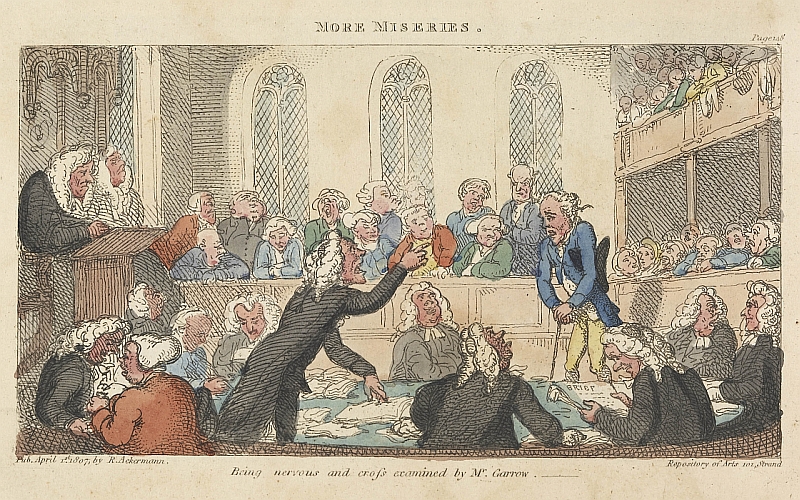
An 18th century trial.