One More Atrocity from the Supreme Court

Today the SCOTUS issued a decision that will allow public school coaches and teachers to bully and intimidate students into participating in prayers against their will. This is what passes for “freedom of religion” in the imperium per iudices of the United States.

I wrote about Kennedy v. Bremerton School District in April, when the Court heard the case. See SCOTUS, Culture Warriors, and School Prayer for background.

The majority opinion was written by Justice Gorsuch, and Ian Millhiser writes at Vox that Gorsuch misrepresented the facts of the case. (This is the pattern with this Court; if the facts don’t support how you want to rule, then change the facts.)

Moreover, because Gorsuch’s opinion relies so heavily on false facts, the Court does not actually decide what the Constitution has to say about a coach who ostentatiously prays in the presence of students and the public. Instead, it decides a fabricated case about a coach who merely engaged in “private” and “quiet” prayer. …

… In the real case that was actually before the Supreme Court, Coach Kennedy incorporated “motivational” prayers into his coaching. Eventually, these prayers matured into public, after-game sessions, where both Kennedy’s players and players on the other team would kneel around Kennedy as he held up helmets from both teams and led students in prayer.

After games, Kennedy would also walk out to the 50-yard line, where he would kneel and pray in front of students and spectators. Initially, he did so alone, but after a few games students started to join him — eventually, a majority of his players did so. One parent complained to the school district that his son “felt compelled to participate,” despite being an atheist, because the student feared “he wouldn’t get to play as much if he didn’t participate.”

See A coach coerced students to pray, and the Supreme Court just said it was OK by Paul Peterson, father of four former Bremerton High School students.

It’s not the job of coaches or teachers to lead schoolchildren in prayer or coerce them, whether explicitly or implicitly, to join in religious activities. Students and their families, not public school employees, get to decide their religious practices and beliefs. Religious indoctrination is not the instruction that I or the parents I know want the public school involved in.

Well, yes. The issue was never that the coach was seen saying prayers on the 50 yard line; it was that team members were coerced into joining the prayers. And some of the players felt uncomfortable with this, because the prayers didn’t reflect their religious views.

“There is no indication in the record,” Gorsuch wrote, “that anyone expressed any coercion concerns to the District about the quiet, postgame prayers that Mr. Kennedy asked to continue and that led to his suspension.” Perhaps the Justice overlooked the amicus brief joined by parents like Paul Peterson, who felt that Kennedy’s prayers were coercive and out of bounds. Mark Joseph Stern reported,

The plaintiff’s lawyers insist that he was fired from his job as a football coach for engaging in “quiet, private prayer” at the 50-yard line after games. The extensive record developed in the district court tells a different story. It demonstrates that Kennedy formed prayer circles with team members after each game, leading the students in audible Christian prayer while in the midst of his formal duties. When the school district asked him to pray privately instead, he claimed he had been persecuted for his religious exercise.

Kennedy hired far-right lawyers who threatened legal action against the school district, transforming the postgame ritual into a media spectacle. Eventually, students began racing onto the field to join the prayer circle, creating a 500-person stampede that injured multiple people. Put simply, there was nothing “quiet” or “private” about Kennedy’s proselytization. (Also, he wasn’t fired; he was placed on paid leave.)

Not every member of the football team shared their coach’s Christian faith. But virtually all of them felt compelled to participate. Team members later explained that praying with Kennedy was “expected.” The coach even encouraged his own players to recruit their opponents and their coaches into the prayer circle. Some students joined in only because they feared they “wouldn’t get to play as much” if they declined, or because “they did not wish to separate themselves from the team.”

One member of the football team during Kennedy’s tenure, who came forward under a pseudonym for fear of retaliation, attested that he refused to bow his head because Kennedy’s prayers did not align with his own beliefs. He was then “persecuted” for failing to conform, treated poorly by the coaches and permitted to play only because of his talent on the field. The experience still haunts him, as well as others who felt queasy about the indoctrination they faced at school. These players, the student said, “would rather forget about that time of their life.”

Kennedy hired far-right lawyers who threatened legal action against the school district, transforming the postgame ritual into a media spectacle. Eventually, students began racing onto the field to join the prayer circle, creating a 500-person stampede that injured multiple people. Put simply, there was nothing “quiet” or “private” about Kennedy’s proselytization. (Also, he wasn’t fired; he was placed on paid leave.)

Not every member of the football team shared their coach’s Christian faith. But virtually all of them felt compelled to participate. Team members later explained that praying with Kennedy was “expected.” The coach even encouraged his own players to recruit their opponents and their coaches into the prayer circle. Some students joined in only because they feared they “wouldn’t get to play as much” if they declined, or because “they did not wish to separate themselves from the team.”

Christian nationalism, here we come.
The Electoral College: Its Hour Come Round at Last?

It’s enormously unlikely that the current Russian hacker flap is going to stop Donald Trump from being inaugurated, but if he is stopped, it’s my understanding it can only happen in the Electoral College. So let’s take a look.

Why Is There an Electoral College? The Founders were opposed to electing presidents by popular national vote, mostly because they figured each state would just vote for its own “favorite son.” They considered having presidents chosen by Congress or by state legislatures. They finally settled on Electors, however, who were supposed to be really smart guys who would choose a president based purely on merit, and without consideration of partisan politics.

The best sense of what the Founders were thinking might be gleaned from Alexander Hamilton’s Federalist #68, in which he expounds in his overwritten way that

It was desirable that the sense of the people should operate in the choice of the person to whom so important a trust was to be confided. This end will be answered by committing the right of making it, not to any preestablished body, but to men chosen by the people for the special purpose, and at the particular conjuncture.

It was equally desirable, that the immediate election should be made by men most capable of analyzing the qualities adapted to the station, and acting under circumstances favorable to deliberation, and to a judicious combination of all the reasons and inducements which were proper to govern their choice. A small number of persons, selected by their fellow-citizens from the general mass, will be most likely to possess the information and discernment requisite to such complicated investigations.

Hamilton goes on to explain that each state would somehow choose a committee of electors who would convene only once, for one purpose only, and that is to choose a president. In this way this crew would be less subject to being bribed or being under the influence of foreign powers.

The Constitution didn’t specify how the states chose their Electors. I understand that, at first, most of the time they were chosen by state legislatures.

How Was the Electoral College Supposed to Function? In the original wording in the Constitution, Electors were to vote for two people, at least one of whom was not from his state. Then as now, the Electors don’t meet in one place, but within their own states, to vote. The votes were sent in a sealed envelope to the President of the Senate (who would be the sitting Vice President). The votes were to be counted in front of the Senate and House of Representatives. In brief, whoever got the most votes was POTUS and whoever came in second was VPOTUS.

Well, that didn’t last long.  The 12th Amendment, ratified in 1804, provides that Electors vote separately for a president and a vice president. It also provides that if no one candidate receives a majority of all votes (currently the magic 270 number), the House of Representatives chooses the POTUS from among the top three contenders, and the Senate chooses the VPOTUS.

Other than the original provision of voting for one person not from their states, the Constitution places no restrictions on the Electors about whom they can vote for, other than the qualification requirements:

No Person except a natural born Citizen, or a Citizen of the United States, at the time of the Adoption of this Constitution, shall be eligible to the Office of President; neither shall any Person be eligible to that Office who shall not have attained to the Age of thirty five Years, and been fourteen Years a Resident within the United States.

One little archaic constitutional vestige I did not know — to this day, an Elector cannot vote for a president and vice presidential candidate from his own state. One candidate is okay, but not both. So if both the presidential and vice presidential candidates were from Pennsylvania, for example, the Pennsylvania Electors would have to abstain.

And that’s where the U.S. Constitution stands on the matter of the Electors and choosing a president.

The Electoral College Today. Today,  of course, people vote for presidential candidates, and then Electors go through the motions of choosing the POTUS as outlined in the 12th Amendment. That way of doing things evolved pretty quickly in the 19th century, rendering the Electoral College vote into a meaningless, archaic ritual. Lots of amendments have been proposed to get rid of the Electoral College. Obviously, none have gotten very far.

The Electors are chosen by the parties, usually in state party conventions. Some are chosen by state party central committees. A handful of states use other methods — they are appointed by the governor, for example, or even appointed by the presidential nominee him- or herself. The point is that they are people chosen not for their wisdom, but for their loyalty to the party.

There are two aspects of today’s Electoral College that are problematic.

One is the “winner take all” method of choosing Electors that all but two states have adopted. This is not in the Constitution at all, and it’s this factor that makes it mathematically possible for one candidate to have a respectable popular vote majority and still lose the Electoral College. If the Electors were chosen in a proportional way, that’s much less likely to happen. Lawrence Lessig has been arguing that the “winner take all” thing is unconstitutional. However, his argument is based on the Court’s “reasoning” in Bush v. Gore, and there are those who don’t buy it.

Still, while we may be stuck with the Electoral College itself — the less populated states like it, because it gives them a disproportional voice in presidential elections — if someday the winner-take-all practice could be done away with, the Electoral College would more accurately reflect the popular vote.

The other “new” aspect is the binding of the Elector’s votes. Twenty-nine states have made it a felony for an Elector to go rogue and not vote according to his state’s vote. In practice, such “faithless” Electors are very rare and are usually only given a small fine, but they could be penalized more harshly.

Over the years, many constitutional scholars have said that the state “binding” laws are blatantly unconstitutional, and that the Electors must be free to vote as they choose. It was clearly the intent of the guys who wrote the Constitution for the Electors, not the people by popular vote, to choose the president. And while we may think that’s stupid, it hasn’t been amended. The Constitution still says that.

And it was also the clear intent of the guys who wrote the Constitution for the Electoral College to be a bulwark against “cabal, intrigue, and corruption,” as Hamilton put it:

These most deadly adversaries of republican government might naturally have been expected to make their approaches from more than one quarter, but chiefly from the desire in foreign powers to gain an improper ascendant in our councils. How could they better gratify this, than by raising a creature of their own to the chief magistracy of the Union?

This is the very corruption that the Electoral College is supposed to prevent. The masses of the people may be swayed by passions fired up by demagogues, but the wise and level-headed Electors are supposed to be the ones who make the final decision. Or that’s how the Founding Guys imagined it would work, anyway.

If there was ever a time for the Electors to carry out their Constitutional duties and make their own choice for POTUS, this would be it. And if they don’t, then the Electoral College really has utterly failed in the duty it was given.

Blocking Trump wouldn’t necessarily give the election to Hillary Clinton, since the Electors can vote for anybody. If enough of them voted in a way that denied the majority to Donald Trump — say, by choosing Gary Johnson –  the election would go to the House. The House must choose among the three top vote getters. And since we’re talking about the House, that wouldn’t be Clinton. But maybe it wouldn’t be Trump, either.

(For an interesting take on what a mess that could turn out to be, see “Deadlock: What Happens If Nobody Wins” by Laurence H. Tribe and Thomas M. Rollins, from the October 1980 Atlantic.)

I’m hearing a lot of talk on social media that maybe a court could void the election. Courts have voided Senate elections a couple of times, apparently. But I don’t think any court would touch this mess with a thousand-foot pole, especially since the Constitution provides for the Electors or the House to make the final decision in the case of presidents. (And there is no provision whatsoever for re-doing an election, for any reason, which is another rumor I saw somewhere. )

The Electoral College vote is scheduled for Monday, December 19. Chances are Trump will at least get his 270 votes and be inaugurated. But we can dream …

Appeals Court Reinstates Same-Sex Marriage Bans

Yesterday a federal appeals court in Cincinnati reversed lower-court decisions that voided same-sex marriage bans in Kentucky, Michigan, Ohio, and Tennessee.

I believe this is the first genuine break in the streak of court decisions that have struck down same-sex marriage bans. Just yesterday I ran into a list of 22 states in which either federal courts or state supreme courts had voided such bans. The site Freedom to Marry keeps an updated account of where marriage equality stands in the states. Same-sex marriage currently is legal in 32 states, and courts had cleared the way for marriage equality in several other states.

Lyle Denniston at SCOTUSblog has the most detailed account of yesterday’s decision, by the Sixth Circuit Court of Appeals, I’ve seen so far. The primary difference between yesterday’s decisions and the previous ones is that the Sixth Circuit upheld the states’ sovereignty on matters of marriage, and said federal courts had no bearing to countermand a state decision on marriage. The Sixth also said there is no right to marry. And this sets up an interesting contrast in legal thought.

As I understand it, some of the judges who have struck down the bans view marriage as a right of U.S. citizens that states cannot infringe. Others (see especially Judge Richard Poster’s very readable argument) basically say that the states’ reasons for banning same-sex marriage are irrational and blatantly discriminatory. Judge Posner wrote,

To return to where we started in this opinion, more than unsupported conjecture that same-sex marriage will harm heterosexual marriage or children or any other valid and important interest of a state is necessary to justify discrimination on the basis of sexual orientation.

As we have been at pains to explain, the grounds advanced by Indiana and Wisconsin for their discriminatory policies are not only conjectural; they are totally implausible.

The Sixth Circuit decision directly disagrees with Posner on some points. Posner said that “tradition” per se carries no weight, that delaying to change laws because there may be some unforeseen bad consequence to the law is not a valid excuse, and that there is no evidence children are harmed by being raised by same-sex parents. The Sixth apparently disagrees with all of those points, saying the states have a legitimate role in protecting children and that states have a right to “wait and see’ what happens elsewhere before enacting a change themselves. Also unlike Posner, the Sixth denied there was any evidence the law was based on animus to homosexuals.

Of course not. And jokes involving the President and watermelons are not racist. Sure.

Lyle Denniston writes that the Sixth also denies that homosexuals are a “discrete class deserving of special constitutional protection as historic targets of discrimination.”

The most obviously flimsy part of this decision is that it also denies that states have any obligation to recognize same-sex marriages of other states, which seems to me to fly right in the face of the Full Faith and Credit clause of Article IV Section 1.

Several articles today say that this decision almost certainly sets up a Supreme Court test. Justice Ruth Bader Ginsburg had already said awhile back that if the Sixth upheld the bans, bring it on, dudes. Well, not those exact words. How the Court might decide is uncertain, especially after the U.S. v. Windsor decision that struck down the Defense of Marriage Act (5-4, Usual Suspects with Kennedy swinging toward the liberals). I can see Justice Roberts having to decide which outcome would stir up the bigger hornets’ nest.

Update: Kenneth Jost, an adjunct professor of law at Georgetwon, rips the Sixth Circuit Court’s decision apart, and says the badly argued decision may prove to be a “blessing in disguise” for advocates of marriage equality.

Texas vs. the First Amendment

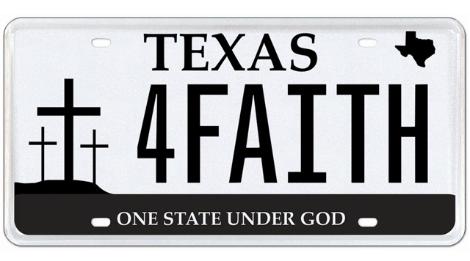
Once again demonstrating they don’t know the Bill of Rights from Longhorn Pie, the state of Texas has approved this vanity plate design:

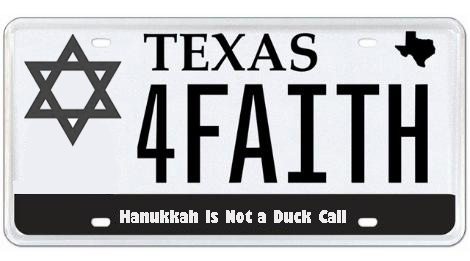
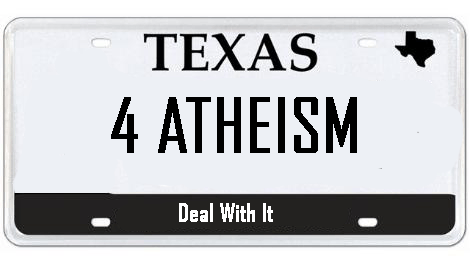
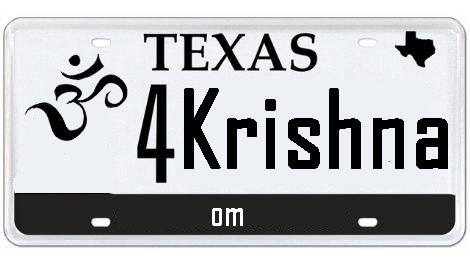
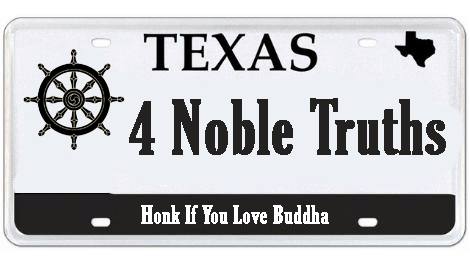
Of course, to be in constitutional compliance Texas would have to offer plates for people who are not Christian. I’m betting a few live in Texas. I’m proposing the following designs:

Of course, actually putting one of the alternative plates on one’s car would no doubt incite some born-again yahoo to slash one’s tires.

To Texas’s credit, it nixed a Confederate flag plate proposed by the Sons of Confederate Veterans. I understand the Sons are suing.