Thanks to Trump, We Have No Good Options

Treasury Secretary Steven Mnuchin and Federal Reserve chair Jerome H. Powell are testifying to the Senate Banking Committee today.

Mnuchin warned that there would be “risk of permanent damage” to the economy if businesses do not re-open right away. This is the same guy who has been sitting on billions of dollars in stimulus funds since March, but he hasn’t gotten around to disbursing most of it. This was a major point of concern for some senators.

The Fed is in the process of rolling out a series of emergency lending programs to keep credit flowing into the economy.

More recently, it has announced five new or revamped programs that will be backed by $195 billion in funding, focused on large corporations, the municipal bond market, midsize businesses and asset-backed securities, which are essentially bundles of loans built on students loans, credit cards and other types of debt.

Of those programs, only a portion of one of the corporate credit facilities is up and running. The various facilities have taken time to design, because they are legally complex and have never before been attempted.

Lawmakers repeatedly urged Mr. Mnuchin and Mr. Powell to get the midsize business “Main Street” facility up quickly. Mr. Powell faced questions over why the corporate programs were helping shakier large companies.

“You’ve pointed out that most of the people being hurt are those earning less than $40,000 a year,” said Senator Chris Van Hollen, a Maryland Democrat. “It’s not clear to me how putting money into junk bonds is helping Main Street.”

There were also concerns about the safety of workers.

Sen. Sherrod Brown (D-Ohio) pressed Mnuchin on the White House’s push to rapidly reopen parts of the economy even as health care advisers have urged more caution.

“How many workers should give their lives to increase our [gross domestic product] by half a percent?” Brown asked Mnuchin.

For the record, Mnuchin didn’t think it was a fair question. But this is the question of the moment — the economy versus lives. Which do we prioritize? Yes, the nation is taking a terrible economic hit, and the longer the restrictions continue, the worse the damage will be. And yes, this is causing terrible stress and harm to millions of individuals who are suddenly without a paycheck. Hey, I’ve been there; I know what being suddenly laid off feels like. It’s a real punch in the gut.

On the other hand, the science guys tell us that if we move to reopen too soon, a lot of people will die who didn’t have to die. The virus is still out there, folks. And because we still don’t have adequate testing, we’re stumbling around in the dark. Maybe if we had better testing, we could be making informed decisions about how much economic activity can be restarted safely. But as it is, we’re all guessing.

The bottom line, as I see it, is that we have no good options. There is no visible course of action that will bring the jobs back in the next few weeks without risking lives. And we’re in this mess because we have no national leadership. The pandemic “response” has been grossly mismanaged from the very beginning and never got better. And that’s why we have no good options. People can argue economy versus lives until they turn purple. No matter what we do, we’ll be stumbling around between deprivation and death for the next several months. That’s just how it is. Do your best and stay safe.

There is no way we’re going to avoid a world of hurt for a lot more people. That would be true even if a miracle happened and we suddenly had a competent federal government going forward. But, unfortunately, Donald Trump is still POTUS. Corrupt wastes of space like Mnuchin are managing what policy Congress creates. Republicans who are opposed to spending that benefits workers — they think spending should only flow to their big-buck donors and themselves — still control the Senate. So it’s not going to get any better.

If we had shut down a lot sooner, if we had tested a lot more, if we could be throwing much more federal money at the states and cities and small businesses and the unemployed to decrease the damage, it wouldn’t be nearly so bad. But Trump is president and Mitch McConnell runs the Senate. So it’s a mess.

See also Max Boot, If Trump had been in charge during World War II, this column would be in German.

And then there are the governors. We’re getting clues that at least some of them are suppressing covid-19 data so that people don’t know how bad it is. Today we learned that the scientist in charge of providing covid-19 data for Florida was fired for refusing to manipulate the data. The Atlanta Journal-Constitution reported on similar shenanigans in Georgia. Georgia’s coronavirus numbers looked good because officials misrepresented the data. See also Georgia’s coronavirus data made reopening look safe. The numbers were a lie.

I’ve written about little else but the pandemic, and Trump’s non-response to it, for the past several weeks. I believe this is truly the biggest failure of leadership in U.S. history.  I’m glad to see at least one pundit who has come around to my view of why Trump has been such a disaster — that he is too bleeping stupid to have any idea what is going on.

Why did Trump keep offering estimates so unrealistically low that they were overtaken by events mere weeks later, exposing him to mockery and providing fodder for attack ads? Lies are typically self-serving. Those statements were not. If he was trying to lowball death estimates so that Americans would reelect him, he needed to pick a number that wouldn’t be exceeded until after Election Day. Whether he intended to lie or attempted to tell the truth, he showed an inability to think just weeks ahead in an emergency that could last months or years.

Similarly, why did Trump declare that the virus would disappear when its spread was imminent? Why did he say we’re close to a vaccine when Americans are unlikely to get one before Election Day? Why did he suggest that injecting a disinfectant into the body might cure COVID-19? I used to worry that Trump’s serial mendacity might harm the nation. Now I worry even more that he isn’t lying, but rather lacks the capacity to see errors in the most obvious falsehoods. He appears to be so impulsive and attuned to the time horizon of an individual tweet, television appearance, or news cycle that he cannot strategize over a longer period.

If I believed in an anthropomorphic God, I’d be arguing that God sent the coronavirus to reveal Trump’s spectacular ineptitude so that he wouldn’t be elected again.

“Is it — does it remind you of something? Reminds you of this. Right? Ones a swab, ones a Q-tip. It’s actually different. It’s very sophisticated actually but it’s a little bit like — so this is the swab and we’ve ordered a lot of them.” Actual Trump quote from April 19 press briefing.
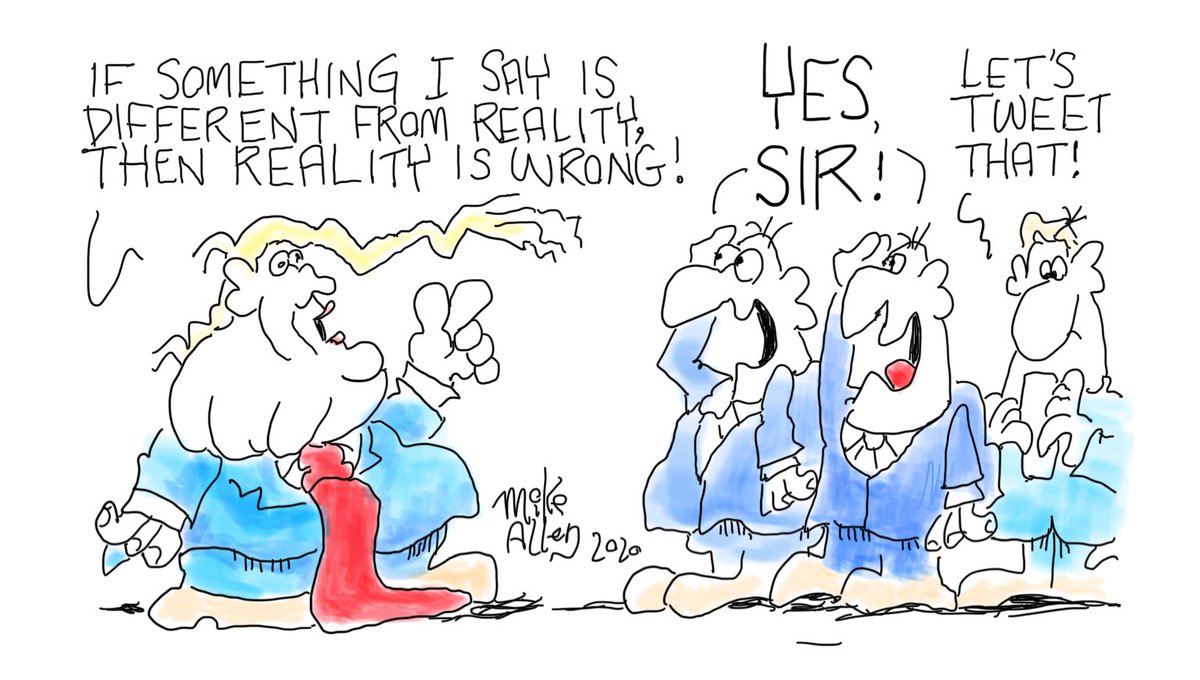
What Ought to Scare You Right Now

Item One: You’ve probably heard that State Department Inspector General Steve Linick, who was fired Friday night, was terminated at the request of Secretary of State Mike Pompeo. It was also widely reported that Linick was looking into allegations that Pompeo is using State Department staff to run personal errands — walk his dog, pick up his dry cleaning, that sort of thing.

But it gets worse. Greg Sargent:

House Democrats have discovered that the fired IG had mostly completed an investigation into Secretary of State Mike Pompeo’s widely criticized decision to skirt Congress with an emergency declaration to approve billions of dollars in arms sales to Saudi Arabia last year, aides on the Foreign Affairs Committee tell me.

“I have learned that there may be another reason for Mr. Linick’s firing,” Rep. Eliot L. Engel (D-N.Y.), the chair of the Foreign Affairs Committee, said in a statement sent to me. “His office was investigating — at my request — Trump’s phony declaration of an emergency so he could send weapons to Saudi Arabia.”

Committee Democrats have also learned that the State Department was recently briefed on the IG’s conclusions in that investigation, aides say. They do not know what role this investigation — and its conclusions — played in Linick’s removal, if any.

Zachary Cohen, CNN:

Secretary of State Mike Pompeo refused to sit for an interview with the State Department inspector general’s office as part of its probe into the administration’s move to bypass Congress and expedite last year’s $8 billion arms sale to Saudi Arabia by declaring an emergency, a congressional aide told CNN Monday. …

…Last May, the Trump administration declared an emergency to bypass Congress and expedite billions of dollars in arms sales to various countries — including Saudi Arabia and the United Arab Emirates — citing the need to deter what it called “the malign influence” of Iran throughout the Middle East.

“These sales will support our allies, enhance Middle East stability, and help these nations to deter and defend themselves from the Islamic Republic of Iran,” Pompeo said in a statement at the time, which put the value of the sales at $8.1 billion.

But the move drew bipartisan condemnation, with lawmakers decrying the precedent it sets, questioning the administration’s claims of an emergency and raising the issue of Saudi Arabia’s human rights record and the killing of journalist Jamal Khashoggi.

Bloomberg News:

While the White House has offered no public details about what may have been behind the firing, Pompeo told the Washington Post that Linick wasn’t helping make the State Department “better.”

“I went to the president and made clear to him that Inspector General Linick wasn’t performing a function in a way that we had tried to get him to,” Pompeo said in the interview.

I have no doubt Linick wasn’t performing as Pompeo wanted him to. I’m sure Trump agreed. And it stinks out loud. See also Jennifer Rubin, Mike Pompeo’s scandals big and small erode his dwindling credibility.

Item Two: Republicans are organizing their voter suppression efforts. Michael Wines, The New York Times:

Six months before a presidential election in which turnout could matter more than persuasion, the Republican Party, the Trump campaign and conservative activists are mounting an aggressive national effort to shape who gets to vote in November — and whose ballots are counted.

Its premise is that a Republican victory in November is imperiled by widespread voter fraud, a baseless charge embraced by President Trump but repeatedly debunked by research. Democrats and voting rights advocates say the driving factor is politics, not fraud — especially since Mr. Trump’s narrow win in 2016 underscored the potentially crucial value of depressing turnout by Democrats, particularly minorities.

The Republican program, which has gained steam in recent weeks, envisions recruiting up to 50,000 volunteers in 15 key states to monitor polling places and challenge ballots and voters deemed suspicious. That is part of a $20 million plan that also allots millions to challenge lawsuits by Democrats and voting-rights advocates seeking to loosen state restrictions on balloting. The party and its allies also intend to use advertising, the internet and Mr. Trump’s command of the airwaves to cast Democrats as agents of election theft.

You should read the whole article, and also read Charles Pierce’s commentary on the article.

Item Three: This one might not scare you, but it’s worth a WTF? Remember the half trillion Treasury slush fund the “administration” planned to hand out with minimal oversight? The Washington Post reports that most of that fund, created in March, is still sitting around at the Treasury Department, unused.

A $500 billion Treasury Department fund created by the Cares Act in March to help stabilize the economy has lent barely any money, according to an initial report issued by a Congressional Oversight Commission created by the law….

… The report describes the lending facilities the Treasury Department has created to operate through the Federal Reserve, and says that only one of them has received funding. It is called the Secondary Market Corporate Credit Facility and is supposed to purchase corporate debt. It has received $37.5 billion.

The $500 billion Treasury fund also set aside $46 billion to make loans and loan guarantees to the airline industry. None of that money has been disbursed.

The Treasury has announced more programs in the works to disburse more of the money, including a Main Street Lending Program that is supposed to help small and medium-size businesses. But Treasury is still piddling around trying to decide what the qualifications and parameters for the program will be. Meanwhile, small and medium-size businesses are failing by the minute. No rush or anything, guys.

The Congressional Oversight Commission that wrote the report still doesn’t have a chair, btw.

From Hoovervilles to Trumpvilles?

Herbert Hoover / Donald Trump  https://www.axios.com/donald-trump-hoover-white-house-c5b08e12-b2e6-4669-b6ee-992f9136a1e0.html

A lot of people are remembering FDR’s New Deal these days. But Kevin McDermott, a columnist for the St. Louis Post-Dispatch, looks back a bit further at Herbert Hoover: Facing another Great Depression, conservative thought is stuck in 1929.

When, for example, Congress sent Hoover a $2.3 billion plan that included public works programs and loans to small businesses and individuals, he derided it as “pork” and vetoed it. “Economic depression cannot be cured by legislative action,” he once declared.

Hoover opposed direct government aid to individuals, leaning instead on tax cuts, import tariffs (which backfired, prompting devastating retaliatory tariffs from America’s trading partners) and repeated assurances to the nation that, as he put it in 1930, “The worst is behind us.”

Is any of this sounding familiar?

For decades conservative propagandists have insisted the New Deal did not work at all, and that the Great Depression was ended by World War II; the New Deal, they say, had nothing to do with it. The truth is that the economy did grow after FDR became president in 1933 —

The time series of real GDP during the period 1929 through 1940. HERSH SHEFRIN https://www.forbes.com/sites/hershshefrin/2020/04/12/great-depression-economics-101-what-historical-numbers-and-charts-from-the-great-depression-foretell-about-the-economy-and-stock-market/#536e761b1e3c

It’s believed that dip in 1938 happened because FDR scaled back New Deal programs and spending in 1937. When the economy sagged, the spending was cranked up again. See Paul Krugman, New Deal economics, who explains the New Deal better than I can.

And conservatives don’t ask themselves how it is a war ended a depression. The answer is, the military build up necessitated by World War II was the New Deal on steroids — massive government spending that created jobs and put a lot of money in the hands of ordinary people, who then went out and bought new stuff. Again, Paul Krugman explains this better than I can. The problem with the New Deal, Krugman argues, is that it didn’t go big enough until pushed into more spending to take on the Axis Powers.

Back to Kevin McDermott:

Congressional Democrats last week unveiled a $3 trillion proposal that goes beyond bandages. It addresses the havoc individual Americans face in areas like health care, rent and mortgage payments and student loan debt, while providing almost $1 trillion to state and local governments to prevent additional waves of layoffs. Other big ideas are out there as well, some from within the GOP. Missouri Republican Sen. Josh Hawley’s proposal to mostly cover small-business payrolls for sheltered workers could be a far better use of federal dollars than waiting until those workers are unemployed.

Mitch McConnell is having none of it. “We have not yet felt the urgency of acting immediately,” the Republican Senate majority leader told reporters last week. “That time could develop, but I don’t think it has yet.”

What is he waiting for? Pearl Harbor?

The recently passed House bill is the HEROES Act.

The 1,800-page HEROES Act is an opening offer of Democratic priorities, starting with nearly $1 trillion in direct aid to state and local governments dealing with the fallout of the coronavirus pandemic. It would also include another round of $1,200 stimulus checks for eligible Americans (those making less than $75,000 per year). The HEROES Act provides $75 billion in mortgage relief, $100 billion for rental assistance, and $75 billion for coronavirus testing. In addition to expanding unemployment insurance, it would also forgive some student loan debt and provide more pay to essential workers.

The bill has been criticized from the Left for not being generous enough, and from the Right for containing provisions that aren’t directly related to the pandemic. However, I’ve yet to see a list of what those provisions are.

For all his cheerleading to open up the economy again, I haven’t found a quote attibuted to Trump himself expressing an opinion on the HEROES bill. However, “the White House” says that if passed, the bill would be vetoed. In this, Trump truly is reinacting Herbert Hoover. Ironically, back in 2018 Mike Allen wrote at Axios that Trump feared being turned into Herbert Hoover by the inaction of Federal Reserve Chair Jerome H. Powell. Powell, you might remember, has an aversion to lowering interest rates to goose the economy when the economy doesn’t need goosing. But now Trump is doing a grand job of turning himself into Hoover without Powell’s help.

The shutdown is doing huge economic damage. Hale Stewart explains the damage here. Paul Krugman has been arguing that as bad as the damage is, to re-open and then experience a second wave would be even worse. Healing the economy depends on addressing the pandemic, which means testing and tracing, which Trump doesn’t want to do because too much testing makes him look bad. And we really could be looking at an all-out depression. So there we are. Screwed.

A Hooverville in New York City

Stuff to Read About Inspectors General

Just some links today; more tomorrow.

Aaron Blake, Trump’s slow-motion Friday night massacre of inspectors general

WaPo Reporters, Trump ramps up retaliatory purge with firing of State Department inspector general

Charlotte Klein, “Dangerous Pattern of Retaliation”: Trump Escalates War on Government Oversight With Late-Night Purge

Peter Wade, Watchdog Fired by Trump Was Investigating Pompeo, House Foreign Affairs Chair Says

Nathalie Baptiste, Trump Fires State Department Watchdog Who Provided Ukraine Documents to Congress

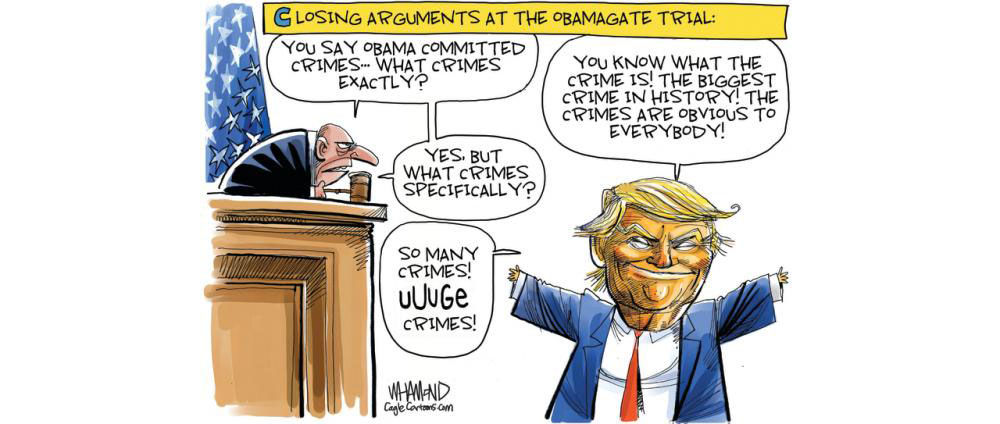
A Guide to Obamagate-gate

This exchange made news a few days ago.

Whatever Obamagate is, it’s still a big deal on Trump’s Twitter feed. This is from today.

So, what the bleep is he talking about? What is Obamagate? Fortunately, the definitive guide to Obamagate was written for the Washington Post by Alexandra Petri, and you should go there and read her column to fully appreciate what we’re talking about. Then come back.

Back now? Good. Now that we’re all clear about what Obamagate is, we need to consider what it represents to Donald J. Trump. Because he clearly is very worked up about it. David Graham at The Atlantic explains how it all began:

On May 9, CNN reported that Obama had labeled Trump’s pandemic response “an absolute chaotic disaster” the day before, on a call with alumni of his administration. Early the next morning, as part of a long string of Mother’s Day tweets—as these rants exceed themselves, it’s become more and more difficult to find superlatives to adequately describe them—Trump retweeted a user who had mentioned “Obamagate.” The term has quickly become part of Trump’s vernacular, with 13 subsequent uses, including two yesterday.

Precisely what Trump is alleging against Obama is obscure, and probably beside the point. Trump isn’t really interested in alleging any particular crime. The point of “Obamagate” is to try to recapture the force that propelled Trump to political prominence—questioning the legitimacy of the first black president—as he heads toward a difficult reelection campaign in the midst of a global crisis.

Graham calls Obamagate an extension of birtherism. Just as actual proof, including newspaper birth announcements and a long-form birth certificate, could not quell the belief that Barack Obama was born in Kenya and not Hawaii, Obamagate needs no support except the desperate belief that it must be true, whatever it is.

As near as any of us not living in the Trump universe can tell, Obamagate may have started out having something to do with the much-debunked (see also) claim that President Obama personally ordered a wiretap on Trump Tower. But now it is appears to be mostly tied in to the Michael Flynn prosecution and the “unmasking” of Michael Flynn in intelligence reports back in the late days of the Obama Administration. That Obama Administration officials did not know the identity of the person they wanted “unmasked” — the point of the “unmasking” was to see who was being talked about in the reports — kind of eludes the Trumpers. And such “unmasking” is a legal and even routine thing to do when intelligence agencies report hinky activity. But Trump has twisted this around into a conspiracy against him.

Susan Glasser in the New Yorker tells us that Obamagate makes perfect sense, to some:

To outside observers, the charges—like Trump’s original political sin, lying about the easily provable fact of Obama’s birth in the United States—seem so absurd as to be the mere caricature of a conspiracy, as sketched by a con man who couldn’t even bother to offer convincing details. The point, though, is not to convince those who aren’t already in the know. “Obamagate” is niche programming for the Trump superfan audience. If you don’t get it, that doesn’t matter; you’re not supposed to. It’s a slogan, a rallying cry. Details are all but irrelevant. At 8:57 p.m. on Wednesday, Trump sent out an all-caps tweet. The message consisted solely of the word “OBAMAGATE” followed by an exclamation point. To those not following Trump as a daily soap opera, it might seem like a desperate diversionary tactic from a floundering President. To his supporters, it made perfect sense. Which is why, when Trump followed up on Thursday morning with an equally angry and cryptic demand that Obama be called to testify before the Senate—about what was entirely unclear—news organizations mostly ignored him in favor of the morning’s testimony by the recently fired head of vaccines at the Department of Health and Human Services, or, as the Drudge Report called Richard Bright, the “whistleblower of doom.” Except for Fox News, that is, which obliged the President with a banner headline.

The lack of details is a feature, not a bug. If no facts are claimed, no facts can be disproved. David Frum:

The “Obamagate” that Trump tweets about—like the comic-book universes on which it seems to be modeled—is a tangle of backstories. The main characters do things for reasons that make no objective sense, things that can be decoded only by obsessive superfans on long Reddit threads.

So you’re saying that the deep state set up this whole elaborate plot to entrap Trump, but instead of using any of that material, it instead sabotaged Hillary Clinton 10 days before the election?

No, no, you don’t get it. You’ve gotta go back to the Benghazi episode four seasons back. Well, really to Troopergate, but that’s only available on DVD …

Now, you might wonder what good it does Trump to promote a scandal that only one’s superfans believe, when the majority of voters are not superfans. Throughout his “presidency,” Trump has shown total disinterest in expanding his base. Those other people don’t count. He may not understand that his base alone can’t re-elect him.

It has to be said that promoting baseless conspiracy theories worked for him before. Birtherism built his political base, and “but her emails” won for him in 2016. However, the endless congressional investigations and news coverage of the damn emails probably hurt Clinton more than anything Trump said. And it’s possible James Comey, not Trump, cost Clinton the election.

On the other hand, some elements of the press don’t seem to have learned the lessons of 2016. Greg Sargent:

The latest developments in the Michael Flynn case should prompt us to revisit one of the most glaring failures in political journalism, one that lends credibility to baseless narratives pushed for purely instrumental purposes, perversely rewarding bad-faith actors in the process.

News accounts constantly claim with no basis that new information “boosts” or “lends ammunition” to a particular political attack, or “raises new questions” about its target. These journalistic conventions are so all-pervasive that we barely notice them. …

…For instance, the Associated Press ran this headline: “Flynn case boosts Trump’s bid to undo Russia probe narrative.” Axios told us:

Biden’s presence on the list could turn it into an election year issue, though the document itself does not show any evidence of wrongdoing.

CNN informed us that this is “the latest salvo to discredit the FBI’s Russia investigation and accuse the previous administration of wrongdoing.”

But here’s the problem: These formulations do not constitute a neutral transmission of information, even though they are supposed to come across that way.

The new information actually does not “boost” Trump’s claims about the Russia investigation or “discredit” it. And if there is “no evidence of wrongdoing,” then it cannot legitimately be “turned into an election issue.”

There will be no House investigations, since Democrats control the House. But Trump has a corrupt Bill Barr and a compromised Justice Department at his disposal to at least engage in investigation theater. And, of course, Republicans still have the Senate. At least Miz Lindsey shot down Trump’s call to have President Obama testify before Congress.

In the end, we may have to hope that the American people will understand that Trump is just trying to change the subject from his pandemic failures. In 2016, Trump dominated election coverage. Now he has to share the stage with a virus.

Bleepity Bleep Microsoft

My PC was treated to one of those automatic updates first thing this morning, and I spent the rest of the morning and a chunk of the afternoon trying to make it work again. It’s back to normal now, and I need a nap.

Dr. Rick Bright testified to the House Health subcommittee today. Bright used to be head of the Department of Health and Human Services’ Biomedical Advanced Research and Development Authority. He says he was demoted because he criticized the administration’s “response” to the pandemic. Among other things he pointed out that the administration has no plan, as I said yesterday. Trump doesn’t do plans.

Here’s another analysis by Mona Charen that’s worth reading — All He Does Is Fight. Charen writes that Republicans decided to support Trump because he was such a dogged fighter. But it turns out that fight is all he does.

Since January, we have witnessed a vivid lesson in the limits of fighting. There were ample reasons before now to recoil from Trump’s style of combat. It is so consistently cruel, witless, below-the-belt, and unhinged (e.g. his recent tweets implying that MSNBC host Joe Scarborough is guilty of murder), that it tainted by association any reasonable arguments that might be advanced for conservative ideas. But in his handling of the coronavirus pandemic, we’ve witnessed that even when a dire emergency calls for traits other than bellicosity, fighting is all he knows how to do. This is proving to be a catastrophe for the nation, and also for Trump’s own self-interest.

He honestly doesn’t know how to address a problem to solve it. All he does is react in self-defense.

While the situation cried out for competent coordination and planning, for calm briefings with experts, he looked only for foils. He fought with Democrats, exclaiming on February 28 that “this is their new hoax.” He tangled with insufficiently “grateful” governors who asked for supplies. “I say . . . don’t call the governor of Washington. Don’t call the woman from Michigan.” He disparaged frontline medical professionals, wondering on March 29 whether they were stealing masks (“Are they going out the back door?”). He had a spat with congressional leadership in late February when they proposed an initial coronavirus package more than three times the size of Trump’s request (“Pelosi’s incompetent.” He’s “Cryin’ Chuck Schumer”). He reversed his previous gushing praise and began to blame China for the virus, encouraging the use of nicknames like “Wuhan virus.” He picked a fight with the Postal Service, poured out tweetstorms about his predecessor, whom he accused of dark crimes, and above all, from before dawn till after dark every single day, he battled the press.

In other news — Michigan closed down its capitol building today and canceled a legislative session rather than risk a confrontation with more armed protesters. Seriously, this has got to stop. It’s nothing but terrorism.

At The Atlantic Adam Serwer has a historical retrospective on birtherism that’s fascinating and relevant.

See also Jonathan Last and The Curious Case of the People Who Want to “Reopen” America—But Not Wear Masks. The people opposed to pandemic restrictions harbor a collection of wildly contradictory conspiracy theories.

You might think that these disparate factions would be at war with one another as much as they are against Anthony Fauci. After all, if the coronavirus is a bioweapon that has been unleashed on America by the ChiComs, then some batty old lady claiming that it’s the inevitable consequence of giving kids MMR shots is part of the coverup.

And, conversely, if you’re an anti-vaxxer, then the bioweapon story is also part of a coverup: Anyone who believes it is trying to alibi Big Pharma just as surely as Fauci is.

Yet in vivo, these groups all seem to be holding hands.

Which suggests that not one of these people actually believes what they’re selling.

The one thing they all have in common is that they don’t blame Donald Trump for the mess we’re in. That probably tells you all you need to know.

Trump Doesn’t Do Plans

People are noticing that Trump still doesn’t have a plan. From Caroline Mimbs Nyce, The Atlantic:

It’s been more than 100 days since the first reported case of the coronavirus in the United States, but Donald Trump still doesn’t seem to have a plan. Instead, the president, my colleague David A. Graham points out, is returning to the “breezy language” he employed “in the earliest days of the pandemic” and holding on to “a blithe faith that the disease will simply disappear of its own accord, without a major government response.” …

…He appears to be at a total loss. “His plans have often been derided by skeptics as unwise, unrealistic, or simplistic,” David, who’s covered the president’s responses to an assortment of natural and political crises, notes. “This situation is different, though: Grappling with a multifront crisis, Trump seems to have no plan at all.”

It’s not “seems to have no plan.” Trump just plain doesn’t have a plan. All he does is react to what’s happening, whether it’s to boast or blame or sign some piece of paper that makes it seem he is doing something. But there is no plan. And I question whether he ever has plans. He has ideas, many of them nonsensical; he has intentions; he knows what he wants. He appears to be perpetually scheming. But plans, not so much.

David Graham:

It’s been 111 days since the first reported case of the coronavirus in the United States. It’s been 57 days since President Trump issued social-distancing guidelines, and 12 days since they expired.

Yet the Trump administration still has no plan for dealing with the global pandemic or its fallout. The president has cast doubt on the need for a vaccine or expanded testing. He has no evident plan for contact tracing. He has no treatment ideas beyond the drug remdesivir, since Trump’s marketing campaign for hydroxychloroquine ended in disaster. And, facing the worst economy since the Great Depression, the White House has no plan for that, either, beyond a quixotic hope that consumer demand will snap back as soon as businesses reopen.

Ezra Klein:

It is shocking. More than 60 days after President Trump declared a national emergency over the novel coronavirus, there is still no clear national plan for what comes next. “The lockdown is not meant to be a permanent state of affairs; it’s intended to be a giant pause button that buys you time to get ready for the next phase,” Jeremy Konyndyk, of the Center for Global Development think tank, says.

But the Trump administration wasted the pause. Over the past two months, the US should have built the testing, contact tracing, and quarantine infrastructure necessary to safely end lockdown and transition back to normalcy — as many of our peer countries did. Instead, Trump has substituted showmanship for action, playing the president on TV but refusing to do the actual job. He has both dominated the airwaves and abdicated his duties. As a result, America’s progress against the coronavirus has stalled, even as the lockdown has driven the economy into crisis.

Part of the issue here is that Trump is deeply and profoundly stupid. I doubt that he has a clear understanding of how anything happens. He’s spent most of his life faking his way through situations that were over his head, I suspect, and he got away with the act only because he’s a bully with a lot of money. By now he probably does believe he’s brilliant.

And now he’s in a situation that requires complex planning. Such a thing is way beyond his capabilities, and it appears there is no one left in his circle who can pick up the slack, including his dimwit son-in-law. Even if there were a plan, he wouldn’t understand it and wouldn’t follow through on it. And we know this because he’s ignoring the closest thing he came to a plan, the White House guidelines for reopening the economy. Ezra Klein:

The guidelines are not quite a plan, but they are at least a framework: They call for states to reopen when caseloads have fallen for 14 days, when hospitals can test all health care workers continuously, when contact tracing architecture is up and running.

President Trump, however, shows neither familiarity with, nor support for, his own guidelines. He routinely calls on states to reopen though they have not met the criteria his administration suggests. For instance, his series of tweets calling on right-wing protesters to “LIBERATE!” Michigan, Virginia, and Minnesota from stay-at-home orders contradicted his own administration’s guidance and created a distraction for state officials trying to manage a crisis.

There is an argument out there that not having a plan is the plan. Jay Rosen:

The plan is to have no plan, to let daily deaths between one and three thousand become a normal thing, and then to create massive confusion about who is responsible— by telling the governors they’re in charge without doing what only the federal government can do, by fighting with the press when it shows up to be briefed, by fixing blame for the virus on China or some other foreign element, and by “flooding the zone with shit,” Steve Bannon’s phrase for overwhelming the system with disinformation, distraction, and denial, which boosts what economists call “search costs” for reliable intelligence. …

…“The plan is to have no plan” is not a strategy, really. Nor would I call it a policy. It has a kind of logic to it, but this is different from saying it has a design— or a designer. Meaning: I do not want to be too conspiratorial about this. To wing it without a plan is merely the best this government can do, given who heads the table. The manufacture of confusion is just the ruins of Trump’s personality meeting the powers of the presidency. There is no genius there, only a damaged human being playing havoc with our lives.

“The manufacture of confusion is just the ruins of Trump’s personality meeting the powers of the presidency.” Exactly. Sowing bullshit and confusion is all Trump knows how to do, so that’s what is done. And, unfortunately, he is suspicious of what he can’t understand, possibly because if he can’t understand it he might not be able to control it. This is no doubt why the White House blocked publication of a re-opening plan drafted by the CDC. The White House called the CDC plans “overly prescriptive.” Translation: More details than Trump had the patience to try to grasp.

So, there is no plan. And we need a plan.

There is a book that I have read about but not actually read that may provide a clue to why Trump is especially averse to plans. According to reviews and interviews, in The Strange Case of Donald J. Trump: A Psychological Reckoning,  Northwestern University psychologist Dan P. McAdams proposes that Trump lacks the continual internal narrative that most humans maintain through their lives. This narrative is an ongoing story that connects and contextualizes day to day events and helps us make sense of them. But McAdams thinks Trump doesn’t work that way.

Trump, McAdams argues, can’t form a meaningful life story because he is the “episodic man” who sees life as a series of battles to be won. There is no connection between the moments, no reflection and no potential for growth when one is compulsively in the present.

Donald Trump is a “truly authentic fake,” writes McAdams, professor of human development and social policy at the School of Education and Social Policy. “Trump is always acting, always on stage — but that is who he really is, and that is all he really is. He is not introspective, retrospective or prospective. He does not go deep into his mind; he does not travel back to the past; he does not project far into the future. He is always on the surface, always right now.

“In his own mind, he is more like a persona than a person, more like a primal force or superhero, rather than a fully realized human being,” McAdams adds.

It makes sense that if you relate to life as a series of unconnected episodes, the whole concept of planning would elude you.

In another interview, McAdams said,

He is certainly the “Disrupter in Chief.” He wakes up every morning ready to do battle with his enemies, and he wins by developing tactics that are unprecedented and completely audacious. He did this in the real estate industry in the 1980s, and he does it today. Because he has no story for his life in his own head, Mr. Trump approaches each day as a new episode, with a new battle to win. All that matters is winning the episode. The episodes do not build from one to the next. There is no narrative flow to Donald Trump’s life, at least not in his own head.  This is why he is able to lie with such shameless abandon, and why he is unpredictable from one moment to the next. All tactics, no strategy.

That actually explains a lot, especially the many easily verifiable lies and his incessant flip flops. It’s often said that if you want to change Trump’s mind, be the last person to talk to him. If he has no internal convictions other than in his own greatness, one policy idea is as good as another.

This also explains why he’s such a terrible business man. Most of his businesses have flopped, and if you look closely you see a lot of impulse but probably not much market testing or, well, planning.

So don’t expect him to plan. Planning requires thinking out a number of steps to be carried out over a period of time. Not going to happen.

At this point, he seems to have entirely given up on addressing the pandemic itself and is focused only on mitigating the political fallout. So he’s thrashing around blaming Democrats and anyone in media he thinks isn’t on his side. Oh, and he’s pressuring the CDC to revise down the death counts. Not to do anything about the deaths, mind you; he just wants the number to be smaller. It’s making him look bad.

Republicans Are Already Undermining the Biden Administration

There’s a lot going on today. I was listening to the Senate hearings with U.S. health authorities. At the same time, the Supreme Court is hearing arguments about whether Donald Trump can ignore a number of subpoenas and keep his tax and other financial records secret. Stay tuned.

Yesterday Paul Waldman wrote a post called Republicans have already decided Trump is going to lose. Republicans seem monumentally uninterested in economic stimulus right now, Waldman says. Why would that be?

Despite the urgent need for more action, Republicans are in no hurry to pass another rescue package, leaving it to House Democrats to figure out what the economy needs. What you get from the Republican side is mostly resignation. The government has done what it can, they say, and now we just need to remove the stay-at-home orders and let the economy heal itself.

You can explain Trump’s own lack of interest in more spending by the fact that he has no idea what’s good for him and seems to think that if he puts on a show about how great the economy is doing, he can make it a reality. But other Republicans are not so deluded.

So, why not no stimulus? It should be obvious to most people that the economy isn’t going to bounce back any time this year. We’re marching into the November elections with a lot of unemployment and closed business. WTF?

This is something that Republicans, like everyone else, are coming to understand. So some of them may be looking ahead to when Trump is no longer president.

That means, perhaps above all, resuming the deficit fear-mongering that was such an effective tool to hamstring Barack Obama’s presidency. It also means adjusting their policy and spending agenda to the defensive. They aren’t bothering to talk much about new tax cuts or anything else they’d like to pass. Instead, the focus is shifting to cutbacks and constraints. “Automatic spending cuts as the economy improves” is something a Republican would want only if there’s a Democrat in the White House. It shows that that’s precisely what at least some of them are anticipating.

Meanwhile, Republicans are encouraging and amplifying the still-small movement to defy stay-at-home orders, with all the same deranged rhetoric about “tyranny” that we heard in 2009 when conservatives rose up in rage at Obama. Any work they do now will make it easier to ramp up the new version of the tea party if Joe Biden wins.

That’s not something I had considered before Waldman wrote this. I have been assuming that we were dealing with the usual corruption, stupidity, and ideological blindness. But this puts another spin on it.

On the other hand, maybe it really is just the usual corruption, stupidity, and ideological blindness. Charles Pierce:

In the annals of Not Missing A Trick, using the pandemic to squeeze out full-time workers and replace them with prison labor ranks right at the top, up there with using the pandemic to fulfill your decades-long goal of demolishing Social Security. In New Orleans, the former play is nearly complete. …

…Meanwhile, in Washington, there’s a pincer movement closing in on the most successful social-welfare program in the country’s history. The administration* has dug in on a payroll tax cut, which would drain money from the Social Security system, and now we’re hearing a proposal to let people draw down their own future Social Security payments now. Both SS and Medicare will be stressed if the oncoming pandemic-fueled recession is as bad as it is predicted to be, but it would be wrong to interpret anything coming from the administration*—or from the Republican Senate—as anything but a few more miles in the long march against these programs.

Last week Paul Krugman wrote,

Covid-19 has had a devastating effect on workers. The economy has plunged so quickly that official statistics can’t keep up, but the available data suggest that tens of millions of Americans have lost their jobs through no fault of their own, with more job losses to come and full recovery probably years away.

But Republicans adamantly oppose extending enhanced unemployment benefits — such an extension, says Senator Lindsey Graham, will take place “over our dead bodies.” (Actually, over other people’s dead bodies.)

They apparently want to return to a situation in which most unemployed workers get no benefits at all, and even those collecting unemployment insurance get only a small fraction of their previous income.

Because most working-age Americans receive health insurance through their employers, job losses will cause a huge rise in the number of uninsured. The only mitigating factor is the Affordable Care Act, a.k.a. Obamacare, which will allow many though by no means all of the newly uninsured to find alternative coverage.

But the Trump administration is still trying to have the Affordable Care Act ruled unconstitutional; “We want to terminate health care under Obamacare,” declared Donald Trump, even though the administration has never offered a serious alternative.

Given that we have a crisis unprecedented in most of our lifetimes, and given that the job losses are no one’s fault, one would think that Republicans might just temporarily put aside their zombie ideology and respond to people’s needs. “But no; they’re as determined as ever to punish the poor and unlucky,” Krugman writes.

For example, you still hear complaints that spending on food stamps and unemployment benefits increases the deficit. Now, Republicans never really cared about budget deficits; they demonstrated their hypocrisy by cheerfully passing a huge tax cut in 2017, and saying nothing as deficits surged. But it’s just absurd to complain about the cost of food stamps even as we offer corporations hundreds of billions in loans and loan guarantees.

But what’s even worse, if you ask me, is hearing Republicans complain that food stamps and unemployment benefits reduce the incentive to seek work. There was never serious evidence for this claim, but right now — at a time when workers can’t work, because doing their normal jobs would kill lots of people — I find it hard to understand how anyone can make this argument without gagging.

A lot of those people out of work and struggling are Republican voters. It’s also the case, however, that poor whites receiving benefits have a wonderful capacity to see themselves as deserving of those benefits, while those less white people getting the same benefits are not deserving. Hey, I’m from the Ozarks. I’ve seen it.

Peter Nicholas writes at The Atlantic that Trump’s people recognize that they cannot allow the November election to be a referendum on Trump’s handling of the pandemic. The plan is, then, to persuade people that Joe Biden would do even worse.

Trump is betting that he can stoke enough doubts about Biden’s leadership that his own record looks preferable by comparison. Trump wins if voters view the race as a clear choice between Biden and him, but if “the election becomes a referendum on Trump, it’s a much closer call,” one senior Trump-administration official told me. “This race has to be a contrast,” says John McLaughlin, a Trump pollster.

Well, good luck with that. One of their major talking points is that Joe Biden said something about avoiding air travel during the 2009 swine flu pandemic that was considered stupid at the time. I don’t think that’s going to do the job for them.

And might Republicans be willing to cut Trump loose as he continues to flounder? They’ve been protecting him on the theory that his re-election will help them with congressional elections. But now they are concerned that if Trump goes down he will hurt down-ticket races and give the Senate to Democrats. See Republicans grow nervous about losing the Senate amid worries over Trump’s handling of the pandemic and Nervous Republicans See Trump Sinking, and Taking Senate With Him.

Two of the most evil senators of all time, Lindsey Graham and Mitch McConnell, both facing re-election in the fall.

Only Little People Have to Make Sacrifices

There is some kind of pathology at work here, but I can’t pin down exactly what kind it is.

Four CEOs of food companies and the president of the American Farm Bureau Federation were told to remove their face masks before a meeting in Iowa Friday with Vice President Mike Pence, a startling video posted by The Intercept reveals.

Pence — also without a mask — appeared a short time later at the headquarters of the Hy-Vee grocery chain in West Des Moines for a roundtable discussion with the men in front of an audience.

And this, from three days ago:

Two dozen House Republicans gathered with Trump and other administration officials in the State Dining Room at the White House on Friday afternoon to discuss the country’s economic recovery from the pandemic. None of the attendees wore a mask.

“I do want to advise our media friends before they write stories about how we didn’t wear masks and we didn’t possibly socially distance adequately, that you saw to it that we had tests, and that nobody in here had the coronavirus unless it’s somebody in the media,” said Rep. Louie Gohmert, R-Texas, during the meeting.

“So the only reason we would wear masks is if we were trying to protect ourselves from you in the media. And we’re not scared of you. So that’s why we can be here like this,” Gohmert continued.

Putting aside the very real possibility of false negatives, this is not the traditional way American leaders have behaved during times of deprivation. Ladies and gentlemen, I give you President Franklin Roosevelt’s ration book:

Franklin D. Roosevelt Presidential Library and Museum.

I assume FDR didn’t use the coupon book personally, but at Eleanor’s insistence the White House adhered to the same rationing during World War II expected of everyone else. The White House chef served up gourmet items like “noodles and mushrooms with chicken scraps.” Eleanor also planted a victory garden on White House grounds.

Of course, this was the same war that featured Princess Elizabeth engaged in auto mechanics. I can’t imagine Ivanka doing this.

But the Roosevelts were old-school aristocrats with genuine class. Trump has less class than a carnival sideshow. Clearly, in Trump’s World only the little people suffer ill effects from disasters. Lead by example? Are you kidding?

Last Friday we learned that Mike Pence’s press secretary Katie Miller — also the wife of distilled banality of evil Stephen Miller — tested positive. There was a quick flurry of news stories saying the vice president would self-quarantine, quickly followed by another flurry saying he wouldn’t. And he’s not. (However, the Governor of Iowa, Kim Reynolds, is doing a “modified self-quarantine,” whatever that is, as Mrs. Miller was present at a White House meeting the governor attended recently. Where is her faith?)

Another administration might have insisted on setting an example by quarantining. Not this one. Clearly, the message they are trying to send is that only the little people — not Trumpers — have to put up with inconveniences because of the pandemic.

But let us go back to the testing Louie Gohmert spoke of in the quote above. Everyone around Trump gets tested daily now, we are told, and their contacts are traced to check infection spread. That’s the sort of test-and-track procedure used by all the other countries that are getting the pandemic under control now. But not the U.S., because Trump doesn’t want widespread testing, because the numbers would make him look bad. So he’s letting the quickly rising death toll (officially 81,225 as of this morning) make him look bad, instead. I’ll come back to this.

Greg Sargent writes,

The news that the novel coronavirus has invaded President Trump’s inner circle — and that the White House is implementing aggressive testing and tracing to combat it — is a devastating story on an obvious and immediate level, but also on a deeper and longer-lasting one.

Most palpably, it has revealed the sort of glaring double standard that’s catnip to political media: The White House is taking extensive steps to protect Trump and his top advisers with resources that are largely unavailable to the rest of us, in part due to his own dereliction. …

… The problem isn’t just that this story is revealing that Trump and his advisers benefit from testing and tracing that the rest of us mostly do not enjoy, though that’s damning enough.

It’s also that this shatters the larger illusion Trump is trying to weave with his magical reality-bending powers — that the coronavirus has been so tamed by his stupendous leadership that it’s now safe to reopen the country, setting the stage for an equally spectacular Trump-marshaled comeback.

I don’t think the illusion is shattered just yet, but if someone closer to Trump — one of his offspring, Jared Kushner, Melania, or Pence — came down with covid-19, that would put some cracks in it. I suspect it would take Trump himself becoming seriously ill to really shatter it, though.

Back to the death count. Jonathan Chait wrote last week that Trump has gone into death-denier mode, claiming the official count is inflated.

The next step, reports Axios, will be to begin publicly questioning the listed totals of coronavirus deaths. “Trump has vented that the numbers seem inflated,” it reports, as have several people around him who believe the same.

This is not just a matter of public spin, like Trump’s campaign to pressure the news media into reporting that his tiny inauguration crowd was larger than it was. The news source he trusts, Fox News, has been running hours of programming questioning the death totals. One Fox theory has seized on changes to official tabulation by the CDC. Another misinterprets the categorization of pneumonia deaths. Axios reports that Trump himself has repeated yet another theory, which raises questions about an increase in previously uncategorized nursing-home deaths in New York.

All of these theories are pure crankery. Indeed, the official recorded death count is lower, not higher, than the actual coronavirus death toll. People who die at home from the virus without receiving medical attention have not been included in the official totals. But the fact that Trump and his allies have developed so many different pseudo-statistical objections shows how desperate they are to cast doubt on the official numbers.

The propaganda campaign has worked. The percentage of frequent Fox News watchers who believe that the official coronavirus death counts are exaggerated has risen from 45 percent last month to 61 percent this month.

You might recognize that all this follows yesterday’s post, about how less-educated whites, especially those who live outside of urban areas, still believe the pandemic is mostly a hoax and that there is no sensible reason they can’t all return to life as normal right now. And that follows the post from the day before, on how a disproportionate amount of the pain of the pandemic in America has fallen on nonwhites. Bobbleheads on the teevee keep saying we’re all in this together. We may all be in this, but we’re not together.

Oh, and today Illinois Governor JB Pritzger and his staff are working from home after a colleague tested positive.

More Stuff to Read

Evan Osnos, The New Yorker, The Folly of Trump’s Blame-Beijing Coronavirus Strategy

Gabriel Debenedetti, New York, Biden Is Planning an FDR-Size Presidency

Robert Shapiro, Washington Monthly, The Real Unemployment Rate Is Worse Than Trump Will Tell Us

David Atkins, Washington Monthly, Republicans Want to Sacrifice Your Social Security But Not Their Tax Cuts

David Atkins, Washington Monthly, Trump Was Never on a Glide Path to Re-Election Even Before the Virus

White, Poor, and Resentful

Here’s a curious thing — In the past few weeks, 671,288 Kentuckians filed for unemployment benefits. That’s equal to a third of the workforce in the state. In itself, that’s not surprising. Kentucky is not famous for white collar telecommuter-type jobs. The biggest employers are manufacturers, especially auto makers. After that the state’s economy mostly rests on mining, agriculture, and tourism. These are not economic sectors doing especially well right now. Even horse racing is shut down.

Further, Kentuckians on the whole are not a wealthy lot to begin with. The state ranks 45th in household income among the 56 U.S. states and territories. In 2018, median household income in Kentucky was $48,392, and per capita income was $26,948. So one imagines that a large portion of Kentuckians live from paycheck to paycheck.

Now, here’s the curious part. One would think, in a sane world, that a senator from Kentucky would be working hard right now to get some relief benefits to his constituents. This is especially true if that senator were up for re-election this year. But here in Bizarro World, Kentucky’s Senator Mitch McConnell is leading Republican efforts to quash any further relief packages that might benefit ordinary folks. McConnell wants to wait and see if the first round of $1200 checks have any stimulating effects on the economy before considering another round. But those checks were mostly relief, not stimulus, meant to let people buy food and pay bills. McConnell is also said to be (suddenly) worried about the deficit, even though running it up by cutting taxes on the wealthy was just grand with him.

Oh, and Kentucky’s other senator, the even more worthless Rand Paul who has recovered from covid-19, appears to have voted against nearly all of the stimulus-relief bills that have gone through the Senate this year. He missed some votes while he was ill, or he might have voted against all of them.

How do these bozos get elected? Well, Kentucky is about 88 percent white and is also one of the least educated states, ranking 45th out of 50 states in educational attainment. And less-educated white people are loyal Republican voters.

At WaPo, Jonathan Capehart has a column/podcast up called ‘Dying of whiteness’ during the coronavirus pandemic. Capehart interviews Jonathan Metzl, the director of Vanderbilt University’s Center for Medicine, Health and Society, who wrote a book called Dying of Whiteness: How the Politics of Racial Resentment is Killing America’s Heartland.

“It was kind of a warning of the lengths to which white working class voters could either have underlying racism or be manipulated to vote in support of wealthy donors and corporations, but against their own lifespans,” Metzl told me in the latest episode of “Cape Up.” “And it’s just been on steroids since this pandemic started.”

At a moment like this, says Metzl, when people are desperate, they fall back on more extremist ideologies. And Trump has been masterful at exploiting their resentments and fears.

Some non-urban whites also might feel invicible to the coronavirus, because the teevee news shows us deaths in big cities and also deaths among black and brown people, as I wrote in the last post. So they aren’t afraid of the virus and believe they are being forced to suffer economic deprivation because it’s hurting those other people, and they resent it. The government is forcing them to wear masks and shelter in place and go without a paycheck for something that isn’t their problem, as they see it.

Protesters near Kentucky state capitol last month.

Kentucky is about average in per capita infections and deaths, and so far the virus spread has been mostly in the urban areas. Rural Kentucky has been barely touched. And, maybe rural Kentuckians will be spared, in part because of the mitigation policies they resent. We’ll see. But we can’t necessarily count on a big poor white backlash against Mitch McConnell’s stinginess.

The one bright spot in this mess is Democrat Andy Beshear’s win over incumbent Matt Bevin in last year’s gubernatorial election. Yeah, that was just last November. Seems like years. Bevin campaigned by wrapping himself in Trump, so to speak. But as I wrote last year, Beshear won not only in the cities and suburbs; he also won some rural counties. And that was mostly because Beshear promised to let people stay on the state’s expanded Medicaid program, while Bevin had vowed to pull the plug on Medicaid. So, rural Kentuckians don’t always vote against themselves.

Oh, and chip in to help Amy McGrath build the grassroots team that can defeat Mitch McConnell.

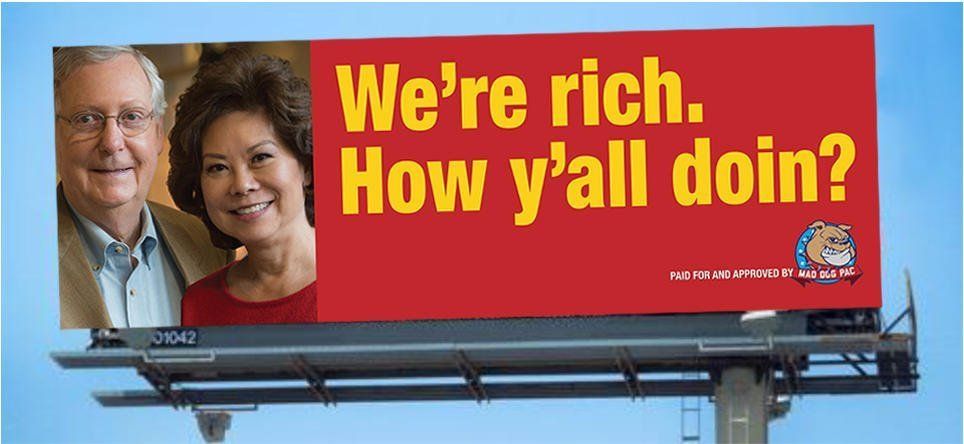
A billboard in Kentucky