The Mahablog

Politics. Society. Group Therapy.

The Mahablog

Trump, Interrupted

Trump has responded to people nagging at him about Puerto Rico by agreeing to visit it next Tuesday. That’s a week from today, right? I know he’s really busy bitching about the NFL and Republicans in Congress, but one would think he could have scheduled something a bit sooner.

Puerto Rico is in crisis —

After Hurricane Maria knocked out electricity to all of Puerto Rico, residents of the U.S. territory are “gasping for air” in the relenting heat, says the mayor of the island’s capital city of San Juan.

“What’s out there is total devastation. Total annihilation. People literally gasping for air. I personally have taken people out and put them in ambulances because their generator has run out,” Mayor Carmen Yulín Cruz told ABC News.

Cruz said Puerto Rico has been prepared for major storms since the end of August, when Hurricane Irma was approaching. Irma slammed into the island and caused deaths and devastation, and was soon followed by the catastrophic hit of Maria. Parts of the island have now gone several weeks without running water and electricity.

Hospitals in particular are struggling without power, supplies, and even food and water. Before this is over we’re probably going to learn that a lot of people died after the storm who could have been saved by a quicker response. They are probably dying right now.

But Trump, who was so pleased with himself because he managed to visit Texas after Harvey, seems to feel no sense of urgency about Puerto Rico. In fact, he thinks he’s doing a good job.

President Donald Trump said he plans to travel to Puerto Rico next Tuesday to survey the wreckage left behind by Hurricane Maria, and boasted that his administration is getting “really good marks” for its response to the devastating storm.

“I mean I think we’re really getting really good marks for the work we’re doing,” Trump told reporters at the White House, also saying, “I grew up in New York so I know many people from Puerto Rico. I know many Puerto Ricans, and these are great people. And we have to help them.”

He added, “We’ve gotten A-pluses on Texas and on Florida. And we will also on Puerto Rico.”

So far, Trump has managed to figure out that Puerto Rico is an island. At least, he actually said this:

 “We’ve gotten A-pluses on Texas and in Florida, and we will also on Puerto Rico,” Trump said at the White House. “But the difference is this is an island sitting in the middle of an ocean. It’s a big ocean, it’s a very big ocean. And we’re doing a really good job.”

I can confirm that Puerto Rico is in an ocean, so we’re making progress in some ways.

He also said, “This is a thing called the Atlantic Ocean, this is tough stuff.” Yes, but there is also a thing called the “Navy.” They have boats.

Earlier today it was announced that the hospital ship the USNS Comfort would be heading to Puerto Rico, but the Miami Herald just reported that the Comfort wouldn’t be going yet.

On Tuesday, Nathan Potter, of the Naval public affairs office told The Miami Herald that the vessel was currently docked in Norfolk and had “no plans to deploy.”

Possibly the White House hasn’t yet figured out that the military doesn’t respond to rumors on the Internet. You have to send them orders.

The BBC asks, “Does Trump care about Puerto Rico’s hurricane victims?” Judging by his tweets, he has more important things on his mind, such as pro sports:

When he did finally tweet about Puerto Rico, it was to complain that Puerto Rico owed millions to Wall Street and the banks.

With all the hurricane there was bound to be a Katrina in there, somewhere, and I think we found it.

Noted in Passing

The Rapture was yesterday. So far, nobody has turned up missing.

Stupid is as stupid does:

Presidential son-in-law and senior adviser Jared Kushner has corresponded with other administration officials about White House matters through a private email account set up during the transition last December, part of a larger pattern of Trump administration aides using personal email accounts for government business.

Kushner uses his private account alongside his official White House email account, sometimes trading emails with senior White House officials, outside advisers and others about media coverage, event planning and other subjects, according to four people familiar with the correspondence. POLITICO has seen and verified about two dozen emails.

Some people don’t like to do what they’re told.

NFL players used the national anthem to show their defiance to President Donald Trump’s criticism, with at least 100 players kneeling or sitting in protest and one team staying in the locker room.

Most teams in the early afternoon games locked arms in solidarity. At least three team owners joined their players.

If Colin Kaepernick gets an NFL job soon, he should send Trump a thank you card.

It looks like Angela Merkel has been elected to a fourth term.

It looks like there are three definite Republican nos on the new atrocity health care bill, McCain, Paul, and now Cruz. And Susan Collins sounds like a no to me, too.

Police Brutality in St. Louis

Today the St. Louis Post-Dispatch has committed an act of journalism and reported on police activity last weekend. A bit slow, there, but better late than never.

It appears that last Sunday night, some vandals broke some windows and flower pots, and the police conducted a sweep that covered several blocks. Among those arrested were an undercover cop, who was beaten by his own “brothers.” Another was an air force lieutenant who was standing outside his home, watching. Another was a photojournalist working on assignment from Getty Images. Another was one of the stage crew for U2, scheduled to give a concert on September 16, who got caught in the sweep when he stepped out of a bar. This may have something to do with why U2 canceled the concert. The Post-Dispatch:

The police were congratulated by their acting police chief, who said they “owned tonight,” and got praise from Gov. Eric Greitens for their tactics. But as more details emerged about heavy-handed police tactics, criticism mounted. A lawyer for the Post-Dispatch condemned the “inappropriate and disturbing” arrest of one of its journalists. A lawsuit on Friday alleged that the police violated people’s civil rights. And two top city officials on different days used the word “disturbing” to describe allegations of abusive police.

On Wednesday, City Counselor Julian Bush called allegations regarding the arrest of Post-Dispatch reporter Mike Faulk disturbing.

On Friday, Mayor Lyda Krewson asked the director of public safety to investigate how an undercover officer became bloodied during his arrest Sunday when he was mistaken for a suspect believed to be carrying chemicals that could be sprayed on officers.

It gets better.

Lt. Alex Nelson, 27, who works in cyberoperations at Scott Air Force Base, was walking around his neighborhood with his wife when they became trapped between quickly closing police lines. He said he was kicked in the face, blinded by pepper spray and dragged away.

“It’s our street,” he said. “I hear the police say it was their street, but it’s literally my street. I have coffee on that street, and I own property on that street. We were not active protesters. We were looking into the neighborhood to observe events that were unfolding.

“I’m very sad how they treated me and my wife through the escalation of violence they used on me. It was incredibly unnecessary. I’ve had training on how to arrest and be arrested, and I capitulated to every demand that was made of me, even before I was on the ground. We were told to move back, and we moved back. We were told to move this way, we moved this way. We obeyed every command that we heard. We were never given an order to disperse. Not once.”

He said while waiting to be loaded into a police vehicle, he said he was an officer in the military. He said the police officer replied, “Shut up. Stop. I don’t care.”

William Waldron, part of the U2 crew: “They threw me on the ground and told me I was being arrested,” he said. “The guys inside were trying to come out and tell them I was a part of their crew, and police told them if they opened up the door they were going to arrest them.”

Several people who said they were complying with police orders were pepper sprayed anyway. A number of people — some were taking part in the demonstration, some just happened to be in the area — suffered injuries from being slammed to the ground and dragged around by police. One observer suffered nerve damage from having his hands bound too tightly.

Another observer said, “As they told people to disperse, they wouldn’t let people leave. We were there for about 30 minutes, and then the police gave the final warning to disperse, but wouldn’t let people leave. That’s when the police started rushing and macing.”

Also:

Fareed Alston of East St. Louis was filming the protests for his company City-Productions and Publishing when he was arrested.

“It was like imminent danger, a wall of police circling around us,” Alston said. “They told us to get on the ground and everyone complied. Even as we did that they started pepper spraying us and kicking us to the ground with their foot and taking people’s phones.”

Alston, 28, said as he was being taken to the police van he saw officers giving high fives, taking selfies and smoking cigars.

It has been widely reported that when the sweep was over, police were chanting “Whose streets? Our streets.”
There is an acting chief of police now because the former one resigned in April of this year when the newly elected mayor, Lyda Krewson, was sworn into office. Krewson had no role in the Stockley verdict that touched off the recent protests. However, she does need to step up and take charge of the police department, and fast.

More on the New Republican Atrocity

The most important thing to understand is if this new “repeal and replace” bill becomes law, it won’t just screw up Obamacare. It will impact how most of us access health care, directly or indirectly. It’s actually worse than the last bill they tried to pass.

Will Bunch wrote at Philly.com:

The stated motive of its sponsors — Sens. Lindsey Graham of South Carolina and Bill Cassidy of Louisiana — is to return power and flexibility to the states. But the states — even those run by Republican governors like Trump ally Chris Christie in New Jersey — do not want this. Neither do doctors, nurses, hospital administrators, or anyone else who knows one whit about how health care in America actually works. One particularly harsh critic urged defeat of the Senate bill because it “reduces funding for many states significantly and would increase uncertainty in the marketplace, making coverage more expensive and jeopardizing Americans’ choice of health plans.” What pot-brownie-addled BernieBro said that? The association of Blue Cross Blue Shield insurers, that’s who.

Margot Sanger-Katz writes at the New York Times that the bill would force states to build entire health care systems from scratch.

The bill, proposed by Bill Cassidy and Lindsey Graham, would eliminate Obamacare’s expansion of state Medicaid programs to cover poor adults and its system of subsidies to help middle-income Americans buy their own insurance in state marketplaces. Instead, it would allow states to apply for big block grants of money once they have developed a plan to use the money to provide health care or health insurance coverage. …

…States could use the money in any number of ways: state insurance programs, subsidies for private insurance, direct payments to health providers, high-risk pools or more. They would be free to preserve the central consumer protections created by Obamacare, or to decide to allow insurers to limit benefits or charge higher prices to sicker customers than healthier ones.

The challenges would fall into two major categories. First, states would need to make political choices about what they want their system to look like. Next, they would need to submit applications, hire contractors and build new systems to run them. Neither would be easy.

Oh, and the states have two years to accomplish this.

The bill would make health care an active, high-stakes political debate in all 50 states. Under Obamacare, states had limited, rather binary policy choices, and even those were hard for state governments to make quickly.

A considerable percentage of state governments are even more dysfunctional and corrupt than the U.S. Congress. People in those states can pretty much kiss their access to health care goodbye. Insurers have come out against it, because the amount of uncertainty this bill would create would pretty much blow their business model out of the water. And, whether people want to admit it or not, what happens with federal funding, including Medicaid, deeply impacts hospitals and sets off ripple effects that impact everyone.

So far, the most effective voice speaking out against this atrocity is Jimmy Kimmel.

“Oh, I get it. I don’t understand because I’m a talk-show host, right? Well then, help me out. Which part don’t I understand? Is it the part where you cut $243 billion from federal health care assistance? Am I not understanding the part where states would be allowed to let insurance companies price you out of coverage for having pre-existing conditions? Maybe I’m not understanding the part of your bill in which federal funding disappears completely after 2026? Or maybe it was the part where the plans are no longer required to pay for essential health benefits, like maternity care or pediatric visits?”

“Or the part where the American Medical Association, The American College of Physicians, The American Academy of Pediatrics, The American Hospital Association, The American Cancer Society, The American Diabetes Association, The American Heart Association, Lung Association, Arthritis Foundation, Cystic Fibrosis, ALS, The National Multiple Sclerosis Society, and The March of Dimes, among many others, all vehemently oppose your bill?” he continued. “Which part of that am I not understanding? Or could it be, Senator Cassidy, that the problem is that I do understand, and that you got caught with your G-O-Penis out? Is that possible? Because it feels like it is.”

I assume Senate Democrats are speaking out against this also, but media are ignoring them. See also Greg Sargent, Cassidy-Graham could still blow up in the GOP’s face. Here’s how.

Republicans Are Still Trying to Take Away Your Health Care

The continents are getting slammed. Hurricanes, floods, fires, earthquakes. I don’t really want to talk about politics. But duty calls.

The Senate is trying to pass another repeal-and-replace bill, and it’s a doozy. It’s safe to say that if this goes through, whatever health care plan you have now would be screwed, sooner or later.  See Sarah Kliff, I’ve covered the GOP repeal plans since day one. Graham-Cassidy is the most radical. See also Obamacare 101: What would the Graham-Cassidy repeal bill do?

Mitch McConnell is pushing this bill as hard as he can push it.

The pressure is on because Republicans are attempting to use a procedure known as budget reconciliation to pass the bill. The process allows them to avoid a Democratic filibuster and pass the bill with only a simple majority. Republicans currently hold 52 seats in the Senate.

But the rules that allow Republicans to use reconciliation will run out at the end of September, per a ruling from the Senate parliamentarian. This has spurred intense urgency to pass the legislation.

The intention to introduce the bill to the floor likely means that the GOP is close to the necessary votes — and that McConnell may be pressuring some wavering members. Cassidy told reporters that the bill is supported by 48 or 49 Republicans.

So it’s going to be another close vote on absolutely devastating legislation. The Washington Post has an analysis of which votes are likely and which are still up for grabs. It’s going to be another nail-biter, I’m afraid.

Greg Sargent had some positive news today.

Unfortunately for the bill’s supporters, a new study just came out that will enable Republicans to make a somewhat more informed decision about this legislation, after all. And it could deal a blow to the bill’s chances. It should, anyway.

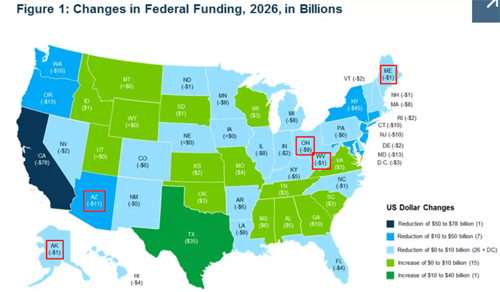
The study, which was released this morning by Avalere Health, a consulting firm, finds that many states will see sizable cuts to the federal money that would flow to their states, relative to current law. Some of those states are represented by the GOP senators who are currently deciding whether to back the bill, including Lisa Murkowski (Alaska), Susan Collins (Maine), Rob Portman (Ohio) and John McCain (Ariz.).

This graphic shows which states would lose and which would gain, funding wise. Blue is lose, green is gain. Texas makes out nicely, for some reason. California is the most screwed.

This is the Graham-Cassidy bill; I see Graham’s South Carolina gains funds, but Cassidy’s Louisiana loses. Weird. Anyway, I hope these results will keep senators Murkowski, McCain and Collins on the right side.

Speaking of Cassidy, last night Jimmy Kimmel ripped Cassidy a new one on the teevee:

On his show on Tuesday night, Kimmel attacked Cassidy as a “liar” for coming on his show earlier this year and saying that he would not back any legislation that does not protect people with pre-existing conditions, or does not cover families who face healthcare emergencies. Kimmel drew attention earlier this year for delivering a monologue in which he talked about his infant son’s heart surgery, and made the case for affordable health care for families who have less means in such emergencies.

But Cassidy insisted that his healthcare legislation would pass what he has dubbed the “Kimmel test,” or ensuring that all families have affordable care.

“It was a personal attack, and I cannot help that, but all I can say is if you are in Texas, or if you are Maine, or Virginia, or Missouri, there will be resources in your state that you have not had that can provide you coverage, and we have protections for pre-existing conditions,” he told NBC News.

Texas, Virginia and Missouri maybe; not so much Maine. California, definitely not. Actually, Sarah Kliff says Graham-Cassidy brings back the preexisting conditions problem and allows insurers to deny coverage or charge higher rates for them.

In short, contact your senator, now. If you have a Republican senator, contact them multiple times.

Trump at the UN: He Kept His Shoes On

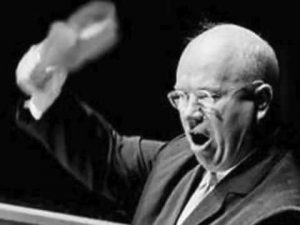
Khrushchev and his shoe at the UN, 1960

Trump addressed the UN this morning, and I’m pleased to say that he did not at any point pull off a shoe and pound it on the podium. Credit where credit is due.

However, that’s the good news. Here’s the bad news: The content of the speech.

The headlines from the speech are calling out Trump’s threat to bury North Korea.  Well, okay, he said “totally destroy,” not “bury,” which arguably is worse. But at least he didn’t remove articles of clothing to make a point. I’m sure someone in media will give him presidential points for being presidential and all, that he didn’t disrobe on live TV.

Here’s a snip from the Washington Post:

The president warned of growing threats from North Korea and Iran, and he said, “The scourge of our planet is a group of rogue regimes.”

He praised the U.N. for enacting economic sanctions on Pyongyang over its nuclear and ballistic missile tests. But he emphasized that if Kim Jong Un’s regime continued to threaten the United States and to destabilize East Asia, his administration would be prepared to defend the country and its allies.

“We will have no choice but to totally destroy North Korea,” Trump said, before calling Kim by a nickname he gave the dictator on Twitter over the weekend. “Rocket Man is on a suicide mission for himself.”

Trump added, “If the righteous many do not confront the wicked few, then evil will triumph.”

Ooo, we’re even calling Kim Jong Un funny names. That’s so … third grade.

Aaron Blake writes,

President Trump took to the floor of the United Nations General Assembly on Tuesday and, in his maiden speech there, called the leader of North Korea “Rocket Man,” decried “loser terrorists” and said certain parts of the world are “in fact, going to hell.”

But Trump’s perhaps oddly chosen colloquialisms masked what was a pretty astounding escalation of his rhetoric when it comes to North Korea. Just to be clear: The president of the United States threatened to wipe a country of 25 million people off the map.

Well, when you put it that way, it does seem unprecedented. And unpresidented.

Trump’s speech Tuesday ratcheted things up in two respects: saying the United States would also unleash a massive response on behalf of its allies, and threatening to “totally destroy” the country.

We still have allies? Who knew?

Polls show the American people are not confident in Trump’s ability to handle the North Korea situation, with 61 percent saying they are “uneasy.” Trump’s words Tuesday likely won’t calm many fears, but he’s clearly gambling on North Korea backing down in the face of big talk.

Yeah, that’s been working so well so far. Oh, wait …

The speech news gets better …

President Donald Trump spent much of his address to the United Nations General Assembly Tuesday berating Iran and complaining about the “embarrassment” of a nuclear deal his predecessor signed with the country.

There’s an embarrassment, all right, but it’s not the Iran nuclear deal.

“It is far past time for the nations of the world to confront another reckless regime,” he said upon first referring to the nation, following a condemnation of North Korea. “One that speaks openly of mass murder, vowing death to America, destruction to Israel and ruin for many leaders and nations in this room.”

The many leaders and nations worked hard for that nuclear deal, just as they worked hard for the Paris Agreement. They aren’t going to renegotiate it on Trump’s say so.

“The Iranian government masks a corrupt dictatorship behind a false guise of a democracy,” he said.

Well, Trump would know corrupt dictatorships behind a false guise of a democracy. And I bet he knows shoes, too. He could have brought some samples of Ivanka’s shoes and pounded some of them on the podium. Then Ivanka could tweet about which retailers carry her shoes. I wonder why he didn’t think of that.

After all, at one point in the speech he said, “We do not seek to impose our way of life on anyone but rather to let it shine as an example.” Some of Ivanka’s shoes are pretty blingy. Yes, we lead the first world in income inequality, I believe, or at least we’re in the top ten. We’re also number one among the wealthier industrialized democracies in the percentage of citizens with substandard health care. I doubt very much that other nations want our way of life imposed on them, frankly. But who doesn’t like shoes?

I’m sure there will be more commentary about this speech later in the day, as soon as the people who write political commentary have a stiff drink and mutter at the walls for a while. It was some speech.

See also: Here Are the Most Trump Things Trump Said in His United Nations Speech

Ken Burns’s Vietnam War

I watched the first episode of the PBS Vietnam War series and thought it was good so far. I don’t think anything was said I didn’t already know, but a lot of it was stuff most people don’t know.

I was a bit dismayed to find people on social media trashing it, some of whom apparently didn’t even watch it. One person decided to not watch it because one of the sponsors was Bank of America, and she was certain it wouldn’t be any good. Others assume it will be a whitewash of U.S. crimes and refuse to watch.

I left a comment somewhere that the first episode (which covered the beginning of French colonialism to 1961) was accurate, and got a response from someone named Doug Zachary — “Barbara you are the perfect fascist citizen. fall in line. smile, really BIGLY!” I take it Doug has Issues.

Of those who claimed to watch it and who dissed it as propaganda, my impression is that they won’t accept anything that isn’t an anti-American polemic. The problem with that is that they seem to want to think that Americans in the 1950s and 1960s went to Vietnam just to napalm Vietnamese children for kicks and grins, and don’t want to hear how mostly well-meaning people talked themselves into thinking that the war was the right thing to do, even though it wasn’t.

To me, that last part is the most important part of the story, and the part of the story that people need to understand. Because that’s how evil works. Most people who do wrong things don’t recognize they are doing wrong things at the time. They persuade themselves they are doing the right thing. We keep doing wrong shit because people get worked up into thinking that the wrong shit is righteous and necessary, and then when it all goes bad nobody wants to look back try to understand how they could have been so mistaken. Well, here’s a chance. Those of you who are too young to remember Vietnam could apply this same lesson to several more recent misadventures, like Iraq.

Tonight’s episode covers 1961 to 1963. I expect to see the corruption of the Diem regime and Kennedy’s signing off on Diem’s assassination. This article in Newsweek contains some pans of some of the episodes that haven’t been shown yet. So we’ll see.

See also “What Trump Needs to Learn from Vietnam.”

You Won’t Get It If You Don’t Ask for It

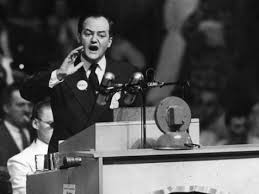
Hubert Humphrey at the 1948 Democratic National Convention

Hubert Humphrey’s Civil Rights speech at the 1948 Democratic National Convention was one of the great moments in the party’s history.

“Friends, delegates, I do not believe that there can be any compromise on the guarantees of the civil rights which we have mentioned in the minority report,” he said. “In spite of my desire for unanimous agreement on the entire platform, in spite of my desire to see everybody here in honest and unanimous agreement, there are some matters which I think must be stated clearly and without qualification. There can be no hedging — the newspaper headlines are wrong. There will be no hedging, and there will be no watering down — if you please — of the instruments and the principles of the civil-rights program.”

Humphrey was speaking in support of the civil rights plank of the 1948 Democratic Party platform, which said this:

The Democratic Party is responsible for the great civil rights gains made in recent years in eliminating unfair and illegal discrimination based on race, creed or color,

The Democratic Party commits itself to continuing its efforts to eradicate all racial, religious and economic discrimination.

We again state our belief that racial and religious minorities must have the right to live, the right to work, the right to vote, the full and equal protection of the laws, on a basis of equality with all citizens as guaranteed by the Constitution.

We highly commend President Harry S. Truman for his courageous stand on the issue of civil rights.

We call upon the Congress to support our President in guaranteeing these basic and fundamental American Principles: (1) the right of full and equal political participation; (2) the right to equal opportunity of employment; (3) the right of security of person; (4) and the right of equal treatment in the service and defense of our nation.

This platform also said “We favor legislation assuring that the workers of our nation receive equal pay for equal work, regardless of sex,” and called for some kind of national health care. Seriously, this is a very progressive platform, the domestic policy section especially. The Dems would have to update the foreign policy section, but the domestic policy section could be adopted in 2020 with just a little tweaking.

Did I mention this was said in 1948?

Of course, there were many years of struggle ahead before the Civil Rights Act of 1964 made discrimination illegal. Martin Luther King and the Civil Rights movement forced the Democratic Party to introduce that law,  and we’re still struggling to fully implement that law.  My point is that before change could happen, somebody had to stand up and say this. Somebody had to commit to this. Somebody had to say, this is the right thing to do.

I’m sure Hubert Humphrey didn’t expect racial discrimination to disappear after the election. As it was, the entire Mississippi delegation and half of the Alabama delegation stomped out of the convention in protest of the civil rights plank. Two weeks after the convention, President Truman issued executive orders mandating equal opportunity in the armed forces and in the federal civil service. Southern segregationists  organized to form a “states’ rights” party and nominated Strom Thurmond as its presidential candidate. Civil rights was a divisive issue for Dems in 1948. But they adopted that platform because it was the right thing to do.

Today, we’re squabbling over an issue that shouldn’t be that divisive — universal health coverage. Whether you call it “single payer” or “Medicare for All” or just “universal coverage,” by now it should be obvious to anyone with a functional brain that achieving this is going to require some sort of national, taxpayer-supported system that sidelines for-profit insurance companies and includes controls to prevent price gouging. It’s almost certainly going to mean phasing out job-based group insurance. Beyond that, the hundreds of other nations that provide universal coverage for its citizens have gone about this in various ways, not all of them “single payer,” strictly speaking. We should be studying them.

The hysterical reaction against the Affordable Care Act never made sense, if you realize that just about all the ACA did was regulate health insurance to force insurance companies to cover more people and provide some subsidies so that poor people could pay the private insurance company premiums. That the premiums were still not affordable for a lot of folks is largely the fault of the insurance companies, and indeed it’s the fault of the whole idea that private-for profit insurance can pay for most medical care with affordable premiums and without bankrupting people. It can’t. All the other nations of the world figured that out a long time ago.

But in the U.S., the insurance companies, the medical-industrial complex and the conservative media-think tank network that largely controls public opinion have made universal coverage a taboo subject. Until now.

There are 16 Democratic senators supporting the bill, a remarkable number considering where the healthcare debate was two years ago, when Sanders first campaigned for president as a democratic socialist long shot. At the time, pundits, political operatives and countless elected officials dismissed the single-payer Sanders dream as a disingenuous moonshot.

Now, the man who told Obama to lay off Bain Capital (Cory Booker) and the woman who once voted in favor of withholding federal funds from sanctuary cities (Kirsten Gillibrand) are co-sponsors of Sanders’ bill. Times, indeed, have changed.

Some are not persuaded.

In an interview with Vox’s Ezra Klein, Clinton repeated attacks on single-payer she made during her primary campaign against Sanders, arguing that more modest measures like a public insurance option or a Medicare buy-in for people 55 and older are more realistic and achievable.

“I don’t know what the particulars are” on Sanders’s latest plan, Clinton said, but added, “He introduced a single-payer bill every year he was in Congress — and when somebody finally read it, he couldn’t explain it and couldn’t really tell people how much it was gonna cost.”

She clarified that she’d support a bill opening up Medicare or Medicaid and cutting prescription drug costs, but cautioned, “I think it’s going to be challenging if within that bill, there are tax increases equivalent to what it would take to pay for single-payer, and if you’re really telling people — about half of the country — that they can no longer have the policies they have through their employer.”

She noted that this issue arose in 1993-94, when she was crafting a health reform plan in the Bill Clinton administration, and she concluded then that the forces arrayed against single-payer, not least of which were the public’s fears about such a program, were insurmountable.

Those forces may have been insurmountable in 1993-1994; there are people who argue that the Clintons themselves blew the opportunity then, but let’s set that aside. I personally think it was insurmountable in 2008; just getting the ACA passed was a massive achievement at the time.

But it’s not 1994 any more. It’s not even 2008 any more.

I’ve long believed that universal health care would become politically viable in the U.S. as soon as a big enough part of the working and middle class in the U.S. realized that they are being screwed by the medical-industrial complex, and I think we’re about there.

When Mike Dukakis talked about health care reform in his presidential bid in 1988, all the Republicans had to do was trot out some hard hat guys with union benefits to talk about the great health coverage they had for a few dollars a month, and why mess with that? But those hard hat guys are harder to find these days.

In 1999, 67 percent of nonelderly Americans were covered by employee insurance. In 2014, that had fallen to 56 percent, as the old-fashioned full-time job with benefits became more and more  elusive in the U.S.  If we include all Americans, less than half are covered by employee benefit insurance now. See also “Let Them See How We Live. Let Them Come.”

People in the U.S. don’t know what solutions are possible because nobody tells them. Sanders’s cardinal sin, according to some, is that he stood up and told people what is possible. Apparently, according to some Democrats, this is not allowed. We are not allowed to speak the name of a thing until we have a fully formed program with all the details ironed out, and even then we must limit ourselves to those programs that are achievable in the near term, under current political conditions. This means Democrats negotiate with themselves until they come up with something that they think Republicans might accept, so that it can be watered down some more before passing.

Under those rules, Hubert Humphrey wouldn’t have been allowed to speak at the 1948 Democratic Convention, and the civil rights plank would have been axed from the platform. Yes, the 2016 Democratic platform has a section about “securing universal health care,” but the verbiage that follows is about protecting the status quo —

Democrats will keep costs down by making premiums more affordable, reducing out-of-pocket expenses, and capping prescription drug costs. And we will fight against insurers trying to impose excessive premium increases.

— and maybe throwing in a few tweaks to existing programs, but it offers nothing that looks anything like genuine universal coverage.

Paul Waldman wrote last week,

Support for some kind of universal coverage is now the consensus position among Democrats. And Sanders’ single payer plan is the one that has gotten the most attention, so it’s going to be the one against which other plans are measured.

But we have to understand this plan for what it really is: an opening bid. While he won’t say so himself, I doubt even Sanders believes that something in this form could pass through Congress. Even so, it represents an important strategic shift for the Democratic Party.

Waldman goes on to say that both Barack Obama and Bill Clinton tended to negotiate with themselves, giving away too much too quickly before negotiations with Republicans even started. On the other hand, Sanders’s Medicare for All asks for everything. It covers everything, without co-pays or deductibles. It even covers abortions. And, as a lot of people have pointed out, such a bill has no chance of passage in Washington now. But a watered-down bill has no chance, either.

Waldman continues,

This bill is being offered in 2017, when there’s a Republican president, a Republican House, and a Republican Senate. It doesn’t have to be realistic. It can be a way of saying, “This is what as Democrats we think a perfect health insurance system would look like.” In that sense, this bill could be extremely useful, since it will communicate the Democratic vision to voters in a way that isn’t too hard to understand. …

… Once the Sanders plan is in wide circulation, if I said, “How about an expansion of Medicaid to become a basic plan for all adults, while private insurance would still exist to offer supplemental coverage?”, you might now say that sounds pretty reasonable. If you did, it would mean that Sanders had effectively widened the debate and made what not long ago would have seemed like radical ideas look like moderate compromises.

Exactly. It tells people what is possible. It’s saying, we can have this, or something like this, if we demand it. We don’t have to put up with the status quo.

To me, one of the biggest mistakes Hillary Clinton made last year was not just to dismiss Sanders’s health care plan as politically untenable, but to compare even asking for universal coverage — which is what most people mean by “single payer” — to believing in unicorns. The widely circulated video of her proclaiming that single payer will “never ever come to pass” damaged her more than she seems willing to admit.

Josh Marshall wrote last week,

Medicare for All is a horizonal demand. It satisfies a basic need and does so by looking beyond the corrupt, meretricious system we now have. The activity of private insurance companies symbolize much that is wrong with contemporary capitalism. You don’t have to be a leftwinger from Park Slope to hate these companies. Believe me: a lot of those people who voted for Trump (whom the liberal elite dismisses as racists and misogynists) hate insurance companies.

While Medicare for All would cause an upheaval in the health insurance markets, it is actually based on expanding a system that works and that has remained intact for over fifty years. It’s incremental in its own way. It is also very easy to understand, while most of the incremental reforms I’ve seen require a degree in healthcare economics to comprehend and rarely seem to apply to “you.”

Unfortunately, a lot of Democrats are still too mired in learned helplessness to stand up for what’s right; see Democrats Against Single Payer by Branko Marcetic at Jacobin. So it’s going to be up to voters to continue to apply pressure on the Democrats to grow a spine. Watch them fold up like cheap lawn chairs as soon as Republicans begin their pushback. Socialized medicine! Higher taxes! Booga booga booga booga!

I say, let the Republicans go to their constituents and tell them no, you can’t have this. We must support the medical-industrial complex. We must support the rights of insurance companies to make lots of money, even if you or your loved ones are cut off from life-saving medical care for the sake of profit. Let the Republicans defend that position. Stop being afraid to stand up for the right thing.

Trump, Painted in a Corner

Greg Sargent writes that Trump supporters are in meltdown mode:

With the chatter intensifying about the possibility of President Trump cutting a deal to protect the “dreamers,” The Post reports today that his loudest supporters are in a fury. They are warning that “the base” will desert him if he commits such a massive betrayal.  …

…The most vocal immigration hard-liners who backed Trump in the media and Congress — people such as Ann Coulter, Rep. Steve King (R-Iowa), and Stephen K. Bannon and his merry Breitbart warriors — are warning Trump that his voters won’t tolerate it if he agrees to legislative protections for hundreds of thousands of people brought here illegally as children, as part of a deal with Dems.

However, Sargent goes on to argue that what they’re really afraid of is not that Trump’s base will turn against him, but that it won’t. Robert Costa and Michael Scherer write,

Yet the lasting political cost of Trump’s engagement with top Democrats on immigration remained ambiguous. While Coulter and others vented, several conservative leaders Thursday remained hesitant about breaking with the president publicly given his continued grass-roots support and their desire to focus Republican ire on the leadership in Congress.

“The jury is still out on whether the base starts to leave him. And I’m not sure what the truth is,” Rep. Steve King (R-Iowa) said in an interview. “If this stands and we end up with amnesty, the base that was pulled together because of immigration will start to peel off in significant ways.”

But, King added, “No one is quite sure about how this will play out and whether it’s truly what we worry it’ll be.”

Since there actually is no deal on DACA — and I’m skeptical there ever will be — I doubt the base is that perturbed. Many of them probably aren’t aware of any of this. We’re not talking high-information voters here. It’s also the case that a recent poll showed that only 15 percent of Americans favored deporting dreamers. This suggests that at least some Trump supporters are at least ambiguous about it. However, Huffpost reports a few are burning their MAGA hats.

Elsewhere in WaPo, we read that Republicans on the Hill don’t know what to do with themselves.

Despite their control of both chambers and with a GOP partner in the White House, congressional Republicans are laboring, sometimes awkwardly, to project leverage over efforts to rewrite the nation’s tax laws and craft a bill to decide the fate of hundreds of thousands of young undocumented immigrants.

Some are privately fuming over the valuable political cover Trump is giving to centrist Democratic senators who are top targets in the 2018 midterms in states the president won. By negotiating with them and appearing at events together, the president is potentially easing their challenge of winning conservative voters.

I think a lot of people in media are making way too much of the “new,” supposedly bipartisan Trump. Along with being a bigot and a grifter, Trump is also a sucking black hole of emotional neediness. If Nancy and Chuck figure out how to exploit that to get some concessions here and there, grand. But nobody can be Trump’s friend, or at least not for long, without completely capitulating to the needs of his ego. So the Donald, Nancy and Chuck show can’t possibly last forever.

My impression is that Trump just wants to succeed at something, and he’s been thrashing around trying to find the magic formula that will enable him to do that. And he’s noticed that the Republican Congress isn’t getting anything done that he can sign and claim as an accomplishment so that he will be praised in the New York Times. He doesn’t know why, but it isn’t.  Maybe this bipartisan thing will work.

But his problem is that if he does something that pleases most Americans, the Right will turn on him like a rabid skunk. If he caters to the Right, he’s stuck with dealing with the whackjob Freedom Caucus in the House, and nothing gets done. He’s in a completely untenable place.