Jeff Sessions: Watergate or Waterloo?

So I’m back, the malware cleanup is done, and the site is safe to visit. I’ll be back tomorrow with some actual posts.

I didn’t get to watch it, but I take it Jeff Sessions’s testimony today was a lot of chest thumping and bluster without substance.

Josh Marshall:

The big and overriding takeaway from this hearing is that Sessions declined to answer almost all the pertinent questions – in most cases because they involved his discussions with President Trump and in at least one case (or this was what I understood him to be saying) discussions with other leaders at the Department of Justice. There’s an important back and forth about what basis he had for this refusal. That is important in itself. But the gist, as Sessions eventually seemed to concede, was that he was refusing to answer because he did not want to preclude or render moot the President’s ability to assert executive privilege.

But as the President hasn’t asserted executive privilege yet, I’m not sure how that’s supposed to fly.

What did jump out at me across the whole testimony is that Sessions claims he recused himself from the Russia probe simply and only because it involved a presidential campaign of which he could reasonably be viewed as a top advisor. This is almost certainly not true. Sessions recused himself the day after The Washington Post reported two meetings with Ambassador Kislyak which Sessions had failed to disclose at his confirmation hearing. Sessions now claims that that he had made what amounts to an in pectore recusal the day after he was sworn in (little shout out to you canon lawyers out there). So in Sessions’ mind, what we thought was a recusal was just the formal version of what he had done in his head weeks earlier. Again, this seems almost certainly false. Inevitably this elaborate ruse undermines his credibility about all the rest. Comey seemed to have in mind something more than simply a technical reason requiring Sessions to recuse himself.

Big picture: Sessions refused to answer the biggest questions; he was almost certainly not telling the truth about what triggered his refusal. Most of the rest was atmospherics.

Jennifer Rubin:

The contrast with Comey was striking. Sessions, grayer and older, looked nervous and shrunken in his seat, growing defensive at times. He weakly complained to Sen. Kamala Harris (D-Calif.) about her questioning. He sharply objected: “I’m not able to be rushed this fast, it makes me nervous.” Indeed, while Comey was relaxed, confident and expansive, Sessions was evasive and skittish. He repeatedly refused to answer questions, not invoking executive privilege but saying it was Justice Department “policy” not to talk about conversations with the president. Democrats repeatedly challenged him, accusing him of “stonewalling.” Sen. Martin Heinrich (D-N.M.) slammed him: “You are impeding this investigation.” Heinrich told Sessions there’s no “appropriateness” standard that alleviates him from the need to testify under oath fully and completely. Heinrich flat out accused Sessions of “obstructing” the investigation.

Sarah Posner:

Sessions’s recusal — his justification for it, and the scope of how he defines it — is central to the integrity of the FBI’s investigation into Russian interference in our election, and possible Trump campaign collusion with it. That’s because Sessions was at the center of advising the Trump campaign on national security issues during the campaign and has failed to be forthcoming about how that role might have blended with his communications with Russian officials throughout. This raises questions as to how impartially he can exercise his role as the nation’s chief law enforcement officer and whether he may still be in a position to influence the Russia probe.

Sessions’s testimony, though, failed to put to rest any doubts Senate investigators, or the public, have about many of the matters relating to his recusal, and whether he is adhering to it. In fact, Sessions only raised new and potentially damaging questions about his actions and cast doubt on his own truthfulness about what the recusal entails.

Charles Pierce:

The people who best treed JeffBo on his most preposterous bullshit—Heinrich, Kamala Harris of California, and The Mustache of Righteousness, Angus King of Maine—could only push him so far. Everybody on that committee knew that what JeffBo was selling was batter-fried nonsense. (Call me an elitist snob if you like, but whenever I hear a Southerner talking about “mah honah,” I reach for William Tecumseh Sherman’s phone number.)

Everybody on that committee knew that, when JeffBo declined to answer questions about whether James Comey was fired because of the Russia probe, he was hiding the plain truth behind a privilege that he’d made up on the spot. Everybody on that committee knew that JeffBo’s memory lapses were at best highly convenient. (He couldn’t remember meeting the Russian ambassador, but he could quote an op-ed by William Barr from almost a year ago? That dog don’t even want to hunt.) Everybody on that committee knew that you can’t refuse to answer a question because the president* might want to invoke executive privilege at some vague point in the future. But if the majority is content to look like an entire bag of tools and pretend otherwise, there’s not much the Senate can do about being obstructed in such a shameless fashion.

Actually, there is one historical precedent for what Sessions asserted that went unmentioned, and that precedent is not promising. Although even it wasn’t as barefaced as it was on Tuesday, the assertion of an illegitimate, unasserted “executive privilege” was, for a long time, central to the defense of John Mitchell, Richard Nixon’s corrupt AG who went to jail behind his crimes relating to Watergate and what Mitchell himself called, “the White House horrors.” It is an argument you make when you know that there is an unacceptable political price to be paid if the president* actually does assert executive privilege in advance—which is what the Obama administration did on several occasions, despite Tom Cotton’s having been deliberately and dishonestly obtuse on the comparison during Tuesday’s hearings.

There’s only a certain amount of sham that our institutions can tolerate. We’re getting very close to it.
 

The Trump-Russia Collusion Scandal Is Not About Hillary Clinton

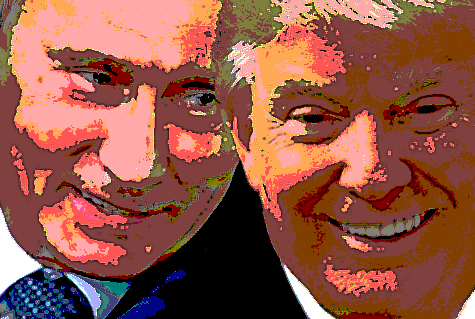
I’ve been arguing for months that the Russian hacking story needs to be taken seriously apart from whatever one felt about the election. I’ve also been saying all along that there’s no clear indication that anything the Russians did made any difference, and Clinton probably would have lost anyway.

I’m bringing this up now because I keep running into people who sincerely believe this whole Trump-Russia thing is just something like a false flag operation being run by Clinton supporters in media and government. One of these geniuses just told me James Comey obviously is part of this conspiracy. Um, James Comey? The guy who probably did cost Clinton the election? The whackjobbery is strong with this one.

Clinton supporters do like to bring up the Russian hacks as one of their many excuses for why Clinton’s loss was not her fault, but frankly, that’s bogus, also. As I’ve said, there’s no clear indication that anything the Russians did cost Clinton the election. There were so many factors that cost Clinton the election that it’s just about impossible to point to any one that made any measurable difference — with the possible exception of James Comey’s October 28 letter to Congress about Clinton’s damn emails. That does seem to have hit Clinton’s poll numbers hard.

And at this point, to believe the “false flag” theory one would have to believe that Glenn Greenwald and the crew at The Intercept are Clinton trolls. I don’t think so.

There are five major investigations going on right now into connections between the Trump campaign and Russia — two investigations in the Senate, two in the House, and one being led by special counsel Robert Mueller. Russian interference in the election is only one items on their agenda. They’re also looking into the circumstances that led to Michael Flynn’s dismissal as national security adviser, any inappropriate connections between Trump campaign and staff and foreign governments, leaks to media, and attempts to impede investigations of all that.

We don’t know what all Bob Mueller is doing, but he’s still staffing up. This just in —

On the other side of Pennsylvania Avenue, special counsel Robert Mueller has been quietly and methodically building the equivalent of a small US attorney’s office — a team of formidable legal minds who’ve worked on everything from Watergate to Enron, unlikely to leave any stone unturned.

The hires include top criminal prosecutors.  These include Michael Dreeben, considered one of the top criminal prosecutors in the U.S. Mueller is serious, and he has no particular ties to the Clintons that I can find. It may be months yet before we know where he’s going with his work.

Aside from the election, it seems just about every part of Trump’s real estate business, plus any associates one ever hears about, has ties to Russia. This is particularly critical, since Trump still is making money from that business, and genetically compromised offspring Eric admitted that he shows his father profit reports.  (Today the Washington Post published a story saying that Trump lawyer Marc E. Kasowitz has ties to Russia, for pity’s sake. )

Eric Trump said in an interview aired early Tuesday that sharing profit reports with his father “doesn’t blur the lines” in separating the family business from President Trump’s administration.

“You’re allowed to show that and remember the president of the United States has zero conflicts of interest,” Eric Trump told ABC’s “Good Morning America.” Zero.”

Some of those profits may be from money laundering for the Russians. Trump is extremely vulnerable to abuse-of-office and corruption charges, whether he realizes it or not. And then there are the many associates, such as his out-of-his-depth son-in-law Jared Kushner, who might as well have an “R” for rotten stamped into his forehead.

So, yeah, this is a big deal, and it’s a big deal that has nearly nothing to do with Hillary Clinton.

Impeachment Now? Maybe Not.

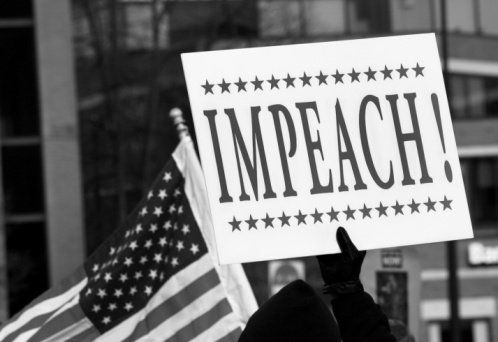
There’s lots of hollering for impeachment NOW, in both news and social media. I want Trump to go away as much as anybody, but if it’s done at all we’ll get one shot at it. Not all the ducks are in a row yet. The Slate Impeach-o-Meter has the odds for an impeachment at 41 percent, which seems about right to me —

And yet, as I alluded to yesterday, until this stuff all tangibly happens—until the things the Mueller investigation might conclude become the things it did conclude—Republicans, who hold the majority in Congress, don’t really have any reason to bail on their president. So we’ll raise our meter, but only by a symbolic 1 percent.

What’s going on with Trump resembles the Nixon almost-impeachment more than it does what went on with Andrew Johnson or Bill Clinton. Although technically Nixon wasn’t impeached, when he resigned in 1974 he did so after articles of impeachment had been passed in the House Judiciary Committee, and party elders in Congress assured him that they not only would pass in the House, there were enough votes in the Senate to remove him from office.  So this is the one time the impeachment/removal process succeeded, even if it was cut short at the end. So let’s look at Watergate.

Forgive me for not explaining who everybody in this narrative is. I’ve got a limited amount of time to blog today.

The Watergate burglary happened on June 17, 1972. Later that same month, the first of Woodward and Bernstein’s investigations tying the burglars to the White House were published in the Washington Post.

In June 1972 (we learned later), Nixon and Haldeman agreed to try to shut down the FBI investigation of Watergate. Through surrogates, FBI Director L. Patrick Gray was ordered to stay out of it.

The Watergate burglars were indicted by a federal grand jury for burglary, conspiracy and wiretapping in September, 1972.

Nixon was re-elected in a landslide in November, 1972.

In January 1973 the Watergate trial began. Several burglars entered guilty pleas. McCord and Liddy were convicted. Shortly after that McCord told a judge that he’d perjured himself under pressure. About this time John Dean began to cooperate with federal prosecutors.

In April, L. Patrick Gray resigned as FBI Director after it was discovered he had destroyed evidence that had been in E. Howard Hunt’s safe. William Ruckelshaus is appointed to replace Gray. Shortly after that Nixon aides Ehrlichman, Haldeman, and Kleindienst resigned. John Dean is fired. Nixon looks guilty as hell.

The Senate Watergate Committee began televised hearings in May 1973. Shortly after that Archibald Cox is appointed special prosecutor.

In July 1973, Nixon refused to release White House tapes to anybody.

In October 1973, Vice President Spiro Agnew resigned for being a corrupt s.o.b. I don’t think anyone ever connected him to Watergate.

October 20, 1973, was the “Saturday night massacre” that resulted in Archibald Cox being fired. Nixon was pretty much toast after that, but impeachment was still several months away.

Let’s now move on to 1974. People close to Nixon continue to be indicted or to confess to illegal activities of various sorts.

On March 1, 1974, Nixon himself is named an “unindicted co-conspirator” in indictments of seven former presidential aides.

Finally we get to May 9, 1974 — impeachment hearings begin in the House Judiciary Committee. They were televised beginning on July 24. The Committee approved articles of impeachment by the end of July.

And then on August 8, Nixon delivered his resignation speech. He had been assured that not only would the articles be approved in the House, there were enough votes in the Senate to remove him from office. So, while Nixon technically was not impeached, in effect he actually was.

As I see it, relatively speaking, Trump’s case is somewhere around late spring or early summer of 1973. There is a lot of investigating still to do, and people close to Trump (first and foremost, Kushner and Sessions, IMO) have yet to be grilled and (presumably) indicted. As we’re seeing today after the Comey testimony, plenty of Republicans are still trying to protect Trump. And they have a majority in both Houses. And today’s Republicans are even worse partisan whackjobs than Republicans were in the 1970s. If attempted now, impeachment would fail.

I’m saying impeachment right this minute is premature. Let the process play out a little bit more first. I don’t mind Democrats standing up and saying they’d support it, but I also don’t mind Democrats saying it’s too soon, because it is.

The Comey Testimony

Naturally I’m having computer issues today, which means posting will be limited. From what I’ve heard of the Senate hearings so far, it strikes me that Republicans seem to be trying to blame Comey for not stopping Trump from trying to obstruct justice. Good luck with that, guys.

The Art of the Fake

A few days ago, we were told that Donald Trump had signed a $110 billion arms deal with Saudi Arabia. Details were not made available to the press immediately, but we were assured that this was a Big Deal.

“That was a tremendous day. Tremendous investments in the United States,” The so-called president said. “Hundreds of billions of dollars of investments into the United States and jobs, jobs, jobs.”

I’ve been keeping an eye out for analysis of what jobs might be created, or whether Congress actually would approve it. but it turns out there’s nothing to approve.

That’s right; the Brookings Institution is reporting that there is no arms deal.

I’ve spoken to contacts in the defense business and on the Hill, and all of them say the same thing: There is no $110 billion deal. Instead, there are a bunch of letters of interest or intent, but not contracts. Many are offers that the defense industry thinks the Saudis will be interested in someday. So far nothing has been notified to the Senate for review. The Defense Security Cooperation Agency, the arms sales wing of the Pentagon, calls them “intended sales.” None of the deals identified so far are new, all began in the Obama administration.

The author, Bruce Riedel, says that it’s doubtful the Saudis could pay for a $110 billion arms deal, anyway, given the price of oil these days.

So what was that dog and pony show in Riyadh about, anyway? I’ll bet you can guess, but here’s a hint:

The Trump International Hotel received about $270,000 from a lobbying campaign tied to the government of Saudi Arabia last year, according to a filing submitted to the Justice Department last week.

The filing from the MSLGroup, a public relations firm, shows that the group spent about $270,000 at the Trump International Hotel while conducting lobbying efforts on behalf of the Saudi Arabian government. MSLGroup was helping Saudi Arabia with several lobbying efforts, including opposing the Justice Against Sponsors of Terrorism Act (JASTA), which allows the families of 9/11 victims to sue Saudi Arabia.

Yes. The so-called president insults the mayor of London for allegedly being soft on terrorism; meanwhile, he’s been in bed with a group trying to prevent the Saudis from owning up to their role in 9/11. An attack on Trump’s city. What a guy.

Capitalism Is Devouring Itself

In today’s New York Times, we read that the CEO of Yahoo has been making $900,000 a week for running her company into the ground.

When a withered Yahoo is absorbed by Verizon Communications in the next week or so, it will be the end of an era for one of the pioneering names of the internet age.

It will also conclude the remarkable five-year run of Yahoo’s chief executive, Marissa Mayer, who was paid nearly a quarter of a billion dollars — a generous sum even by Silicon Valley’s lofty standards — while presiding over the company’s continued decline.

Ms. Mayer, now 42, was hailed as a savior when she left Google for Yahoo in 2012. But during her tenure, Yahoo was hit by two of the biggest privacy breaches in history. Advertisers, Yahoo’s bread and butter, fled the service. Users shifted ever more attention to Google, Facebook and other rivals. Yahoo’s staff shrank by almost 50 percent.

The company ended up so weakened that its board had little choice but to sell.

Mayer will made about $239 million on the sale.

Now, we might think that Yahoo stockholders must be really pissed off at Mayer. Apparently not, because she made them a lot of money.  As the once-significant Yahoo faded into obscurity,  for some reason stock prices kept going up. This was mostly because of other companies in which Yahoo invested. Mayer is brilliant at handling investments; she’s not good at running companies. And the Board of Directors allowed this situation to fester for five years.

Yahoo’s board recognized Ms. Mayer’s failure to meet business targets and docked her bonuses and stock awards in four of the five years she was in charge. But under terms of her original employment agreement, it also granted her new shares annually, easing the sting.

The biggest financial price she paid for her mistakes came this year, when she gave up her cash bonus for 2016 and equity awards for 2017 –about $14 million — as a penalty for management’s failure to act on evidence of the theft of data from 500 million accounts in 2014. That incident, along with the 2013 breach of one billion accounts, prompted Verizon to renegotiate its original purchase agreement with Yahoo, shaving $350 million from the $4.83 billion price.

There are people defending Mayer and saying that Yahoo wasn’t fixable. And that’s probably true; it was over the hill five years ago and more. I can’t even remember how long it’s been since I had anything to do with Yahoo. Still, I’m having a hard time wrapping my head around all that money. It’s like really big businesses like Yahoo, failures or not, operate outside of the normal laws of physics.

Meanwhile, WaPo covered the annual Walmart annual shareholder meeting. “They highlighted recent investments in training and technology and talked about the importance of cutting costs while increasing sales. Each 1-percent decrease in expenses amounts to a $1 billion savings for the company, Chief Financial Officer Brett Biggs (introduced by Shelton as ‘the pharaoh of finance’) told shareholders.”

Among their cost-cutting innovations? They want employees to deliver packages on their way home from work. I’m not making that up.

Earlier in the week, the company announced it is enlisting employees to deliver online orders on their way home from work. The effort, meant to cut costs by eliminating third-party delivery services, is being tested in three U.S. stores.

And this happened:

But some employees were less concerned about the future than the present. A handful of shareholders and Walmart workers presented proposals at the meeting, calling on the company to treat its workers better by offering higher wages, improved benefits and more predictable schedules.

“An unfair leave policy, reduced hours and low pay make it difficult for most of us to pay our bills and take care of our families,” said Carolyn Davis, who works at a Walmart store in Outer Banks, N.C., and was representing the activist group Organization United for Respect Walmart. “Walmart can, and should, live up to the promises it makes: letting us take care of our children when they are sick, and accepting our doctor’s notes.”

Janie Grice, an employee from Marion, S.C., asked the company to offer more information on gender and racial information on the company’s part- and full-time workers.

“Too many of us are still part-time,” she said. “Too many of us have schedules and hours that change so frequently, we can’t plan our lives or line up a second job. Too many of us still can’t pay our bills.”

The meeting adjourned with no action taken on any of the above issues.

At Informed Comment, Juan Cole wonders if Trump’s climate change disavowal will kill capitalism.

It wasn’t Donald Trump or alt-NeoNazi Steve Bannon who was mainly responsible for taking the US back out of the Paris climate accord.

It was the Koch Brothers and the rest of Big Oil, and Big Gas, and Big Coal.

It was “energy” corporations who have vast inventories of worthless fossil fuels that they want to unload on the marks quick before everybody realizes they have all the usefulness for human beings of eating arsenic.

There are some well run companies in the world that improve people’s lives. But if corporate America is willing to alternately cook and drown our grandchildren to make a quick buck today, then they are our enemies. They are monsters. Period.

Some oil and gas companies have been critical of Trump’s plan to withdraw from the Paris agreement. But the Koch boys do seem bent on destroying the planet.

The New York Times just published a news story about How G.O.P. Leaders Came to View Climate Change as Fake Science.

Republican lawmakers were moved along by a campaign carefully crafted by fossil fuel industry players, most notably Charles D. and David H. Koch, the Kansas-based billionaires who run a chain of refineries (which can process 600,000 barrels of crude oil per day) as well as a subsidiary that owns or operates 4,000 miles of pipelines that move crude oil.

Government rules intended to slow climate change are “making people’s lives worse rather than better,” Charles Koch explained in a rare interview last year with Fortune, arguing that despite the costs, these efforts would make “very little difference in the future on what the temperature or the weather will be.”

And there is copious evidence showing that climate change denialism has been funded by money from the fossil fuel industries going back years. See “Dark Money Funds Climate Change Denialism,” for example.

Back to Juan Cole:

The compact we had with the corporations had already been reneged on long ago. They were supposed to make and distribute goods efficiently and provide an ever better standard of living to American workers.

But the real value of the average wage of a worker hasn’t increased since 1970.

The cost of a college education for a middle class family has skyrocketed, making it harder for families to get ahead. Graduates go out into the world with $150k debt.

Inequality is spiking. The opportunity for young people to rise beyond their social class has declined dramatically in US. America is no longer the land of opportunity.

So the compact between the public and the corporations was already in trouble. Workers still have not recovered from the 2008-9 crash.

The glib and deeply dishonest attempt of Big Carbon to represent the repudiation of the Paris accords as a victory for American workers will quickly be seen through. Factory jobs in the US have declined, but not because of environmental regulation. The big factor has been robotification. Coal jobs are not coming back.

The American public has shown itself incredibly patient as they watched a handful of corporations simply buy congressmen and senators and have them vote for the interests of the super-rich and against the interests of Americans.

 One more time — if the leaders of the Democratic Party had a lick of sense, they’d realize that most of their “brand” problem comes from the fact that they’re about as compromised as the Republicans in this regard, and their fortunes are not likely to turn around until they stop trying to merely negotiate between the interests of Big Money and the interests of some of their voters. They need to stand up for working people, period.

The bottom line is that these news stories highlight the failure of capitalism to be sustainable unless you regulate the hell out of it. The question is, will capitalism be reined in before or after it destroys American democracy, not to mention the planet?

This Is Not the End of the World, Necessarily

WaPo explains:

Leaving the Paris Agreement itself is an easy, but lengthy, task.

The deal was specifically designed so that the U.S. could join without the need for congressional approval. On Aug. 29, 2016, President Barack Obama wrote a short letter, which was deposited at the United Nations, signaling that the United States would join the agreement.

A short letter from President Trump will suffice to reverse this action. According to the Paris Agreement, nations that want to withdraw only have to leave a written notice in a U.N. depository.

But Trump won’t be able to write this letter until three years after the Paris Agreement came into force — that is to say, not until Nov. 4, 2019 — thanks to a clause in the deal itself.

It then takes another year before the U.S. can leave the agreement — bringing it to Nov. 4, 2020 — which is also the day after the next presidential election.

So we’ve still got some time. Trump’s bonehead decision could be reversible.   However, it won’t be renegotiated.

Mr. Trump said he wanted to negotiate a better deal for the United States, and the administration said he had placed calls to the leaders of Britain, France, Germany and Canada to personally explain his decision. A statement from the White House press secretary said the president “reassured the leaders that America remains committed to the trans-Atlantic alliance and to robust efforts to protect the environment.”

But within minutes of the president’s remarks, the leaders of France, Germany and Italy issued a joint statement saying that the Paris climate accord was “irreversible” and could not be renegotiated.

My suspicions are that in most of the world, Trump is so toxic that any politician who appears to be trying to appease him in any way can kiss his or her career goodbye. But we’ll see.

The timing of this pretty much guarantees that climate change will become a real campaign issue, finally. Greg Sargent writes,

Now that President Trump and the Republican Party have told the rest of the world to get lost, there is a way for Democrats to step up and signal to other countries that the United States remains committed to combating the long-term threat of global warming — even if Trump and the GOP are determined to render the United States a global outlier.

But to do this, they’ll have to win a lot of gubernatorial races in the next two years. Which means Trump’s withdrawal from the Paris climate accord raises the stakes for the three dozen 2017 and 2018 contests in a new way. … There are three dozen contests set for 2017 and 2018 — most of which are in states currently held by Republicans, and almost all of them in the latter year — and winning some key ones could help go a long way.

 A whole bunch of governors and mayors — all Dems, I believe — have vowed to continue to meet the Paris agreement goals. And much of corporate America has spoken out against Trump’s announcement.  The exception to that would be coal industry executives.

… coal company Murray Energy, and its friends at various conservative think tanks, helped convince Trump that Paris put the US “at a very, very big economic disadvantage.” So did the National Association of Manufacturers and the Industrial Energy Consumers of America, out of fears that their energy costs would increase. And according to Timmons Roberts at Brookings, in the past two weeks, the Competitive Enterprise Institute ran 70 ads against the agreement.

However,

Even major oil firms like Chevron (CVX) and BP (BP) have publicly backed the deal.

ExxonMobil CEO Darren Woods wrote a personal letter to Trump earlier this month, urging him to stick to the deal. The U.S., he said, is “well positioned to compete” with the agreement in place and staying in means “a seat at the negotiating table to ensure a level playing field.”

Oil companies like the agreement because it favors natural gas (which they produce) over dirtier coal.

Coal is on its way out, no matter what happens. Industry itself has moved on. Coal jobs are not coming back. People need to understand that environmental regulations are not the problem.

How this could play out — First, if Trump had been smarter, he would have waited until November or so to announce his withdrawal from the Paris Agreements. Another overheated summer, some western wildfires, a category 5 hurricane or two — it’s not clear to me how much Americans actually worry about climate change, but over the next few months Trump’s decision is going to come up in news coverage every time there’s some new weather craziness to deal with.

Second, this could be a real rallying cry for special elections and the 2018 midterms. Democrats running for city and state offices can run on standing up to Trump on climate change, and that’s the sort of issue that could bring millennial voters out of the woodwork and to the polls. I hope that’s what happens, anyway.

Corporate America may wake up to the danger of supporting politicians who are climate change deniers. I’m not holding my breath, but it could happen.

And then there’s the very real possibility that Trump will be bounced out of office before November 2019. He would likely be replaced by another climate change denier, Pence or Ryan. But if the decision to withdraw from the Paris agreement has become unpopular enough by that time, there’s a chance the official letter just won’t be sent.

And even if the withdrawal becomes complete in November 2020, the next president may make re-entering the agreement his first priority.

In other words, there’s a real possibility Trump’s bonehead decision will be reversed, eventually, one way or another, and maybe it won’t be too late. Maybe.