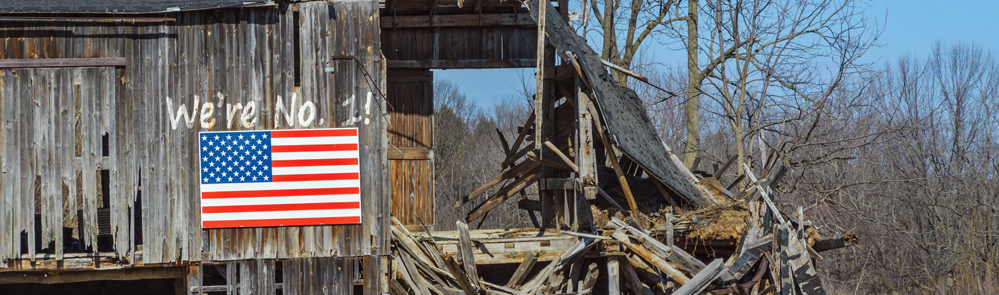
A Nation Holding Itself Hostage?

The Mary Trump book went on sale today. I haven’t read it yet, but do read Dahlia Lithwick’s review  (h/t Swami) —

At bottom, Too Much and Never Enough may be the first book that stipulates, in its first pages, that the president is irreparably damaged, and then turns a clinician’s lens on the rest of us, the voters, the enablers, the flatterers, the hangers-on, and the worshippers. It is here that Mary Trump’s book makes perhaps the most enduring contribution to the teetering piles of books that have offered too little too late, even while telling us that which we already knew. Because Mary Trump begins from the assumption that other analysis tends to end with: Donald Trump is lethally dangerous, stunningly incoherent, and pathologically incapable of caring about anyone but himself. So, what Mary Trump wants to know is: What the hell is wrong with everyone around him? As she writes in her prologue, “there’s been very little effort to understand not only why he became what he is but how he’s consistently failed up despite his glaring lack of fitness.”

The book is thus actually styled as an indictment not of Donald Trump but of Trump’s enablers. The epigraph is from Victor Hugo’s Les Misérables, and it’s emphatically not about Donald John Trump at all: “If the soul is left in darkness, sins will be committed. The guilty one is not he who commits the sin, but the one who causes the darkness.” Mary Trump blames Fred Trump for Donald Trump’s pathology, although she doesn’t claim that her uncle is a tragic victim of abuse. She blames his family that propped him up (also her family, it should be noted), and then in concentric and expanding circles, the media that failed to scrutinize him, the banks that pretended he was the financial genius he was not, the Republican Party, and the “claque of loyalists” in the White House who continue to lie for him and to him in order to feed his insatiable ego and self-delusion. Even the phrase “too much and never enough” is perhaps deliberately borrowed from the language of addiction, and what Mary Trump describes here is not just her uncle’s addiction to adulation, fame, money, and success, but a nation’s—or some part of a nation’s—unfathomable addiction to him.

I’ve had enough experience with psychologically damaged people, especially in the workplace, to see the pattern. If you have to deal with a sociopath or narcissist, you’re either all in or all out. There’s no negotiation, no balance, no middle ground. Especially if this person is in a position of authority, you must either go along with the sociopathy and do whatever is necessary to feed the ego monster you’re dealing with, or you walk away. Perhaps a person with therapist training could find a third way, but that’s not most of us.

One issue that’s come up with a lot of people who originally agreed to work in the administration, like Rex Tillerson or John Bolton, is that they later said they had no idea how damaged Trump is (or words to that effect). They’ve never had the experience of working for a sociopath/narcissist. I would bet money that there are many such people in middle management in companies Tillerson has headed, because the sociopath/narcissist tends to fail up because of his/her sheer aggression and ability to intimidate people. Tillerson and Bolton probably have some sociopathic/narcissistic tendencies themselves.

And then, of course, sociopath/narcissists tends to gather other psychologically damanged people around themselves. The word “codependent” comes to mind. They often create office cultures that replicate their dysfunctional families of origin. The result is an absolutely toxic workplace that will probably crash and burn eventually, but perhaps not for years, because workers who want to keep their jobs will keep trying to be productive. But I have seen this happen so many times that it must be pretty common, or else I have really bad work karma to end up working for these people time and time again.

It must be absolute hell to work for the White House now, but I’m guessing the pay is good and it’s a classy thing to put on one’s résumé (although the Trump White House may prove an exception). That accounts for the people who stick there, but some of them must be inwardly seething, because juicy stuff keeps getting leaked to the press. I bet a lot of them are secretly praying that he loses, so that they can be freed from workplace hell without having to quit or be fired.

But then we have to stand back and look at the enablers who don’t actually work in the White House. It’s possible that someday historians will write that the Trump Administration was the nail in the coffin of the Republican Party. We can hope, anyway. Republicans made the choice to stick with Trump because they were afraid of his base of cult worshippers, we’re told. But Republicans are also utterly dependent on a relatively small handful of mega donors, and to a large extent the MAGA-heads and the deep pocket plutocrats are both holding the Republican Party hostage. Nancy LeTourneau writes,

Because Democrats were so successful in raising small donations online via ActBlue, the Republicans created something similar in 2019 that they call WinRed. But it’s not working out very well for them.

Last month, the National Republican Senatorial Committee prepared a slideshow for Senate chiefs of staff full of bleak numbers about the party’s failure to compete with Democrats on digital fundraising. For anyone not getting the message, the final slide hammered home the possible end result: a freight train bearing down on a man standing on the tracks.

The slideshow, obtained by POLITICO, painted a grim picture of the GOP’s long-running problem. Republican senators and challengers lagged behind Democrats by a collective $30 million in the first quarter of 2020, a deficit stemming from Democrats’ superior online fundraising machine. Since then, Democrats’ fundraising pace accelerated further, with the party’s challengers announcing huge second-quarter hauls last week, largely driven by online donors giving through ActBlue, the party’s preferred fundraising platform.

Republican strategists suggest the problem is that their candidates haven’t done the legwork that is necessary to build a grassroots base of small donors. But at least one Republican who lost in 2018 suggests that the problem goes much deeper.

Many candidates have long assumed that “95 percent of the money you would raise would be from large donors, political action committees. Online fundraising was just to check the box,” said former Rep. Carlos Curbelo (R-Fla.), who lost his seat in 2018 after being outraised by his Democratic opponent. “For a long time, members didn’t understand the potential of online fundraising.”

With tax cuts and deregulation as their only real agenda, Republicans have built their fundraising campaigns around the desires of their big donors who support their election via superPACs. That means that they haven’t had to pay attention to the grassroots in order to build the kind of small donations that come via online fundraising. Therefore, to fully utilize a platform like WinRed requires them to change their entire culture. That’s why they’re struggling.

Instead of protecting Trump, Republicans would be in a much better place now if they’d found a way to dump Trump at least a couple of years ago and let Pence be POTUS. Based on his record in Indiana I doubt he would have handled the pandemic or the police brutality crises effectively, either, but perhaps he wouldn’t have made as total a botch of it all as Trump has. But the Republicans waited too long.

Jacob S. Hacker and Paul Pierson had an article in WaPo last week that points to the same thing —

How did the GOP get here? The conventional account emphasizes white backlash, particularly white male evangelical backlash. After the civil rights era, Republicans attracted an increasing share of resentful white voters by stoking outrage against a growing list of boogeymen: lawless immigrants, godless liberals, anti-gun zealots, dark-skinned freeloaders. In this account, white mobilization in rural and small-town America explains both Trump’s 2016 victory and his 2020 vulnerability.

This account is not so much wrong as badly incomplete. In its fixation on right-wing populism, it ignores right-wing plutocracy: conservative business leaders and reactionary billionaires who’ve focused not just on winning elections, but on rewriting the rules of our economy and our democracy. The growing power of these forces has encouraged the GOP to embrace a retrograde economic program that has little support even among its own voters. One effect is more inequality. Another is a Republican Party more reliant on white identity to stay in power.  …

… With concentrated wealth has come unprecedented investments in politics by billionaire donors and business organizations, mostly on the right. Showcasing this conservative tilt, in 2016, the anti-government advocacy network associated with Charles Koch spent about as much to advance its reactionary agenda and elect sympathetic politicians as the Republican Party itself. In the process, plutocratic forces have reshaped the positions of both parties — especially the Republican Party.

But how do you keep getting votes with an unpopular agenda? That’s where the race-baiting and stoking the fires of resentment and fear come in. This is what Hacker and Pierson are calling “plutocratic populism.” It’s a strategy that relies on organized money and organized outrage.

In the 1990s, GOP leaders like House Speaker Newt Gingrich, Tom DeLay and future House Speaker John A. Boehner embraced wealthy donors and an increasingly assertive business community, which had started ramping up its political efforts in the 1970s. Simultaneously, they nurtured grass-roots groups skilled at stoking grievance, particularly the Christian right and the National Rifle Association. Crucially, so long as these groups got a full-throated defense of gun rights and traditional values (especially from nominees to the federal courts), they had no problems with the party’s plutocratic priorities.

That works as long as members of the outraged mob are either reasonably well off or are completely blinded to how they’re being used. And the wins for the plutocracy under Trump have been huge. Outrageous tax cuts, plutocracy-friendly judges, killing safety and environmental regulations, you name it. The rich are winning, bigly. No wonder the stock markets keep going up even though the economy is in big trouble.

But these wins have come at a growing price. Outsourcing outrage has secured elections but also succored extremism — at times violent extremism. Conservative media have amplified the worst of it. Republican leaders who cultivated backlash soon found themselves undone by it. Two GOP speakers resigned in turn. As Boehner’s chief of staff lamented, “We fed the beast that ate us.” Trump, who fattened the beast, was the party’s logical destination.

Now the bill may be due. If the problem were just an aging and outnumbered voting base, it would be vexing enough. But Republicans have also locked themselves into priorities with powerful backers yet little popular support. When Republicans’ extraordinarily top-heavy 2017 tax bill looked set to fail, one GOP senator predicted “the financial contributions will stop.” Another warned, “My donors are basically saying, ‘Get it done or don’t ever call me again.’ ” A year later, GOP donors were privately advocating that candidates downplay the tax cuts and hype an immigrant “invasion.”

I wrote a couple of days ago that Trump is holding us all hostage, and it still feels that way because none of our crises can be competently addressed as long as he is POTUS. But of course it’s bigger than that. The Republican Party is holding us hostage but the plutocrats and the Trump cult are holding the Republican Party hostage. And as long as the Clinton cult controlled the Democrats, the Democratic Party played the role of enabler of much of what the Republicans were up to. But I think the Dems are finally starting to move on from the Clintons, at least.

Basically, though, we’re a nation holding itself hostage. Nothing but a complete break with the patterns of the past four to five decades or so will save us.

Der Spiegel

How Worthless Is Betsy DeVos?

Well, this went well.

In brief, she is demanding that schools fully open at their regularly scheduled time, but she wants local school districts to come up with their own plans for how to keep children safe.

“Every school should have plans for that situation to be able to pivot and ensure that kids can continue learning, at a distance if they have to for a short period of time,” she said. What’s the plan? The plan is to have plans. It’s a plan plan.

Bash followed up: “Why do you not have guidance…just weeks before you want those schools to reopen,” she wondered, “and what happens if there’s an outbreak?”

“You know, there’s really good examples that have been utilized in the private sector and elsewhere, also with front line workers and hospitals, and all of that data and all of those examples can be referenced by school leaders,” DeVos said.

Private sector office buildings are not schools. Meat packing plants are not schools, Hospitals are not schools. Warehouses are not schools. Schools are different from those places in a lot of ways. Schools involve large numbers of children, some of them quite small, for one thing. Certainly a big city school will have different issues from a small rural school, but will the administration not even provide some baseline criteria? And what about appropriating some money for schools that need to find more space in order to keep students further apart? And what about covid-19 tests?

DeVos flamed out on Fox News, also:

WALLACE: And President Trump tweeted Friday: Schools must be open in the fall. If not open, why would the federal government give funding? It won’t.

Two quick questions and I need a quick answer if I can from you, Secretary DeVos.

One, under what authority are you and the president going to unilaterally cut off funding, funding that’s been approved from Congress and most of the money goes to disadvantaged students or students with disabilities? And secondly, isn’t cutting off funding exactly the wrong answer? Don’t you want to spend more money to make schools safer, whether it’s with plastic shields or health checks, various other systems? Does it make more sense to increase funding for schools where it’s unsafe rather than cut off funding?

DEVOS: Look, American investment in education is a promise to students and their families. If schools aren’t going to reopen and not fulfill that promise, they shouldn’t get the funds, and give it to the families to decide to go to a school that is going to meet that promise.

(CROSSTALK)

WALLACE: Well, you can’t do that.

DEVOS: It’s promise to the American people. That’s —

(CROSSTALK)

WALLACE: I know you support vouchers and that’s — I know you support vouchers, and that’s a — that’s a reasonable argument. But you can’t do that unilaterally, you have to do that through Congress.

DEVOS: Well, we’re looking at all the options because it’s a promise to the American people, to students and their families, and we want to make sure that promise is followed through on.  …

…WALLACE: But, Secretary, I want to get — I want to get to this issue of — because the president of the United States said that the CDC guidelines were tough, expensive and impractical. I want to look at some of the other CDC guidance. They talked about putting up shielding in places where six foot — six feet of distance is not possible, plastic shielding. They talked about staggered drop-offs and pickups. Is that tough, expensive and impractical?

DEVOS: Well, again, all of the guidelines are meant to be helpful, to help local education leaders decide and work on how they are going to accomplish what they need to do, and that is getting kids back in school based on their situation and their realities. We know that schools across the country look very different and that there’s not going to be a one-size-fits-all approach to everything. But the key is, there has to be a posture of doing something, of action, of getting things going, putting a plan together for your specific school, for your specific district or for your classroom that ensures that kids are going to start learning again this fall.

Today the Los Angeles and San Diego school districts announced they would be online only in the fall. I suspect there will be more such announcements. I also anticipate a lot of school districts opening up and then closing back down again when a child tests positive and parents decide to keep their kids home.

But DeVos, like Trump, doesn’t think rules apply to her. Last October she was held in contempt of court for trying to collect student loan debts from people defrauded by for-profit college chains, notably ITT Technical Institute, and Corinthian College, that had collapsed. An injunction had been placed on collecting the debts by a U.S. District Court Judge; DeVos tried to collect them, anyway. She argued that the students still had gotten some value from the schools even though the schools are so notorious now that credits from them are worthless.

This is an ongoing issue. Most recently, the Department of Education has been mailing out letters to people who had filed claims for debt relief. The letters say their claims were accepted but they get zero relief, because they had suffered no financial damage, even though they can’t even put their ITT credits on their resumes.

DeVos also has been using the pandemic as an excuse to funnel public school money into private and religious schools. This is from May:

The Coronavirus Aid, Relief and Economic Security Act, signed in late March, included $30 billion for education institutions turned upside down by the pandemic shutdowns, about $14 billion for higher education, $13.5 billion to elementary and secondary schools, and the rest for state governments.

Ms. DeVos has used $180 million of those dollars to encourage states to create “microgrants” that parents of elementary and secondary school students can use to pay for educational services, including private school tuition. She has directed school districts to share millions of dollars designated for low-income students with wealthy private schools.

And she has nearly depleted the 2.5 percent of higher education funding, about $350 million, set aside for struggling colleges to bolster small colleges — many of them private, religious or on the margins of higher education — regardless of need. The Wright Graduate University for the Realization of Human Potential, a private college in Wisconsin that has a website debunking claims that it is a cult, was allocated about $495,000. All of the colleges could apply for the funds or reject them, and Wright officials said the school did not claim the funds.

This is from last week, after Trump demanded that all schools must open in the fall.

Trump then threatened that if schools don’t reopen for in-person instruction in the fall, the federal government might withhold the billions and billions of dollars it sends to primary and secondary education each year. Education Secretary Betsy DeVos later clarified that the federal government would not withhold public education funding entirely but instead convert grants to schools and districts that don’t open sufficiently into private education vouchers for families. …

… DeVos also initially pushed to tilt coronavirus relief funds away from public schools and toward private schools. In the face of widespread opposition, her department modified that proposal, though public school advocates continue to express skepticism. She also announced plans to use some of the Cares Act funding to provide “microgrants” to support home schooling families.

Also this week, DeVos has been slammed for scheduling more time for meetings with the Federalist Society about ways to protect young men from sexual assault allegations instead of addressing the looming school opening fiasco.

And there have been news stories that children taken from parents at the border have been given to a “Christian” adoption agency with ties to DeVos. With all the other crises going on, that one keeps getting lost.

Chris Koski at a Lawyers, Guns, and Money notes that DeVos is someone horrible enough to have stayed in her position the entirety of the Trump Administration — incompetent, evil, and servile. She has a Bachelor of Arts degree in business economics from Calvin College in Michigan, did not go to graduate school, and has never been a teacher, so she has no qualifications whatsoever for her position. She does appear to have a deeply held animus against public schools, which of course would make her a logical choice to Trump.

UNITED STATES – MARCH 28: Education Secretary Betsy DeVos testifies during a Senate Appropriations Labor, Health and Human Services, Education, and Related Agencies Subcommittee on the FY2020 budget request for the Department of Education in Dirksen Building on Thursday, March 28, 2019. (Photo By Tom Williams/CQ Roll Call via AP Images)

We Are Trump’s Hostages

Sorry I’ve been scarce. I gave a Zoom talk this morning to some zennies and had to prepare something. But now it’s done.

We’re being held hostage by a virus. Very little of our civic or economic life can be normal until we are no longer being held hostage by a virus. That’s what our situation amounts to.

The Right is still trying to blame China. There are stories out today in right-leaning media that Steve Bannon is pushing a story that Chinese scientists have defected to the West and are helping the FBI (wouldn’t that be the CIA?) build a case that the coronavirus was deliberately leaked by a Chinese lab.

Real scientists insist that they can tell the virus evolved in nature and is not a lab creation. But Trumpies remain obsessed with blaming China for our current situation. As if it matters.

If you were being held hostage by crazy gunmen, and you found out that instead of trying to rescue you the authorities are just arguing about who the gunmen work for — the mob? the deep state? Tucker Carlson? — you’d probably be pretty damn pissed about it. Just rescue me, already.

Today Trump is raving on Twitter that he won’t let crazy leftists tear down the Washington Monument or the Lincoln Memorial, “or any other Federal Monumrnt  [sic],” as if that were a real threat. And he’s bragging aboujt the great economy and insisting that Barack Obama played more golf as POTUS than he did. That claim has been debunked copiously, most recently at Business Insider.

But what are you doing about the pandemic, Donald? Anything? He submitted to wearing a face mask yesterday at a visit to Walter Reed. That’s about it, as far as I can tell.

Instead, Trump is pissed at the coronavirus task force officials who keep warning people to maintain social distancing, etc. ABC reported yesterday:

As President Donald Trump threatens to cut funding to schools that don’t reopen in the fall and continues to host mega-rallies as cases of coronavirus increase, there appears to be a growing rift between the Trump White House and its top health advisers.

The president has taken his criticism of the government’s top expert on infectious diseases and of leaders at the Centers for Disease Control and Prevention into the public forum in his massive push to reopen the country.

Despite coronavirus response coordinator Dr. Deborah Birx asking Americans in hot spot zones to avoid indoor gatherings and reduce them to 10 people or fewer, Trump on Friday delivered remarks and attended a home fundraiser in Florida as cases there rise — one day after the state saw a record death toll.

The trip came as Trump seeks to downplay the danger in states like Florida, Arizona, Texas and California struggling to control outbreaks — which he calls “embers” — and openly disputes coronavirus task force officials.

In a series of interviews this week, Trump questioned the expertise of Dr. Anthony Fauci, the director of the National Institutes of Health for more than three decades and a prominent member of the White House coronavirus task force, who continually polls higher in favorability than the president.

We’re being held hostage by crazy gunmen, and instead of rescuing us the police officer in charge tells us to just ignore the gunmen and go on about our lives. Some of us may get shot, but hey, that happens.

A couple of days ago, the New York Times released an internal Trump administration document that said “fully reopening schools and universities remained the ‘highest risk’ for the spread of the coronavirus.”

Clearly, the document was prepared to release to school districts to provide guidance. But it was never released. This is possibly because some of the suggestions for mitigating risks to children and faculty, like widespread testing and contact tracing, would be expensive.

We’ve heard of threats that schools could be invaded and children taken hostage by crazy gunmen, but the government doesn’t want to deal with it because providing protection for children would cost money. So just send the kids to school, anyway. Most of them probably will be okay. And, anyway, we need to deploy troops to protect our monuments.

Oh, there is one thing the White House is doing about the pandemic. It’s working to discredit Dr. Anthony Fauci. NBC reported today:

The White House is seeking to discredit Dr. Anthony Fauci, the nation’s leading infectious disease expert, as it works to marginalize him and his dire warnings about the shortcomings in the U.S. coronavirus response.

A White House official told NBC News that “several White House officials are concerned about the number of times Dr. Fauci has been wrong on things.” The official provided NBC News with a lengthy list of past comments by Fauci earlier in the pandemic, including Fauci saying in January that coronavirus was “not a major threat” and “not driven by asymptomatic carriers” and Fauci’s comment in March that “people should not be walking around with masks.”

Many of the past statements the White House is criticizing Fauci for are ones that were based on the best available data at the time and were widely echoed by Trump, other members of the task force and senior White House officials. As Surgeon General Jerome Adams told CBS News on Sunday, “When you learn more, you change those recommendations. Our recommendations have changed.”

Let’s review:

We’re being held hostage by crazy gunmen. The police have an excellent hostage specialist who might know how to rescue us, but officials dismiss him because he originally thought the hostage-taking would happen on a Thursday instead of Wednesday. So now no one is working to rescue us, because the new guy in charge of rescuing people won’t admit we need to be rescued.

About a week ago Dr. Fauci got out a warning that we must not read good news into a falling death rate.

Anthony Fauci, the nation’s top infectious disease expert, warned Tuesday the U.S. should not fall into “false complacency” because COVID-19 death rates have dropped, noting the virus can cause other severe health outcomes.

“It’s a false narrative to take comfort in a lower rate of death,” Fauci said Tuesday during a livestreamed press conference hosted by Sen. Doug Jones (D-Ala.)

“There’s so many other things that are very dangerous and bad about this virus, don’t get yourself into a false complacency,” he added.  …

…Experts anticipate deaths, a lagging indicator in an outbreak, will rise as people generally don’t die until weeks after they become sick.

Still, President Trump and his allies have touted the falling death rate as an indicator the U.S. is succeeding in its fight against COVID-19.

Trump over the weekend claimed that COVID-19 is “totally harmless” to 99 percent of people who get the disease and he continued to tie surging case numbers to increased testing.

Experts say both claims are false. They note that even people who don’t die of COVID-19 can become seriously ill, requiring hospitalization and ventilation.

And then the Los Angeles Times reported Thursday that death rates are going up in key states, notably Texas, Arizona and Florida, where the rates of infection are surging. Deaths are a lagging indicator, we are told. We don’t see death rates going up until several days after case rates go up. Now, rates are going up.

Crazy gunmen keep taking people hostage, but the authorities tell us the situation is getting better because the gunmen aren’t shooting as many hostages as they used to. Until, eventually, they do. But for that reason, we don’t need to take any measures to stop the hostage taking. Things are just fine.

Mixed News from SCOTUS

I’m trying to wrap my head around SCOTUS rulings today. Adam Liptak at the New York Times explains the Trump financial records rulings:

The Supreme Court on Thursday cleared the way for prosecutors in New York to see President Trump’s financial records, a stunning defeat for Mr. Trump but a decision that probably means the records will be shielded from public scrutiny under grand jury secrecy rules until after the election, and perhaps indefinitely.

In a separate decision, the court ruled that Congress could not, at least for now, see many of the same records. The vote in both cases was 7 to 2. Chief Justice John G. Roberts Jr. wrote both majority opinions.

The court’s decision in favor of the New York prosecutors was a major statement on the scope and limits of presidential power, one that will take its place with landmark rulings that required President Richard M. Nixon to turn over tapes of Oval Office conversations and forced President Bill Clinton to provide evidence in a sexual harassment suit.

In the case concerning the prosecutors’ subpoena, Chief Justice Roberts wrote that “no citizen, not even the president, is categorically above the common duty to produce evidence when called upon in a criminal proceeding.” He added that Mr. Trump may still raise objections to the scope and relevance of the subpoena.

The two holdouts were Alito and Thomas. We probably won’t see the records before the election, but I trust the New York prosecutors will not hesitate to go forward and nail the bleeper next year.

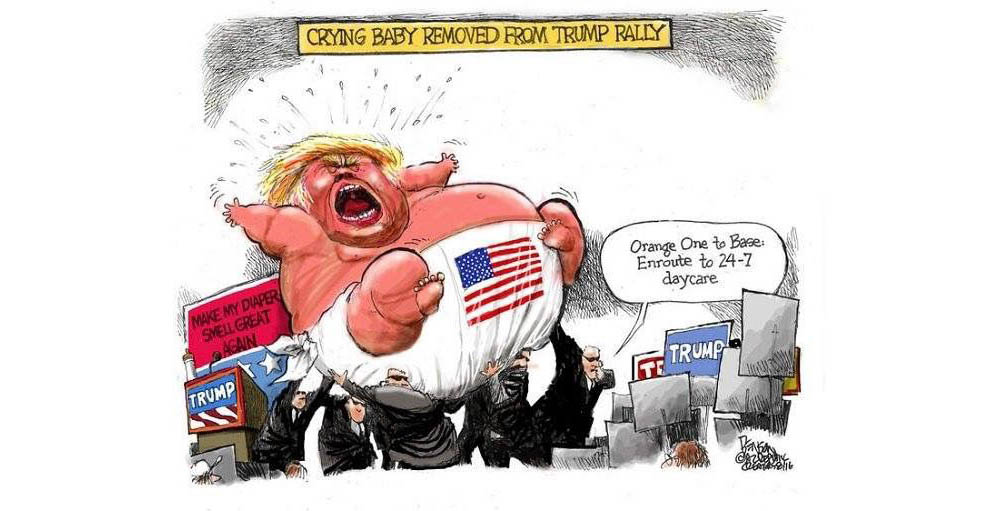
Note that the Big Baby is having a meltdown now:


What can one say, but …

Here’s another explanation of the rulings, from Mark Joseph Stern at Slate:

The Supreme Court managed to pull off a seemingly impossible balancing act on Thursday: It denied President Donald Trump the sweeping immunity from oversight he demanded while also shielding Trump from oversight before the November election. In Trump v. Vance, the court cleared the way for a New York grand jury to subpoena the president’s tax returns … eventually. In Trump v. Mazars, the court upheld Congress’ authority to investigate the president but stymied (at least for now) its current efforts to do just that. With these two decisions, the Supreme Court—and, specifically, Chief Justice John Roberts—has dealt a blow to Trump’s alarming view of unbridled executive power. Yet it has also protected this particular executive from immediate scrutiny.

Vance and Mazars are different cases that ask a similar question: Is the president above the law while he is in office? Or must his executive authority yield to other compelling interests? In both cases the Supreme Court declared that, no, the president cannot exploit his constitutional powers to insulate himself from all oversight. This ruling is a major blow to Trump, and very good news for the fundamental democratic proposition that the president is not a king. But the court went on to give Trump a temporary victory by sending both cases back down to the lower courts for further assessments. In Vance, this move is probably just a hiccup on the way to a final order sending Trump’s tax returns to a New York grand jury. In Mazars, however, the court’s compromise could functionally kill the House of Representatives’ efforts to get its hands on Trump’s financial records.

Aaron Burr made the news today, and not the entertainment section. Jennifer Rubin:

In Vance, Chief Justice John G. Roberts Jr. — writing for a 7-to-2 majority — held that the president not only lacks immunity from a state criminal investigation but also enjoys no special, heightened standard of proof. Roberts recounted the history of the trial of Aaron Burr and then-Chief Justice John Marshall’s ruling that President Thomas Jefferson was not immune from a subpoena for records. “In the two centuries since the Burr trial, successive Presidents have accepted Marshall’s ruling that the Chief Executive is subject to subpoena,” Roberts wrote. He also cited U.S. v. Nixon, which held that “the President’s ‘generalized assertion of privilege must yield to the demonstrated, specific need for evidence in a pending criminal trial.’” While these cases involved federal subpoenas, Roberts held that state subpoenas are no different. Rejecting the notion of absolute immunity, Roberts found that “we cannot conclude that absolute immunity is necessary or appropriate under Article II or the Supremacy Clause.” (On this, he points out there was unanimous agreement in the court.)

So while it’s disappointing the records won’t be released  before the election, it could have been worse.

In another significant ruling I didn’t see coming, the Court ruled that about half of Oklahoma is rightfully a reservation under the jurisdiction of the Muscogee (Creek), Cherokee, Chickasaw, Choctaw, and Seminole Nations.

The Supreme Court on Thursday ruled that nearly half of Oklahoma falls within an Indian reservation, a decision that could reshape the criminal-justice system by preventing state authorities from prosecuting offenses there that involve Native Americans.

The 5-to-4 decision, potentially one of the most consequential legal victories for Native Americans in decades, could have far-reaching implications for the 1.8 million people who live across what is now deemed “Indian Country” by the high court. The lands include much of Tulsa, Oklahoma’s second-biggest city.

The swing vote this time was Gorsuch, siding with the four liberals.

“Today we are asked whether the land these treaties promised remains an Indian reservation for purposes of federal criminal law,” Justice Gorsuch wrote. “Because Congress has not said otherwise, we hold the government to its word.”

I suspect it’s going to take some time for people to figure out how this is going to work. But treaties are treaties.

The Push to Reopen Schools: Trump in a Microcosm

Trump wants schools to reopen in the fall. That in itself is not unreasonable; the American Academy of Pediatrics also wants schools to open in the fall. I’m sure a whole lot of parents of school-age children want schools to reopen in the fall. What the kids think no doubt varies.

However, Trump really wants schools to reopen in the fall. He seems nearly frantic about it.

Let’s review:

From CNN as of 6/30/2020. Source: Johns Hopkins Data Center

So, we can say the U.S. and Europe are not exactly in the same place wth this pandemic thing. But maybe we could reopen schools if we took proper precautions …

NPR:

Existing CDC guidance includes temporary school dismissals if there is a substantial spread of COVID-19 within the community and, in cases of mild to moderate community transmission, modifying classes where students are in close contact, staggering arrival/dismissal times and enforcing social distancing.

The CDC continues to update its website with best practices, including this checklist for schools. It’s unclear which specific guidance the president was rebuking.

So no precautions. Trump just wants the doors to open and the students to get their butts back in classrooms. There’s been some vague talk about providing targeted help for schools in hot zones, but nothing specific.

Trump’s talk of cutting off funding for schools rings a bit hollow when you understand that federal money is, on average, less than 10 percent of revenue, the NPR article says. Also, school funding is appropriated by Congress; Trump has no authority to cut it off.

It’s also the case that public schools in the U.S. are administered by locally elected school boards, and so ultimately the go or no-go decisions will be up to them. Trump says he will lean on governors to force schools open, but I’m not sure how much even governors can do if a particular school district decides to postpone opening because of the pandemic.

The reason Trump is frantic to open schools is, obviously, that having kids at home makes it harder for a lot of workers to get back to their jobs. His whole Grand Plan for re-election hinges on Making America January 2020 Again, but without having to actually do anything about the, you know, pandemic. He’s not a detail guy.

So he’s going to tweet and harangue and bitch that the evil Democrats want to keep schools closed because of “politics,” and he will send all of his remaining minions out to talk to the media about how much they value education and want to get kids back to school. The one thing I doubt he will do is provide useful guidance and sufficient funds for whatever adjustments (such as number of students in a classroom) schools might have to make.

And if the pandemic is really slamming us in September, as I suspect it might, will America’s parents be all that keen about sending the kids back to the same overstuffed classrooms with no thought given to what germs the kids might pick up and bring back home? And has Trump even considered that such parents might be angry with him for putting their families at risk? Probably not; he’s not exactly the responsible parent type.

It appears that after all this time and all the suffering, Trump still doesn’t get that the pandemic is a really bad thing that he can’t intimidate or wish away. But Greg Sargent argues that the problem isn’t that Trump is in denial about what could happen. He knows; he just doesn’t give a bleep. “Malevolent” is the operative word here.

Once we dispense with the idea that Trump remains “in denial,” we’re left with a few interpretations. The most charitable is that Trump continues to have principled disagreements with experts over these matters, but there are zero indications he has any substantively grounded views on them of any kind.

A far less charitable interpretation is that he’s merely indifferent to the catastrophic consequences that are resulting from these failures — and will continue to do so — and that he’s prioritizing nakedly self-interested political calculations over any such concerns.

I’m leaning toward the latter, because that has been Trump’s pattern all along. Time and time again he’ll launch some scheme to do this or that — separate families at the border, ban travelers from Muslim countries, etc. — with no planning, no consulting with people tasked with carrying out the scheme, no forethought to consequences — and at some point you just have to admit, this is who he is. Trump doesn’t do plans. He doesn’t give a shit about anyone but himself. He just wants what he wants, now.

That’s why I’m saying this school reopening thing — issue? controversy? — is the Trump administration in a microcosm. Trump makes up his mind that something will be to his advantage, and he throws endless tantrums until he gets what he wants. But he can’t be bothered to do the thing in incremental steps or make accommodations to people for whom doing the thing would be a problem. And he doesn’t consider consequences, even if they are explained to him.

This doesn’t necessarily rule out denial, though. The man has some serious short-circuiting in his brain. Previews of the upcoming tell-all book by his neice Mary Trump point to this. “… Donald’s pathologies are so complex and his behaviors so often inexplicable that coming up with an accurate and comprehensive diagnosis would require a full battery of psychological and neuropsychological tests that he’ll never sit for,” she writes.

Mary takes the media to task for searching for a “strategy” in anything Donald does and for soft-pedaling what she describes as multiple psychological disorders, which, by her account, check a variety of boxes in diagnostic manuals. She thinks that Donald, at a minimum, suffers from an “antisocial personality disorder” and a longstanding but undiagnosed learning disability.

Mary Trump is a trained clinical psychologist, so I am inclined to take her word for this. We do not need to spin our wheels over the why; we just need to understand this is what Trump does, and he doesn’t have it in him to do anything else.

That said, could schools be reopened in the fall? Matt Yglesias has an article up at Vox that looks at this question from several angles. The short answer is yes, but not without a whole lot of money and planning, little to none of which schools are going to get from the federal government or most of the state governments. So, once again, we’re heading toward a disaster we can see coming, but because of Trump there’s little that will be done about it.

Trump: Running on Empty

There’s a lot of good commentary on the Trump campaign today, much of it with a similar theme — Trump is running on empty.

Quinta Jurecic and Benjamin Wittes, The Atlantic, Trump Is Campaigning on a Platform of Abject Failure

In a series of speeches over the past several days, the president has spelled out, or at least gestured toward, the major themes of his coming campaign. There will be other themes, to be sure—mostly, one presumes, attacks on Joe Biden—but the president’s recent speeches in Tulsa, in Phoenix, and at Mount Rushmore all outline what appear to be the main components of his affirmative case for a second term.

Trump’s arguments for himself are threefold, Jurecic and Wittes write. First, he claims to have built a great economy (as opposed to coasting on the economy left him by Barack Obama, which is closer to the truth) before the pandemic hit. He is the guy you want to make the economy great again, as opposed to Biden, who is going to raise your taxes. How persuasive this argument will be if the economy doesn’t get significantly better before November is anybody’s guess, but I’m doubtful it’s going to work.

Second, he’s boasting he did a great job keeping the pandemic under control, while at the same time claiming it isn’t that bad and will just go away. “As The Washington Post reports, he has suggested 19 times since February that the virus might just “go away”—most recently on July 1,” Jurecic and Wittes write. Trump is at the mercy of the virus.

And third — culture war. Confederate monuments, law and order, scary immigrants, more racist dog-whislting than we’ve seen since the 1960s. At the same time, there will be much demonizing of the “left-wing mob” trying to destroy everything good and pure and white in America.

Let’s take these three items in reverse order, starting with culture wars. Jamelle Bouie writes at the New York Times that if the election were held today, Trump would almost certainly lose in a landslide. He’s got four months to turn his fortunes around. Can he do it?

With enough racist demagogy, Trump seems to think, he’ll close the gap with Biden and eke out another win in the Electoral College. But it is one thing to run a backlash campaign, as Trump did four years ago, in a growing economy in which most people aren’t acutely worried about their lives and futures. In that environment, where material needs are mostly met, voters can afford to either look past racial animus or embrace it as a kind of luxury political good. When conditions are on the decline, however, they want actual solutions, and the politics of resentment are, by themselves, a much harder sell.

Bouie goes on to provide some examples from history to argue that racist campaigns work better in good times than bad, concluding —

… if it takes a decent economy to make voters conducive to the campaign Trump wants to run — then he is, at this moment, speeding down an electoral dead-end. As long as Covid-19 is out of control, as long as there is mass suffering, sickness and economic distress, then nothing short of actually doing his job will help him get ahead. There simply is no substitute for good governance.

And good governance isn’t something Trump can do. He couldn’t do it if he tried. He has no clue what “governance” even is. See also Shane Savitsky at Axios, Trump’s failing culture wars, and Zeeshan Aleem at Vox, Trump is going all in on divisive culture wars. That might not work this time.

I’m seeing some Trump ads on St. Louis television stations that are about what’s going to happen when you call the police and have to deal with an automated telephone tree with a five-day response time. But whatever you think of defunding the police, that’s a state and local matter. I’ve also seen internet ads playing up the alleged corruption of the Obama-Biden administration, although exactly what that corruption was supposed to be is not explained.

The Trump campaign is painting Joe Biden as too weak and feeble to deal with all the chaos the “left-wing mob” is bringing. However, at the same time, the Trumpies are trying to hang the anarchists and Antifa! and all the dark boogeymen in their dark minds around the neck of Biden, as if he were in cahoots with them, and I don’t think they can have it both ways.

Anyway, I agree with the view that most voters whose lives have been upended by the pandemic and the economic disruptions caused by the pandemic don’t want to hear about Confederate statues. They want to know what you’re going to do to put their lives back together.

And attacking Bubba Wallace? Seriously? See Will Leitch, New York magazine, Trump Can’t Turn Bubba Wallace Into Colin Kaepernick.

About the pandemic — Greg Sargent writes that it is just now dawning on Republicans that maybe they’ve made some bad decisions.

For many weeks, the basic story that President Trump told the country — and himself — went like this: The only thing restraining us from roaring back to greatness is the oppressive restrictiveness of overzealous officials, mostly Democratic governors and pointy-headed health experts.

In this narrative, by tweeting things such as “LIBERATE MICHIGAN,” Trump aligned himself with the proposition that once lockdowns were lifted, Americans chafing to resume normal activity would instantly do so by the millions, unleashing a miraculous “V-shaped recovery.”

Yet privately, Trump’s own allies are suddenly making a major admission that completely overturns this narrative. Instead, they are acknowledging a core truth about this whole crisis — one that has already landed his reelection effort in deep trouble. …

… Trump’s allies are admitting what numerous experts have said for months: That in order to seriously get back on track to economic recovery, we have to tame the virus first. And they’re admitting that this is a key reason he’s in trouble.

So Republican politicians are swallowing hard and saying, um, yeah, maybe we ought to be wearing masks. Maybe we should have maintained isolation longer, instead of pushing to open the economy back up so fast.

Just as an example of how the ground has shifted, today Texas governor Greg “what pandemic?” Abbott blasted local leaders for not taking the pandemic seriously enough and enforcing restrictions, including mask orders.

There is also serious talk about whether down-ballot Republicans should cut their ties with Trump to salvage their own elections. They aren’t going to do it next week, but if we get to the first of September or so without visible progress on either the economy or the pandemic, some may feel forced to make that choice.

[Update] See Nancy LeTourneau at Washington Monthly:

Trump’s failing campaign is threatening Republican control of the Senate. Nevertheless, when asked whether the president has exhibited failed leadership in response to the coronavirus, Senator Joni Ernst defended him saying, “I think that the president is stepping forward.”

Apparently that response helped her opponent, Theresa Greenfield, raise over $100,000. It’s worth noting that the most recent Des Moines Register poll showed Greenfield leading Ernst by three points. In a state Trump won by nine points in 2016, that same poll had Biden ahead by one point.

The Senate race in Iowa demonstrates the dilemma facing Republicans all over the country—even in traditionally red states: Do they stick with the president and go down with him, or do they hold him accountable and risk losing the support of the GOP base, which remains loyal to Trump. At this point, they’re obviously picking the former. But according to Gabriel Sherman, they’ve adopted a deadline on that.

A Republican strategist told Gabriel Sherman that “Republicans have Labor Day penciled in as the deadline for Trump to have turned things around. After that, he’s on his own.” LeTourneau expresses the opinion that Republicans are deluded if they think Trump is going to start doing anything differently from what he’s doing now, which isn’t working.

Regarding the economy, bringing that back will depend a lot on the virus and a lot on Congress. The headlines today are full of the names of all the companies and organizations that got PPP loans instead of your cousin whose restaurant business is going under. Even so, Congress needs to get another stimulus package out, soon. Mitch McConnell opened the door a crack yesterday that maybe something would be considered, which suggests what’s left of his hair isn’t in fire yet. It ought to be.

The only thing I can say for sure is that Trump is not going to pivot away from his campaign decisions. It’s going to be GLOOM DOOM CULTURE WAR, what pandemic?, and trust me on the economy from now until the election.

The Problem With “Western Civ”

I’m still thinking a lot about history and how we tell it. Charles Blow today recalls a Columbia University sophomore who went on an infamous rant about how white people created the modern world.

“We invented science and industry, and you want to tell us to stop because oh my God, we’re so baaad. We invented the modern world. We saved billions of people from starvation. We built modern civilization. White people are the best thing that ever happened to the world. We are so amazing! I love myself! And I love white people!”

Blow says that these are the sentiments “at the root of patriarchal white supremacist ideology.”

To people who believe in this, white men are the heroes in the history of the world. They conquered those who could be conquered. They enslaved those who could be enslaved. And their religion and philosophy, and sometimes even their pseudoscience, provided the rationale for their actions.

It was hard not to hear the voice of von Abele when Trump stood at the base of Mount Rushmore and said, “Seventeen seventy-six represented the culmination of thousands of years of Western civilization and the triumph not only of spirit, but of wisdom, philosophy and reason.” He continued later, “Our nation is witnessing a merciless campaign to wipe out our history, defame our heroes, erase our values and indoctrinate our children.”

To be clear, the “our” in that passage is white people, specifically white men. Trump is telling white men that they are their ancestors, and that they’re now being attacked for that which they should be thanked.

The ingratitude of it all.

I don’t know if world history is still being taught this way, but back in my day world history was “western civilization.” We skipped from ancient Egypt to Mesopotamia to Greece and Rome to the rest of Europe and, eventually, the European conquest of the New World. Period, end of the story of world history. Nothing about Africa after ancient Egypt, nothing about Asia after Mesopotamia except through the eyes of the Crusaders, nothing at all about East Asia, nothing about the indigenous civilizations of the Americas except that they were conquered.

One of the challenges I faced when writing The Circle of the Way was that I had to get up to speed on Asian history. Indeed, most of what I know about Asian history I’ve learned, in bits and pieces, over the years while studying and writing about bits of Buddhist history. I stumbled into what European colonialism did to the people and civilizations of India, Sri Lanka, Myanmar, Vietnam, Cambodia, etc. This is dark stuff, and I don’t know if Europeans have ever reckoned with it. Americans are nearly all blissfully unaware of it. Then, to get Circle right I had to dig deeper into the histories of China, Japan, and Korea. I developed an appreciation of what “western civ” might look like to an Asian, which is, um, not nearly as flattering as how “western civ” sees itself.

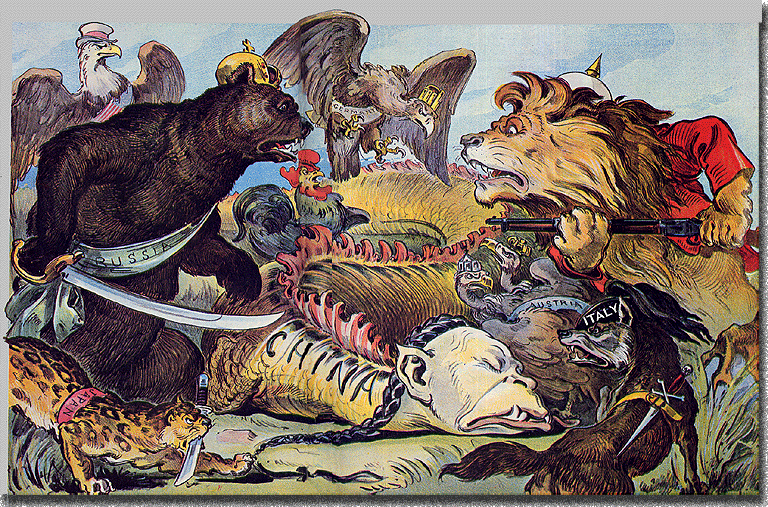
19th century cartoon of western powers fighting over the spoils of China.

That the period of European exploration and conquest had a huge impact on what we call the “modern world” is beyond doubt, but if that had never happened it is not at all a given that we wouldn’t now have a modern world that is just as technology-rich and “enlightened” as this one. I’ve come to realize that a whole lot of the acrimony and tensions in the world today can be traced back to cultural and societal destruction caused by European colonialism and other episodes in which Europeans, and Americans, messed around with other people’s countries. The partitioning of the Middle East after World War I comes to mind.

If you look at all of world history, you see that there’s nothing innate in Europeans to make them uniquely advanced. If anything, through most of world history Europe was, relatively, a cultural backwater. In the 12th century China was light years ahead of Europe in technology and other advances, from movable type, compasses, and timepieces to architecture to the earliest development of commercial farming. During the period of the European crusades the Islamic world was at a cultural peak, and was way ahead of Europe in science and mathematics. From the 11th to 14th centuries many Europeans traveled to the Middle East to study, and in part from this infusion of not European scholarship eventually the Renaissance was born.

So, white folks, we ain’t that special. Deal with it.

Charles blow quotes Trump as calling attempts to correct the historical record a “defilement” of history. Is it a defilement to state, correctly, that several of the founding fathers were slave owners and that even Abraham Lincoln said some things that come across today as blatantly racist? “It is not a defilement, but deprogramming,” Blow writes. “It is a telling of the truth, and the time for it is long overdue.”

Getting history right is important, because a skewed version of history leads to a skewed version of how we got to be where we are now. Keeping up the pretense that western civ brought nothing but bounty and blessings to the world is keeping us stuck in an untenable present.

And it should terrify all of us that Trump, who knows nothing of history and probably associates Confucius with Charlie Chan movies, is responsible for dealing with China. I assure you that China understand us a lot better than we understand them. As Sun Tzu said, “If you know the enemy and you know yourself, your victory will not stand in doubt.”

And then there’s U.S. history. I’ve already written quite a lot about the damage done by the Lost Cause mythology that romanticizes the Confederacy. But here’s an anecdote that hammers home the denial we are in about it. This is by Tom Wheeler at the Brookings Institute.

A few years ago, I was making a presentation in a former slaveholding state based on my book “Leadership Lessons of the Civil War.” When I referred to those who fought for the Confederacy as traitors, you could feel the air being sucked from the room. Afterward, some who had been in the audience confronted me over the statement.

But the judgment is unassailable. To take up arms against your country is a traitorous act.

This is one one might call a bare-assed fact, but people refuse to look at it. That’s programming.

Erecting statues is just a way to obfuscate that reality while celebrating what caused it. In a similar manner, naming American military bases for generals who fought against America helps keep that traitorous tradition alive.

The Confederate stuff has to go. Other historical monuments we can debate on a case by case basis, but the Confederate stuff has to go.

At the New Yorker, Isaac Chotiner interviews historian Susan Neiman on How to Confront a Racist National History. Neiman has written quite a bit on postwar Germany and how Germans, slowly, came to process the Third Reich. She said,

I think it is very natural for everyone to want to see their ancestors and their nation as heroic. And if you can’t do heroic, then the move is to see yourself and your nation as a victim. But the move from seeing oneself as a nation of victims to a nation of perpetrators is one that the Germans finally and with great difficulty made. And that’s a historical precedent.

White southerners have been programmed to understand the Confederate legacy as a victimization of the South by the northern industrial states. And they see the Confederates as noble and heroic. But they were traitors, their cause was ignoble, and they bleeping started the bleeping war. We’re not going to be done with this hideous “heritage” until white southerners or anyone who romanticizes the Confederacy fully acknowledge that the Confederates were perpetrators. Not heroes, not victims. Perpetrators. At times in our history other Americans played the role of perpetrators. And some of that part of our history — see: Native Americans — is ongoing. It’s time we grew up about it.

Something of a postscript: Recently Jeff Sharlet posted something on Facebook I’d like to share here —

Again, what we see here is that this skewed, heavily mythologized version of history that remains embedded in school curriculum and popular culture just feeds notions of white supremacism and other right-wing wackjobbery. In this case, Sharlet describes the veneration of Stonewall Jackson among some white Christian conservatives. Jackson is held up as a “soldier of the Cross,” the ideal of the Christian warrior. Here’s just a bit —

In All Things for the Good: The Steadfast Fidelity of Stonewall Jackson, the fundamentalist historian J. Steven Wilkins opens a chapter on Jackson’s belief in the “black flag” of no quarter for the enemy with a quotation of Jackson’s view of mercy toward Union soldiers: “Shoot them all, I do not wish them to be brave.”

Earlier, in the Mexican War, Lieutenant Jackson defied an order to retreat, fought the Mexican cavalry alone with one artillery piece, and won. General Winfield Scott, commander of the U.S. forces, commended him for “the way [he] slaughtered those poor Mexicans.” Many of the poor Mexicans slaughtered by Jackson were civilians. His small victory helped clear the way for the American advance, and Jackson was ordered to turn his guns on Mexico City residents attempting to flee the oncoming U.S. Army. He did so without hesitation—mowing them down even as they sought to surrender.

This is commended in Christian popular history as proper Christian warfare. And these are the same alleged Christians who support Donald Trump. Knowing how they understand history does shed some light on their devotion to Trump. But along with his cold-blooded fanaticism for the Cause, Jackson was a flawed man who harbored a host of “eccentricities” that would have been labeled “neuroses” in later times and “psychological disorders” nowadays. He is not exactly a healthy role model. But in decades past even standard histories and textbooks, never mind Christian ones, made him out to be a great American. Enough.

A Normal 4th of July

Back in the day, on a normal 4th of July, people gathered in backyards for potato salad and chips and cold beer and various meats cooked on the grill while a Major League Baseball game played on a radio. Some might take advantage of the 4th of July blowout sales at the mall to get that new microwave or mattress. Some might take a long weekend for a car trip to some scenic place. In the evening, there were fireworks.

At some point in the day, some thought might be given to the Declaration of Independence, but that wasn’t mandatory. And maybe that was okay. The point of the Revolution was to enable people to lead peaceful and normal lives, not to churn out succeeding generations of flaming revolutionaries.

This year — I guess not.

We’re engaged in a vast and messy national argument about our past, our present, and our future. I assume the November election will give us some indication of which argument is winning, although it’s probably too much to hope for a resolution. But as awful as this year has been, this blowup needed to happen. It’s been building for a lot of years. Trump’s awfulness hurried it along, but it would have happened sooner or later.

Let’s hope that next 4th of July we’re all in a much different place, and we’ll all be enjoying big cookouts and fireworks and even blowout sales on mattresses. This year, take some time for a cold beer and watch Hamilton on the Disney Plus channel. You’ll enjoy it.

Stuff to Read

Anne Applebaum, The Atlantic, Trump Is Turning America Into the ‘Shithole Country’ He Fears

Charles Pierce, Esquire, This Fourth of July, We’re in Another One of Those Moments Where the Great Bluff Gets Called

David Atkins, Washington Monthly, The Trump Administration Is Giving Up on Fighting the Pandemic

Robin Givhan, The Washington Post, Trump got his crowd and his fireworks, and peddled his fiction

Paul Krugman, The New York Times, Trump’s Virus Is Spreading, and His Economy Is Stalling

Dale Beran, The Atlantic, The Boogaloo Tipping Point

A More Perfect Union

I’ve been thinking a lot about the convergence of history and myth lately. Modern people like to believe we have left myth behind, but that is not true. As I’ve written elsewhere on this blog, many of us have a whole lot of mythology clanking around in our heads that define us, as individuals and as citizens and as a lot of other things. See, for example, The Myths That Guide Us from 2017 and The Last Hurrah of the Lost Cause from a couple of days ago.

Timothy Egan wrote in today’s New York Times that “No country can last long without a shared narrative.” That may be true, and it’s very possible that a big part of our current divisiveness is that we as a nation have been divided by narrative, and by that I mean narratives that tell us who we are as Americans and what the U.S.A. is supposed to be.

For example, we all may share some part of the history of the Revolutionary War as part of our internal narrative. But it’s striking how much the Right so often falls back on the imagery and symbols of the Revolution, as if they owned them, in support of causes that would baffle the original revolutionaries.

UNITED STATES – APRIL 6: Tea party activist John Oltesvig, of North Carolina, wears a colonial costume with a tri-corner hats as he participates in the rally at the Capitol on Wednesday, April 6, 2012, days before a possible federal government shutdown. (Photo By Bill Clark/Roll Call) (CQ Roll Call via AP Images)

Let’s take taxes. The real founders, of course, were not opposed to  taxes, but to taxes without representation. President George Washington himself put on his army uniform and led federalized militia against the big tax revolt of his day, the Whiskey Rebellion, in 1794.

Or let’s take guns. The framers of the Constitution did not write the 2nd Amendment so that Americans could own any damnfool weapon they wanted to be ready to revolt against the U.S. govrnment whenever they got pissed off enough, as gun-rights activists insist. (See Garrett Epps at The Atlantic for background; I don’t have the strength to wade back into gun rights again.) So we see that today’s political Right is using a highly mythologized version of our founding history as part of their internalized narrative about what America is supposed to be, and it’s doing a lot of harm.

When the founders got around to forming a government, including the second one under the current Constitution, they were very careful not to put too much power into the hands of one person but to spread power around among various parts and levels of government. Today, the Right wants all power to flow to Donald Trump, and anyone considered disloyal must be part of the evil “deep state.” That’s more Orwellian than Jeffersonian, my dears.

The Revolution was supposed to be about freedom. But I wrote back in 2005 that the Right had stripped the word freedom of all meaning and rendered it into nothing but a tribal totem. The people who fetishize about freedom are too often the same ones who want to jail protesters, make excuses for police brutality, and approve of putting children in cages at the border. Oh, and let’s not even start on reproductive rights. Freedom for me, but not for thee.

The Revolution was about people shaking off the rule of a distant power so that they could form their own government with their own elected representatives, with some restrictions on that government written into the Bill of Rights. This was the liberty they fought for, not license to do whatever I want whenever I want to do it, and the hell with everyone else.

See also The Pandemic, the Constitution, and Civil Liberties. The notion that mandatory quarantines or mask wearing is government tyranny that Our Forefathers wouldn’t have approved of just doesn’t hold up. And those who are outraged that bars or hair salons are closed to get the damn pandemic under control are not people I personally want to pledge my life, fortune (such as it is) and sacred honor with, to tell you the truth. I would be concerned that on the day we are called to do our utmost for the nation, they’d be getting their nails done. (I do wonder if a lot of the people who think only “sheeple” wear masks are the same ones who adamantly refuse to grasp the concept of herd immunity and vaccinations, but that’s another rant.)

By now most of us are grappling with the fact that much of our national mythology has been all about white people. This is dysfunctional. We will not be a more perfect union until we are a more inclusive union. Timothy Egan’s column begins:

As baffling as it is to find statues of traitors, slaveholders and killers of Union soldiers ensconced in many a prominent square, consider the historical discordance of Custer County, S.D.

The hard beauty of the Black Hills, sacred land to Native Americans, overshadows the county, the main town and the state park, all named for George Armstrong Custer. The hard history was shaped by the slayer of those native people. Custer’s willful trespass into territory promised by treaty to the Sioux set the stage for the last violent encounters between New World and Old.

Just under 20 miles from Custer is Mount Rushmore, which President Trump plans to visit this Fourth of July weekend. A mere seven miles from Custer is the Native American Rushmore — a still unfinished carving of the Oglala Sioux leader Crazy Horse, 641 feet long and 563 feet high.

Here is the American paradox in a grid of stark geology.

As you know, Trump plans to get his picture taken with fireworks over Mount Rushmore in front of a maskless and not socially distanced crowd this weekend, in spite of the real danger of forest fire and coronavirus spread. The President of the Oglala Sioux Nation, Julian Bear Runner, says that the land around Mount Rushmore belongs to the Oglala Sioux by treaty, and that Trump doesn’t have permission to go there, but of course that’s going to be ignored.

We absolutely must stop treating Native Americans as some relic of past history and bring them into full inclusion of the more perfect union, treaties and all.

Today the Disney Plus channel is beginning to stream the musical Hamilton. I got to see it on Broadway a couple of years ago, I think it was; it’s wonderful. Of course, part of the genius of Hamilton is that it claims the story of the Revolution as one belonging to Americans of color just as much as whites. It’s adjusting our founding story to be more inclusive.

Back in 2016, when a casting call for non-white actors went out for the touring company, righties howled in outrage! But the mostly nonwhite cast is part of the deeply embedded message — this belongs to us, too. The only white character, of course, is King George. And that creates all kinds of subliminal messages about the nature of us and them. Who is us? Who isn’t? It’s long past time to clarify that point.

Recently Leslie Odom, who played Aaron Burr in the original cast, spoke about the tension and dissonance in the piece. Most of the historical figures depicted in the musical were slave owners, after all, and yet here were nonwhite actors recreating this bit of history as their story.

It’s really the first question that needs to be asked is, okay, whose history is this? …

… Lin, he started with, he started the conversation of, “Well, this is the history that we’ve all agreed on, right?” Okay, so these are the facts: as you’ve told them to me again and again. Okay, great. The first step is, now we’re going to take them and we’re going to tell the story in our own words. Are you okay with that?

I might ask here, why do we assume the story automatically belongs to white people? Especially white people whose ancestors got here long after the Revolution?

Odom recalls a young woman telling him, “So my friends and I talk about Hamilton a lot. And we feel like this show actually isn’t revolutionary at all. It’s just a bunch of People Of Color standing on the stage telling White people stories. What do you think about that?”

And all I could say to this young girl, this young revolutionary, was: Lin wrote the show that was on his heart to write. There is no doubt in my mind that in some time, someone is going to write the show that makes Hamilton look quaint. I have no doubt in my mind. I hope I live long enough to see that show. I said to her, “It’s your job.”

Someday, maybe we won’t see this bit of history as “white people stories.”

Along those lines, please do see this video of young people, descendants of Frederick Douglass, reading Douglass’s speech, “What to the Slave is the Fourth of July?” This is part of our heritage. Not just African-American heritage; all American heritage.

I very much hope that we’re living through a lot of last hurrahs, and not just of the Lost Cause. I want to see the end of white supremacy, and the end of conservative Christians being allowed to write policy that favors their religious beliefs over all others; and the end of the notion that ordinary people shouldn’t expect government to do anything for them. It’s our government. That was what the Revolution was about. We can do with it as we want. 

Maybe this is the darkness before the dawn. Let’s hope. But we seriously need to update out national mythology to one that is both a more accurate reflection of real history and that makes us all equally visible and equally valuable. Otherwise our descendants will be refighting the same old wars.

Governing Is Hard, and Trump Can’t Do It

Living in the U.S. right now feels a bit like being on a bus stalled on train tracks and watchng the train coming. You know that there’s no way shit’s not going to get worse the remainder of the year, but there is little one can do. Because …

REUTERS/Kevin Lamarque – RC1D94FA7CB0

Trump is back to hoping the pandemic just goes away. This is from yesterday:

I wrote yesterday that the Trump campaign will likely double down on racism and name-calling, because what else has Trump got? He doesn’t govern. He has no second-term policy plans. Eli Stokols writes at the Los Angeles Times:

President Trump on Wednesday suggested that painting the words “Black Lives Matter” on New York City’s Fifth Avenue would amount to a “symbol of hate,” complaining that such an action would be “expensive” and “denigrating [to] this luxury Avenue.”

That came shortly after a threat by the president to veto the Pentagon’s budget legislation should it include a measure to take the names of Confederate generals off military bases, which he denounced as being sponsored by “Elizabeth ‘Pocahontas’ Warren (of all people!).”

That came only hours after his declaration that he “may END” a federal housing regulation aimed at desegregating neighborhoods, which he claimed has had “a devastating impact” on America’s suburbs.

And that came roughly a day after he re-tweeted a video of supporters in an almost entirely white Florida retirement community shouting “white power” from a golf cart.

Sinking further behind former Vice President Joe Biden in presidential election polls, Trump in recent days has indulged in a string of blatant appeals to racism.

Stokols goes on to cite polls showing this is out of touch with the large majority of the U.S. public, and that political strategists of both parties are baffled by the direction Trump’s campaign is taking. I don’t know why they are baffled, however. Trump’s entire shtick is to run as the strong man who will protect us against some awful scary hated thing, whether it be Hillary Clinton or nonwhite immigrants or (sometimes) China, except when Trump wants something from Xi Jinping, during which times China stops being an awful scary hated thing. I believe we’re back to being alarmed about China now, but it’s hard to keep track.

Nancy LeTourneau asks the question, What Are Trump’s Plans for Reviving His Failing Campaign? Trump’s poll numbers are terrible, not just nationally but also in the critical swing states. Biden is competitive in Georgia and Texas. LeTourneau writes,

With four months to go before the votes are counted, it has become clear that the president will need a herculean effort to counter those headwinds. His situation is unprecedented because no incumbent has ever trailed by this much at this point in an election cycle. So what are Trump’s plans for a comeback? According to reporters at the Washington Post, here are a few things that are being considered.

1. Remain in denial about the polls
2. Launch a shake-up of campaign staff
3. Deploy a campaign message about Trump as a builder (ie, “he’s building a wall”)
4. Push a “renew, restore, rebuild” theme about the economy (as the pandemic continues to rage)

Seriously, what else can he do? He’s not going to suddenly become an effective president. He doesn’t have it in him.

The Washngton Post article cited by LeTourneau adds this:

An urgent task for Trump and his team, advisers say, is to find a way to negatively define Biden — transforming the election into a choice between the two men, rather than a referendum on the president.

Trump has recently been asking advisers whether he should stick with his current nickname for Biden — “Sleepy Joe” — or try to coin another moniker, such as “Swampy Joe” or “Creepy Joe.” The president is not convinced that “Sleepy Joe” is particularly damaging, and some of his advisers agree and have urged him to stop using the nickname. In a tweet on Sunday, Trump tried out yet another variant: “Corrupt Joe.”

Biden seems to understand that it’s to his advantage that the election be a referendum on Trump. It’s possible something will happen between now and the election that will change that, but I can’t imagine what.

Trump thinks his ace in the hole is the economy, and if the economy continues to improve he’ll be back in business. The June jobs numbers are in now, and they appear not to be bad. But the numbers don’t reflect the re-closings that are happening in the hot spot states. Catherine Rampell, WaPo:

In June the U.S. economy added 4.8 million payroll jobs, which is of course great news for those newly hired. Unfortunately, it means diddly squat for those still out of work.

And many, many millions more Americans remain in that unhappy situation.

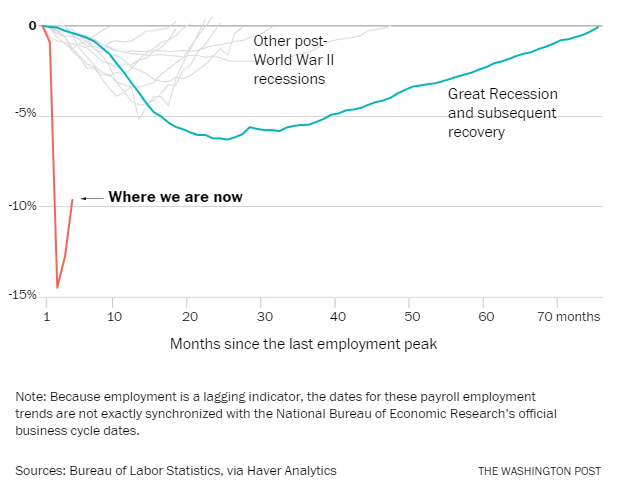
To help you visualize just how deep the U.S. job-market hole remains, once again I bring you the Scariest Jobs Chart You’ll See All Day. It plots the trajectory of job changes in this recession alongside those from previous downturns (and subsequent recoveries).

I think the chart is pretty clear, although Rampell adds more explanation in her op ed if you want to read it. Rampell continues,

There’s also reason to worry that our little “rocket ship” might slow down — or perhaps already has.

Thursday’s jobs report reflects activity in mid-June. (The Bureau of Labor Statistics’ employer survey always covers the pay period that includes the 12th of the month.) In some senses, only a couple of weeks feels like ages ago.

Since mid-June, confirmed coronavirus cases have surged, especially across the Sun Belt. Some states have halted or even reversed their reopening plans, especially in the industries that reported the greatest job gains at mid-June: Leisure and hospitality, which according to Thursday’s jobs report shows as adding 2.1 million positions in June, accounted for two-fifths of the overall gain in total payroll jobs.

Some big states are re-closing right now because of out-of-control virus spread. Rampell also points to indicators showing that spending is slowing down even more now, possibly as people are getting a clue that this virus thing isn’t going away anytime soon. When the enhanced unemployment benefits expire at the end of July … crash. And it won’t be long before states start having to lay off employees also. The economy desperately needs more stimulus and other money injected into it, but that’s not likely to happen, because …

(AP Photo/J. Scott Applewhite)

So, we’re screwed. See also The Fed is raising dire economic warnings. But they will go unheeded.

And then there’s the virus. I am predicting that in many parts of the country schools will have to remain closed in September. And then I hope somebody — maybe the Lincoln Project, since they’re better at negative ads than the Democrats — runs a video compilation of all the times Trump said the virus would just go away, or that he had it under control.

Trump obviously still thinks that if he ignores a thing, it will go away. But some things don’t go away.