The Price Many Paid for Politics

More than two months ago, Texas Governor Greg Abbott ended all state pandemic restrictions — mask mandates, capacity limitations, the lot.  Many predicted disaster would follow. But it hasn’t been that bad. There are new cases and new deaths. As of May 20, there were 75,260 active covid cases reported in Texas, and 44 people died of covid in Texas that same day. But those numbers are far lower than the stats for January. As far as covid data is concerned, Texas is about where it was on the first of June, 2020.

Note, however, that in July 2020, the Texas Tribune reported that Texas hospitals are running out of drugs, beds, ventilators and even staff.

Scene from a Texas hospital.

Does that mean that the restrictions and mandates didn’t matter? Not necessarily. At the Atlantic, Derek Thompson has another explanation.

Abbott’s decision didn’t matter because nobody changed their behavior. According to the aforementioned Texas paper, Abbot’s decision had no effect on employment, movement throughout the state, or foot traffic to retailers. It had no effect in either liberal or conservative counties, nor in urban or exurban areas. The pro-maskers kept their masks on their faces. The anti-maskers kept their masks in the garbage. And many essential workers, who never felt like they had a choice to begin with, continued their pre-announcement habits.The governor might as well have shouted into a void.

Across the country, in fact, people’s pandemic behavior appears to be disconnected from local policy, which complicates any effort to know which COVID-19 policies actually work.

In other words, responsible people followed the covid restrictions whether they were mandated or not, and the right-wingers didn’t. Plus now people are getting vaccinated. So maybe Texas won’t have a replay of last summer.

Another interesting bit of data shows that the economic impact of the pandemic was about the same whether there were lockdowns or not.

In November, for instance, a team of economists using private data to survey all 50 states concluded that state-ordered shutdowns and reopenings had only “small impacts on spending and employment.” … Last spring, Illinois towns issued stay-at-home orders, while Iowa towns a few miles away did not. The decline in economic activity was just about the same on both sides of the border.

This is what a lot of economists predicted as the pandemic was beginning. The economy is going to get slammed whether businesses are allowed to open or not, many said. The key to getting the economy back on track is getting the virus under control, they said.

Remember Sweden? All last year the wingnuts babbled about Sweden. Sweden didn’t close any businesses! Why can’t we be like Sweden?

Well, it turns out that Sweden’s experiment in natural herd immunity didn’t work, and the nation officially abandoned that policy last winter and ordered lockdowns. Sweden suffered much higher death rates than other nations in northern Europe. Whether the sacrifice helped Sweden economically depends on whom you ask about it.  Lars Calmfors wrote in the Washington Post in October 2020:

What has been the economic effect? Like other countries, Sweden has been hit hard economically. During the first six months of 2020, the gross domestic product fell by 8.5 percent. Unemployment is projected to rise to almost 10 percent in the beginning of next year.

The drop in GDP is considerably smaller than in southern European countries and the United Kingdom, and one to three percentage points smaller than in Denmark, Germany and the United States. The GDP fall, however, is larger than in Finland and Norway.

Just because the government didn’t mandate many restrictions didn’t mean a lot of Swedes weren’t voluntarily being cautious. Businesses, schools, and day-care centers remained open, but homes for the elderly were closed to visitors (eventually) and public gatherings of more than 50 people were banned (eventually). As in the U.S., telecommuting became the norm when possible. Many travel plans were put on hold. Yet here is the result:
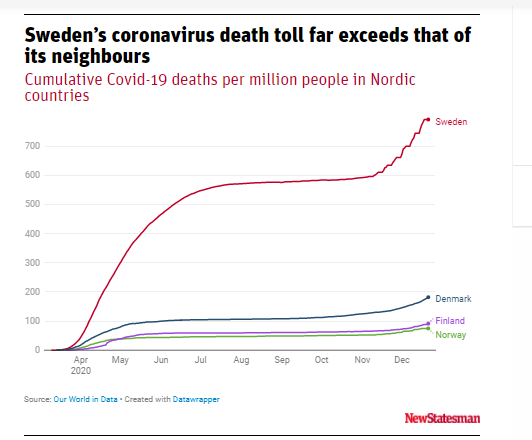
The Swedes are not happy with their government, I take it. See The Inside Story of How Sweden Botched Its Coronavirus Response by Kelly Bjorklund at Foreign Policy.

It may be awhile before we see analysis of rates of infection and deaths in various states and cities and how events and policies might have made a difference here or there, and I’m not going to attempt such a thing now. Just note that this happened this week:

Republican Rep. Marjorie Taylor Greene, during an interview on a conservative podcast this week, compared House Speaker Nancy Pelosi’s decision to continue to require members of the House to wear masks on the chamber floor to steps the Nazis took to control the Jewish population during the Holocaust

Greene, in a conversation with the Christian Broadcast Network’s David Brody on his podcast “The Water Cooler,” attacked Pelosi and accused her of being a hypocrite for asking GOP members to prove they have all been vaccinated before allowing members to be in the House chamber without a mask.

“You know, we can look back at a time in history where people were told to wear a gold star, and they were definitely treated like second class citizens, so much so that they were put in trains and taken to gas chambers in Nazi Germany,” Greene said. “And this is exactly the type of abuse that Nancy Pelosi is talking about.”

Jewish groups were quick to condemn Greene’s remarks.

Maybe she won’t be re-elected next year. We can hope.

Clawing Our Way Back to Reality

I’ve been thinking about cults lately. Cults of various sorts seem to be eating civilization, and not just QAnon, which is bad enough. It’s getting hard to tell where QAnon ends and the Republican Party begins. And people appear to have formed cults, of sorts, around many peripheral issues — anti-vaxx cults, gun cults, political cults.

What’s alarming to me is that people are getting sucked into cults — or fantatical, cult-like movements — through the Web. The social psychologists need to up their game and study this. I cruised around looking for psychological research into cults, and most of what I found seemed to apply only to the cults of the 1960s to the 1990s, in which people were sucked into cults through personal contacts. Now one can be indoctrinated without leaving home. All you need is decent wi-fi.

I found one article that seemed to take in more recent cultish movements, but I know nothing about the author.  Anyway, her definition is:

A cult can be either a sharply bounded social group or a diffusely bounded social movement held together through a shared commitment to a charismatic leader. It upholds a transcendent ideology (often but not always religious in nature) and requires a high level of commitment from its members in words and deeds.

Cults also operate on continuums of influence and control, she says, They don’t always require members to go live in an ashram or devote their entire lives to the cult.

The Denver Post has a fascinating look at Amy Carlson, a cult leader (not the actress of the same name) recently found several days deceased and stuffed into a sleeping bag wrapped in Christmas lights. Carlson appears to have fallen down her own psychological rabbit hole to become as much a victim as a perpetrator of the religious fantasy she built.

But the article also describes a man, unnamed, who left his wife and two children in Mississippi to join Carlson’s cult in Colorado. This was a military vet who had a six-figure income and a $500,000 house, and whose biggest concern was what fertilizer to use on his lawn, his wife says. But he’d already been drawn in to QAnon when his job evaporated during the pandemic. And then he found Carlson’s website and videos.

His behavior at home became more unsettling. He slept less, and he started following a schedule aligned with the seven colors of the chakra, so on certain days he only ate foods and wore clothes that matched that day’s color, as ordered by the cult.

“He was just staring into the sun because they were telling him to do that to get light codes,” Whitten [his wife] said.

In May 2020 he left Mississippi for Colorado. Some time later he was found “wandering in the wilderness alone, naked, dehydrated and with cactus needles in his feet.” He believed he had transcended into another dimension. His family took him home and now say he can’t fathom why he behaved as he did. Assuming that this guy wan’t predisposed to psychosis somehow, it’s disturbing evidence of how easily people can be sucked into crazy through the Internet.

“Transcendence” is an operative word here. “The term transcendence denotes an ego-dissolving encounter – a breakdown of self-boundaries – with something greater than the self,” it says here. The “transcended” person is drawn into an “all-encompassing reality” that differs from mundane reality. As a Zen student I can’t very well knock transcendence, because a breakdown of self-boundaries is part of the practice. But I think what we’re looking at with cults is less about ego-dissolving but a fusing of one’s individual ego with that of a group or leader, which isn’t exactly the effect one is going for in Zen. I wrote a couple of years ago about the Trump cult of personality,

At the same time, many of our great social observers and philosophers — Erich Fromm, Eric Hoffer, Hannah Arendt — have long noted that alienated and insecure people easily surrender their own ego-identities and autonomy to mass movements and authoritarian strongmen. People march blindly into mass movements because the group provides something the individual feels is lacking in himself. Trump, to his fans, is a larger-than-life being of great power and certitude. By surrendering their autonomy to him, they feel that they absorb that power. Through Trump, they find connection, strength and a sense of belonging. The baffling, ambiguous world becomes a place of absolute clarity, with bright lines between good and bad, right and wrong, truth and lies, all as defined for them by Trump.

What a cult can offer is personal validation — your failures are not your fault — and a sense of belonging and connection to something greater than oneself, which can be exhilarating until you’re naked and dehydrated in a desert somewhere.

And there’s also one of my favorite quotes from Eric Hoffer’s The True Believer:

Passionate hatred can give meaning and purpose to an empty life. Thus people haunted by the purposelessness of their lives try to find a new content not only by dedicating themselves to a holy cause but also by nursing a fanatical grievance.

And what else is Trumpism but a complex of fantatical grievances, on steroids?

It’s one thing to be personally suspicious of vaccines. It’s something else to threaten and bully the county health officer out of her job because she tried to institute a mask mandate during a bleeping pandemic. See also Death threats, shoves, and throwing blood: Anti-vaxxers’ bullying of public health officials endangers our country.

I suppose one can be all-in for private gun ownership without being a fanatic about it. But Sandy Hook Truthers are a cult who harass the parents of slain children and anyone whose name got into newspapers in connection with the 2012 massacre at Sandy Hook Elementary School.

Of the January 6 insurrectionists, some of them may have just been caught up in the moment, but some of them clearly had been living in fantasy land for some time and were serious about “taking” the Capital and stopping the certification of the election.

Pro-Trump protesters storm into the U.S. Capitol during clashes with police, during a rally to contest the certification of the 2020 U.S. presidential election results by the U.S. Congress, in Washington, U.S, January 6, 2021. REUTERS/Shannon Stapleton – RC2P2L9YHHVX

And then there’s the Arizona “audit.”

This audit, as ridiculous as it is, has inspired Trump culties around the country to attempt the same thing. If they could just get their hands on the real ballots, surely they will reveal that Trump won. And if they don’t, the ballots can be manipulated somehow until they do, because Trump must have won. They are certain no other result is possible, because “Trump loses” is not part of their new reality.

Paul Waldman asks, What would it take to drag the GOP back to reality? “For those who have fallen down the rabbit hole, 2020 was just one manifestation of the larger problem, which is that elections are pretty much all rigged and no result in which your party loses can ever be legitimate,” he writes.

What’s especially troubling is that political leaders who, one assumes, know this is nuts are indulging the craziness because it’s politically useful to them. Which means it’s not going to end any time soon.

I sincerely believed that once Trump was out of Washington, the old GOP establishment would, perhaps gradually, reassert itself and take charge of the party. But that didn’t happen, and now it’s clear that the clowns are running the circus. Either go along with the act or, like Liz Cheney, be cast out. And I don’t see that the Republican Party has left itself a graceful way out of this.

See also GOP: A Cult Looking for a Personality from 2012.

The Missouri Senate Primary from Hell, 2022

Republican Senator Roy Blunt is retiring after his current term, which ends in January 2023. This leaves an open seat. There are three declared candidates so far, all running for the Republican nomination:

Mark McCloskey. You must remember Mark and Patricia McCloskey, the gun-totin’ St. Louis wackadoos who became sweethearts of the Right for threatening to shoot peaceful Black Lives Matter protesters. The allegedly male half of the pair has declared his candidacy for Roy Blunt’s seat. Here is his pitch:

Of course, there was no “mob” coming to destroy McCloskey’s home or kill his family. But what are facts when you’re defending FREEDUMB?!

McCloskey is a personal injury lawyer who is famous for suing everyone who crosses his path, including his own relatives. Yes, bad judgment, anger issues, and avarice are just what we need in a senator. See also Elliott Hannon, Slate, Mark McCloskey Announces Senate Run Touting Experience as Man in Video Pointing a Rifle at Passersby and Greg Sargent, WaPo, Meet the perfect Senate candidate for today’s Trumpified GOP.

Mark McCloskey shows off his statesmanship skills.

Eric Greitens. You might also remember former Gov. Eric Greitens. In 2018 Greitens resigned in order to avoid turning over documents from his dark money political organization to a House committee looking into impeachment charges. See Bad Coverage of Greitens Resignation for the whole story.

Greitens is a former Navy SEAL who ran for the governor’s office by highlighting his skill at destroying innocent vegetation with various military-style weapons. Because of course that’s an essential skill for a governor. Oh, and the best part is that he’s already hired the Crazy Screaming Lady, Kimberly Guilfoyle, as his campaign manager.

Eric Schmitt. And finally we have Eric Schmitt, currently serving at state attorney general. At least he has some experience in government. However, Schmitt might be the hinkiest specimen of the lot.

You might remember last December, when the Texas attorney general, Ken Paxton, filed a lawsuit challenging the presidential election results in Georgia, Wisconsin, Michigan, and Pennsylvania. You might remember that several other state attorneys general joined the suit. What you might not know, but has since been reported by the St. Louis Post Dispatch (article is behind a paywall, sorry), is that Schmitt was behind getting those other attorneys general to sign amicus briefs on behalf of Paxton’s suit. Shortly after Paxton filed his suit, Schmitt’s top aide sent emails to other Republican AGs urging them to join in. This is from the St. Louis Post-Dispatch story:

The records themselves show, he says, that the attorneys general knew they were engaged in a political fraud, and that’s damaging for the future of democracy. In one email, for instance, an aide to North Dakota Attorney General Wayne Stenehjem makes it clear the amicus brief has little basis in law. “The decision whether we join this amicus is more political than it is legal,” wrote the aide.

(“He” is Jon Western, a political science prof investigating the suit. Schmitt refused to comply with state sunshine laws to provide copies of the emails, but Western was able to get them from another state.)

But Schmitt has a record of filing bizarre lawsuits. Last year he sued China, three government ministries, two local governments, two laboratories and the Chinese Communist Party in U.S. District Court for China’s failure to contain the coronavirus. The suit, which might generously be called “judicial theater,” is still being pursued as far as I can tell.

He’s filed suits against the Biden Administration already. One challenged President Biden’s Mexican border policy, although Missouri doesn’t border Mexico. He also sued the Biden Administration over oil and gas leasing regulations. Most recently he sued the St. Louis County Executive, Dr. Sam Page (a physician), over county covid health orders. The county still had some mask mandates and limits on social gatherings (this was before the recent change in recommendations from the CDC), and Schmitt didn’t believe the county should be allowed to do such things. So he sued, but weirdly forgot to sign the paper filed in court, so the county just ignored it. Well, except to issue the following statement:

“We all know Mr. Schmitt is trying to increase his profile statewide and suing those protecting the health and safety of residents is apparently one of the ways he has chosen to do that. Our focus is on getting people vaccinated and on economic recovery.

“Litigation around public health orders across the country is nothing new and St. Louis County has been successful in defending every legal challenge around public health orders. Our legal foundation is sound.”

That’s about right. It’s all about Schmitt getting attention. What else he does as AG, if anything, I’m not sure.

Those are the three for sure candidates. Some other Missouri Republicans have made the trip to Mar-a-Lago to get Trump’s blessing. None of the other names that have been named as possible Republican candidates are any less nutso that the three in the race so far.

What about Democrats? Claire McCaskill has already said she has no intention of running again. Former governor Jay Nixon is a possibility. You can read about the other possibilities here. None are anywhere close to being as well known as the Republican candidates.

The Roots of U.S. Support for Israel

Juan Cole asks, Do Americans turn a Blind eye to Israel’s Ethnic Cleansing of Palestinians because of White Nationalism? He points out that “Israel has a 75 percent favorability rating, versus 30 percent for the Palestine Authority, according to Gallup,” Professor Cole writes. “Some 58 percent of Americans say that they are ‘more with Israel’ in the struggle, while only 25 percent are ‘more with the Palestinians.'”

So, is it white nationalism? Yeah, not exactly, I don’t think. Maybe some of it. It’s complicated.

First, I suspect that if someone did a sidewalk survey of U.S. adults and asked them what is going on in Gaza, only a small minority could explain it coherently. I’m betting more than half probably couldn’t find Israel on a map and don’t know what Gaza is. Nor would they have half a clue why the Palestinians have issues with Israel, just that they do.

Second, sympathy for Israel has been baked into U.S. popular culture since Israel became a nation in 1948. That was a tad before my time, but after the end of World War II, and the Holocaust, there must have been a huge reservoir of sympathy for Israel from the outset. I am old enough to remember when Prime Minister Golda Meir was in the news nearly all the time. In U.S. popular culture she was a hero. There are plays and movies about her. And I am old enough to remember 1967, when many people on the teevee were celebrating the reunification of Jerusalem. Teenage me understood this to be a good thing, and everyone seemed happy about it. On the other hand, the first I remember hearing about Palestinians was in 1972, when Palestinian terrorists took the Israeli wrestling team hostage. Most of America was glued to the television in anger and sorrow during the crisis.

Juan Cole points out that there are other reasons western powers want to like Israel:

Israel represents itself as a Western aircraft carrier in a strategically crucial part of the world full of energy resources. It gathers and shares intelligence on the Middle East with the West, conducts covert operations against challengers such as Syria and Iran, and at least represents itself as helping keep the oil and gas flowing. Some analysts believe that the Israeli contribution to European and US security is greatly overblown, but the national security elites tend to buy the story.

So, there is a huge reservoir of good will for Israel deeply planted in American culture, whether people understand the Palestinian-Israeli conflict or not. And for many years U.S. news coverage of Israel reflected that good will.

The first person I ever heard question Israeli policies toward Palestinians was Jesse Jackson. See, for example, Jesse and the Jews: Palestine and the Struggle for the Democratic Party by Micah Sifry, from Middle East Report, Nov.-Dec. 1988. (This is at JSTOR; you can read articles for free in PDF format if you register.) Basically, Jackson supported a two-state solution, but various missteps (including Jackson’s infamous “Hymietown” remark) poisoned the water, and much of the establishment Democratic Party dismissed Jackson as antisemitic. This included liberal Jews who  had their own misgivings about Israel’s Palestinian policies by then.

Juan Cole writes that, today, African-Americans are one of the few demographic groups that do not wholeheartedly take the side of Israel. One poll “found that only 42 percent of African-Americans have a favorable view of Israel, while 27 percent have a negative view of it. That is, African-Americans only have about half as much favorability toward Israel as whites,” he writes. That’s possibly because Jackson and other Black leaders since the 1980s have been more willing to speak out against the oppression of the Palestinians than other groups. It’s also the case that African-Americans may be more sensitive to the way a culture can willfully overlook oppression happening under its nose. The same poll showed that Latino Christians also tend to be less supportive of Israel than the U.S. population as a whole.

“Support for Israel is highest in the US among the elderly, Evangelicals and Republicans. That is, at its highest levels it is disproportionately white,” Cole writes. I don’t kinow that the elderly are more disproportionately white than other age demographics, but let’s go on. The elderly part is explained by the fact that these are people who grew up rooting for Israel and Golda Meir and who remember the 1972 Munich Olympics.

And then there are the evangelicals. That’s a weird dynamic if there ever was one. I direct you to a paper at the Schusterman Center for Israel Studies titled Why do American evangelicals love Israel? A big chunk of that support does come from their premillennialist beliefs that say Jesus will return to reign over the world for a thousand years before the final judgment. It’s commonly believed that Jews must first return to Israel — I guess we can check that one off — and then convert to Christianity before that can happen. With this crew, to question Israel is to speak against God’s Plan.

The author of this paper, Walker Robins, continues,

Southern Baptists broadly viewed Palestine through orientalist eyes, associating the Zionist movement with Western civilization, modernity, and progress over and against Palestine’s Arabs, whom they viewed as uncivilized, premodern, and backward. This view was shared by Baptist travelers, by missionaries, by premillennialists and by their opponents. It was shared by those who supported the Zionist movement on prophetic grounds and those who decried it on humanitarian grounds. This orientalist framing of the conflict did not necessarily point to political support for Zionism, but it did provide Southern Baptist supporters of the movement a second, orientalist “language”—supplementing the language of the Bible—that they could draw on in making their appeals to other Baptists.

Robins notes that these evangelicals are the same people who have been big-time Trump supporters. Trump’s decision to recognize Jerusalem as Israel’s capital was all about them. In that population I’m sure there’s a big overlap with white nationalists, although they aren’t exactly identical groups.

Anyway, Professor Cole is looking at polling numbers and proposing a connection between white nationalism and uncritical support for Israel.  There’s a connection, but a somewhat indirect one, I say. Remember that most white nationalists are also raging antisemites, and those who are not evangelical may not give a hoo-haw what happens to Israel. See also How anti-Semitic beliefs have taken hold among some evangelical Christians from 2019.

Of course, it’s also the case that in the weird whiteness hierarchy of American racist culture, which puts the long-defunct tribe of Anglo-Saxons at the top of the heap, Jews are no doubt considered whiter than Muslims.

As far as Republicans are concerned, who knows what goes on their heads these days? If you could x-ray their skulls you might find a homunculus of Donald Trump screaming “Fake news! I won!” They think as they are told to think.

Democrats are more divided on the issue, I keep reading. I haven’t seen any polls broken down by demographics, but I understand younger Democrats are more openly supportive of the Palestinians than older ones. But I don’t think the numbers have yet shifted enough to challenge the status quo.

The latest: Biden is said to have taken a firmer line in his call with Netanyahu

SCOTUS Really Might Overturn Roe This Time

The SCOTUS announced today it will hear Dobbs v. Jackson Women’s Health Organization, a case about a Mississippi law that outlaws elective abortion after 15 weeks’ gestation. There is real concern that this could be the Big One that overturns Roe v. Wade, mostly because now that Amy Comey Barrett is on the court, the conservatives don’t need Chief Justice John Roberts’s vote to make a majority.

It’s also the case that the law being challenged in Dobbs is more straighforward than some of the recent laws the court failed to overturn (mostly because of Roberts). For example, last year the Court failed to overturn a Louisiana law that applied burdensome regulations to abortion providers to discourage them from performing abortions. Roberts voted with the liberals on that one.

But Dobbs simply puts a gestational limit on elective abortion at 15 weeks. The Roe v. Wade guidelines allow states to ban elective abortions, but not before the gestational age at which a fetus might be viable (then as now, 23 weeks). After that, the states must provide exceptions for “life and health of the mother,” and physicians had some discretion about what that meant.

There is a little fudging in the medical literature about the 23-week threshold for viability, but 15 weeks is way outside fudging range. As I understand it, if the Court allows the 15-week limit to stand, Roe is overturned. And if Roe is overturned, a whole lot of states will ban all or most abortions overnight. It may be that the justices could uphold the 15-week ban but include language in their decisions that salvages some parts of Roe, but I wouldn’t expect them to do that.

I personally think this comes under the heading of “be careful what you wish for.” The most recent polls I could find found a significant majority, about two-thirds, of Americans support Roe. Multiple polls have found the percentage of Americans who want abortion outlawed in all or nearly all circumstances to be in the neighborhood of 24 to 27 percent. Abortion has been an effective wedge issue for Republicans because those against it are really against it; they are strong single-issue voters. The rest of the electorate has other priorities.

But Republicans might be setting themselves up for a significant national backlash if Roe is overturned. Maybe that’s what it’s going to take to get some peace on this issue — let the fanatics have their way and let them get slapped down for it.

Some states may accept an abortion ban for a while, but we’ve seen in other places that banning abortions opens many cans of worms that the fanatics haven’t thought out. The Mississippi law makes exceptions for post-15 week abortions for “medical emergency or in the case of a severe fetal abnormality,” but people are going to disagree about what constitutes an emergency and which fetal abnormalities are severe enough. If any. States that ban abortions will soon find themselves dealing with a black market in abortion pills and the return of back-alley abortionists.

It has to be said that there are some civilized nations that have banned elective abortions even earlier, at twelve weeks’ gestation. But in most of those same countries (for example, Denmark) women can get their elective first-trimester abortions free of charge, courtesy of the public health system, and without any hassles. It works for Denmark.

See also: Do see Dear White Christian Pro-Life Friends, a series of open letters by Brian D. McLaren, who identifies himself as a pastor and “public theologian.” He does a masterful job of summing up the recent history of the anti-abortion movement and its effects. Worth reading. See also Abortion Law: Why Cruelty Is the Point from May 2019.

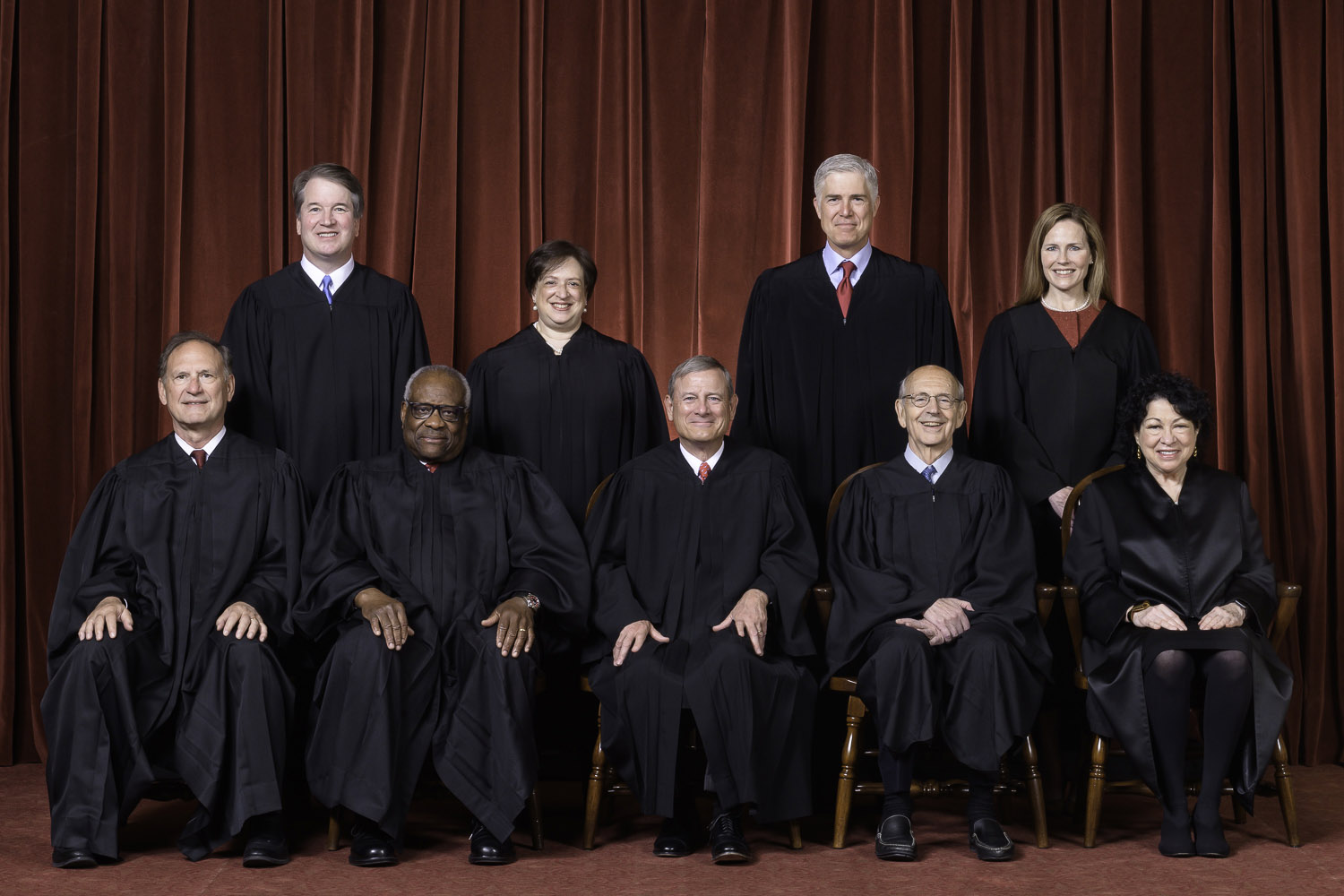
The Roberts Court, April 23, 2021
Seated from left to right: Justices Samuel A. Alito, Jr. and Clarence Thomas, Chief Justice John G. Roberts, Jr., and Justices Stephen G. Breyer and Sonia Sotomayor
Standing from left to right: Justices Brett M. Kavanaugh, Elena Kagan, Neil M. Gorsuch, and Amy Coney Barrett.
Photograph by Fred Schilling, Collection of the Supreme Court of the United States

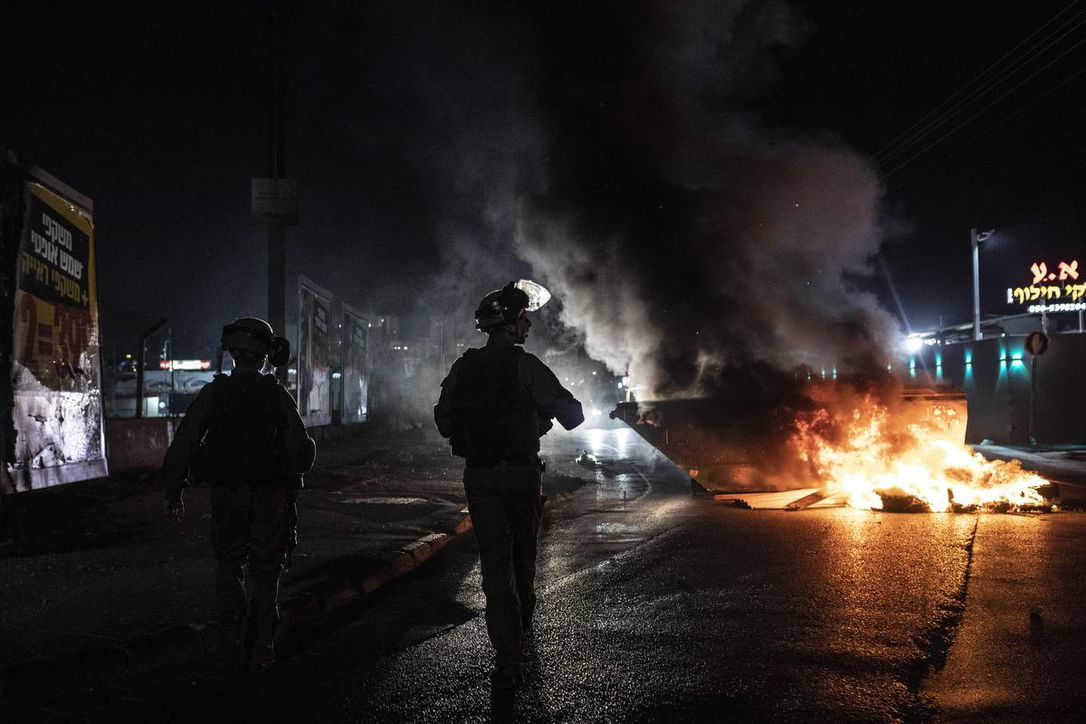
About the Israeli-Palestinian Conflict

Whenever violence breaks out between Israelis and Palestinians I check with Juan Cole to see what he says about it. His post for today, Gaza and Israel’s Kidnapper’s Dilemma: Keeping a Million Children Brutalized in its dark Basement, is very much worth reading. I don’t even want to try to summarize it.

See also H. Scott Prosterman, How Trump’s “Abraham Accords” Inflamed Tensions by Marginalizing Palestinians and how Biden must hold Israel Accountable. Among other things, Prosaterman explains that the escalation of violence will help Bibi Netanyahu stay in power. Unfortunately.

The hostilities shouldn’t be a surprise to anyone. The “Abraham Accords” brokered by Jared Kushner, in which Kushner didn’t bother to consult with Palestinians, were widely recognized at the time to be a bad joke. (But yeah, it’s much easier to reach an accord when you only talk to one side. Efficiency!) From January 2020, see Fred Kaplan, Trump’s Plan for the Middle East Has Nothing to Do With Peace.

And in the present, see also Alex Ward, Trump’s signature Israel policy had a key flaw. We’re seeing it now. Very basically, Mr. Ivanka’s idea was that if other key players in the region — in this case, the United Arab Emirates, Bahrain, Sudan, and Morocco, nations that signed on to the Abraham Accords — normalized relations with Israel, this would reduce support for the Palestnians and force the Palestinians into negotiating a peace deal. A great many people at the time, including John Kerry, said this was nonsense on steroids. The Accords simply encouraged Israeli righties to think they could do whatever they wanted in Gaza without disapproval from outsiders. Alex Ward continues,

Last week, Israeli police in Jerusalem blocked off the Damascus Gate, a popular gathering place for Arabs during Ramadan, sparking protests. An attempt by Jewish settlers to evict longtime Arab residents of Sheikh Jarrah, an Arab neighborhood of East Jerusalem, inflamed tensions, leading to violent clashes with Israeli police. Arab youth attacked ultra-Orthodox Jews in the city, and Jewish extremists assailed Arab residents.

And the violence continues. For a really excellent background article on the whole mess, see Israel’s unraveling by Zack Beauchamp at Vox.

But it’s also the case that we can’t exonerate Democrats on this one. Israel has been something of a political third rail for many years. All American politicians have memorized the standard talking point, “Israel has a right to defend itself.” And so it does. But for a very long time Israeli policies toward its non-Jewish citizens, and Gaza in particular, haven’t had much connection to self-defense.

Further, one assumes that Palestinians have a right to defend themselves also.

The Biden Administration’s response to the current violence has been disappointing. Shadi Hamid writes at The Atlantic,

Despite inching toward the Democratic Party’s left flank on various domestic- and foreign-policy issues, the Biden administration has fallen back on the usual formulas, offering robotic recitations about “Israel’s right to defend itself.” On Thursday, President Joe Biden said that he hadn’t seen a “significant overreaction” from Israel, while failing to mention a word about Palestinian deaths. In so doing, he gave Israel what amounts to a green light to intensify its bombing campaign.

The White House has been eager to highlight Biden’s “unwavering support” for Israel, which raises the question of what, if anything, might cause America’s support for the Israeli government to waver even slightly. This question is worth asking sooner rather than later, now that more than 120 Palestinians have died, a quarter of them children—all in a few days—according to Palestinian officials.

Americans have a hard time processing the Israeli-Palestinian conflict, IMO, because it doesn’t neatly fit into a good guys/bad guys dichotomy. No one is blameless here. But in the U.S. there has been a long-standing consensus that we would take Israel’s side, no matter what, and U.S. news media have carefully reported on the conflict from the Israeli perspective. They are still doing that, for the most part.

It probably didn’t help that the first many of us older folks learned about the conflict was in 1972, when a Palestinian terrorist group called Black September took the Israeli wrestling team hostage at the Munich Olympics. Along with being an atrocity — the entire wrestling team and a German policeman died, as did most of the terrorists, before it was over — it made “Palestinian” synomymous with “terrorist” to most Americans. (And the moral is, terrorism is really bad PR and doesn’t help your cause any. It just makes people not like you.)

Now things seems to be shifting. See Marya Hannun at Slate for How Black Lives Matter Changed the American Conversation About Israel and Palestine. See also Israel-Hamas fighting poses test for Biden and exposes rifts among Democrats at WaPo. Older Democrats are sticking with the old pro-Israel consensus. “But a new crop of younger lawmakers willing to challenge the party’s pro-Israel orthodoxy has put pressure on the Biden administration and congressional leaders amid polling showing growing skepticism among Democrats about Israeli actions,” Anne Gearan and John Hudson write at WaPo. See also Lisa Lerer and Jennifer Medina at the New York Times, Tensions Among Democrats Grow Over Israel as the Left Defends Palestinians.

And it’s not just younger progressives. See Bernie Sanders, The U.S. Must Stop Being an Apologist for the Netanyahu Government.

I assume the U.S. Right is sticking with unwavering support for whatever Bibi Netanyahu does while accusing Democrats of antisemitism. I don’t expect that to change. It seems to me that Netanyahu and Israel’s hard-right policies toward the Palestinians are pushing Israel — unnecessarily — into an existential crisis, and years of blind support from the United States have not helped. It’s a damn shame all around.

Toronto Star

There’s No Fence to Sit On

First, here’s a sad story about Rep. Elise Stefanik’s journey from respected conservative voice at the Harvard Institute of Politics to MAGA-head zombie. My take on this is that Stefanik simply found that the fence she was sitting on evaporated out from under her. As a congressional Republican she had to support the voter fraud lie or be slammed by her caucus, and for that the Harvard IOP bounced her. So she took the road left to her and went full MAGA.

There’s also an in-depth report on Josh Hawley’s road to the insurrection at the Washington Post. Synopsis: Hawley is an egotistical prick. But if you want to know more about how he got to be an egotistical prick, and more about the dimensions and depth of his egotistical prickiness, read away. This was reprinted in today’s St. Louis Post-Dispatch, I noticed.

Here’s another sad story: In his quest to be the lone Democrat holding aloft the sacred torch of bipartisanship, Joe Manchin has been floating an alternative proposal to the For the People voting rights act that he thinks could get bipartisan support.

Manchin is now pitching a fix to the Voting Rights Act that would subject all 50 states to the so-called preclearance process. That goes farther than the VRA restoration legislation that has been previously introduced, which is moving separately from s1 so Democrats can create the kind of legislative record that will make the law more resistant to legal attack. Manchin nonetheless has described the approach as something to be done with bipartisan support.

The “preclearance” part means that all states would need to get federal approval for changes to their election practices. You can read more about Manchin’s proposal here. It really would do some good. But the sad part for Joe Manchin is that it appears Senate Republicans have shot his proposal down already.

On Thursday, [Sen. John] Cornyn signaled that such an idea would not get much buy-in from the Republican Party.

He characterized it in suspicious terms. The idea of a 50-state preclearance system has only been outlined by Manchin in vague terms, which to Cornyn, meant that there is an “effort afoot” to do through the “back door” what S1 was trying to do through the “front door:” a supposed federal “takeover” of the U.S. election system.

See also Biden is reaching out to Republicans. But his real target is Joe Manchin. by Paul Waldman and Greg Sargent. “The only way Manchin will be part of a purely party-line vote for infrastructure is at the end of an extended process in which Biden makes repeated attempts to bring Republicans in, attempts that are clearly rejected by McConnell,” they write. So sad for Joe Manchin. So sad for the rest of us.

It seems to me that we’ve reached a place in our ongoing political drama that there is no longer any place for fence-sitting. The fence is gone, and the middle ground is a sinkhole. Everyone has to choose a side now. Of course, Joe Manchin hasn’t figured that out yet, but maybe the Red Wall of No being offered by his Republican colleagues will provide a hint.

Now a group of prominent Republicans — mostly retired, I think — have issued an ultimatum that they will leave the party if the Republicans don’t get themselves out of the MAGA trap. Jennifer Rubin:

In a document titled, “A Call to American Renewal,” the signatories reference Cheney’s ouster and write, “This ‘common-sense coalition’ seeks to catalyze the reform of the Republican Party and its recommitment to truth, founding ideals, and decency or, if unsuccessful, lay the foundation for an alternative.”

The list of signatories include former governors Bill Weld of Massachusetts, Mark Sanford of South Carolina and Christine Todd Whitman of New Jersey; former representatives Charlie Dent of Pennsylvania, Barbara Comstock of Virginia, James Leach of Iowa, Tom Coleman of Missouri, Mickey Edwards of Oklahoma and Denver Riggleman of Virginia; former CIA director Michael Hayden; former homeland security secretary Michael Chertoff; former Republican Party chairman Michael Steele; and conservative voices such as George Conway and Mona Charen.

That’s going to mean nothing to the MAGAts, I fear. Rubin says the goal of this group is not so much to restore the Republican Party but marginalize the current Republican Party so that sane people can move back in to occupy it. They are especially focused on getting Kevin McCarthy out as House Republican leader, Rubin says. I am skeptical much will come of this, but we’ll see.

Last night on the Chris Hayes show, Sam Seder argued that we’re way past the point at which the GOP can be saved. This is worth watching.

The GOP has been heading in this direction for at least 20 years, Seder says. We are at least five or six years beyond the point at which the party could have been saved. There is no “coming back to their senses.” There is no leveraging this.

Republicans have been going down the path of believing obvious lies that support the reality they want to see for many years. They were well down that road even before we got to the Iraq War buildup, with the ominous aluminum tubes and yellowcake uranium that would turn into mushroom clouds at any moment.

The current situation provides a grim demonstration of how far confirmation bias can be stretched by people who are not, as far as we know, actually psychotic. Increasingly Republicans aren’t just sellling out their principles and their country; they are selling out reality. They are so far gone now that there is no longer a way out. Recent examples include their new theory that Dr. Fauci is responsible for the covid pandemic and that the January 6 insurrection was just tourism. Now Republicans in the Michigan legislature are pushing a bill that would muzzle newspaper “fact check” columns.

Under the legislation, fact checkers would have to register with the Secretary of State and file proof of a $1 million fidelity bond. Civil actions could be filed against the fact checkers, and any violations could result in fines of at least $1,000 per day for as long as the violation continued.

There’s no way back from this. There aren’t enough “reality based” Republicans left in government to reconstitute a workable party.

Back in 1964, Richard Hofstadter wrote,

The difference between conservatism as a set of doctrines whose validity is established by polemics, and conservatism as a set of rules whose validity is to be established by their usability in government, is not a difference in nuance, but of fundamental substance.

It’s been some years since the GOP gave up on government and instead went with polemics alone. Current Republican office holders don’t seem to know how to do anything else. No, there’s no coming back for them.

Tucker Carlson Gets Worse

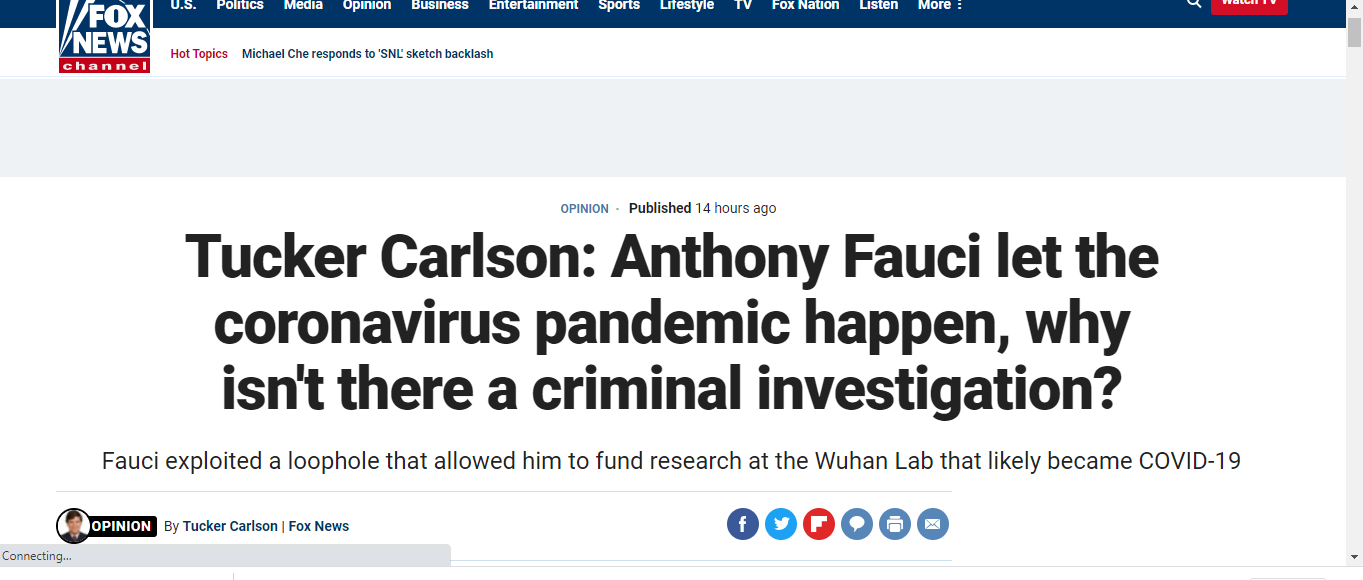
I want to call your attention to an actually headline on the Fox News website today. This is a sceen shot; I am not going to link to this crap.

I found that online today, mind you.

As I understand it, recently Steve Bannon and Peter Navarro teamed up to release a new conspiracy theory that Dr. Anthony Fauci is personally responsible for covod-19. “For whatever reason, Dr. Fauci wanted to weaponize that virus and he is the father of it,” Navarro wrote. “He has killed millions of Americans, if that thing came from the lab, and I’m 99.999% sure it did.”

Before we go any further, do note that fact-checkers went after the new claims back in February and found them to be bogus.

Today there was another Senate hearing in which Rand Paul made an ass of himself arguing with Dr. Fauci. They might as well make this a Netflix series.

During a Senate hearing on the pandemic response, Paul alleged that the National Institutes of Health (NIH) had been sending funding to the Wuhan lab, which then “juiced up” a virus that was originally found in bats to create a supervirus that can infect human cells.

Paul pressed Fauci on the theory that the novel coronavirus was created in the Wuhan lab, and then somehow escaped, either because of an accident or because it was deliberately released.

“Sen. Paul, with all due respect, you are entirely, entirely and completely incorrect,” Fauci said. “The NIH has not ever, and does not now, fund ‘gain of function research’ in the Wuhan Institute.”

Paul continued to argue with Fauci, who is the director of the NIH’s National Institute of Allergy and Infectious Diseases (NIAID), accusing him of cooperating with the Chinese government, and supporting the laboratory that bioengineered a deadly virus.

Fauci noted that although the NIH did fund a project at the Wuhan lab, it was not meant for “gain of function” research into human-made superviruses.

I had to look up what “gain of function” meant. This is from Forbes:

While the NIH did provide funding to a New York based non profit called EcoHealth Alliance that conducted research on bat coronaviruses, there’s no evidence to support the theory the scientists “juiced up” Covid-19 in the lab, as Paul claimed, or that the money funded gain of function research.

Moving on, Paul asked if Fauci could “categorically say that the COVID-19 could not have occurred through serial passage in a laboratory?”

“I do not have any accounting of what the Chinese may have done,” Fauci responded, before adding he is “fully in favor of any further investigation of what went on in China.”

That last remark led to a headline in Murdoch’s New York Post that “Fauci admits COVID-19 could have come from Wuhan lab.” I’m not linking to that crap, either.

Tucker Carlson waded into it last night, I take it. Aaron Blake:

While talking about National Institutes of Health funding for the Wuhan Institute of Virology, Carlson referred to “the deadly experiments that were going on there” — which is valid, given that’s the kind of thing virologists do.

But he then referred to them, as if the lab-leak theory were proved, as “the experiments that clearly went so wrong.”

Again, there is no firm evidence that the spread of the coronavirus was the result of experiments that “clearly” went “so wrong” in the Wuhan lab. Carlson has a knack for suggesting things without saying them directly, but this veered in a much more conspiratorial and unproven direction than usual.

“This wouldn’t have happened if Tony Fauci didn’t allow it to happen — that is clear,” Carlson continued, referring to the funding. “It’s an amazing story. It is a shocking story. In a functional country, there would be a criminal investigation into Tony Fauci’s role in the covid pandemic that has killed millions and halted our country, changing it forever. So why isn’t there a criminal investigation into Tony Fauci’s role in this pandemic?”

The pandemic wouldn’t have happened if Dr. Fauci hadn’t allowed it to happen? Does that mean Anthony Fauci is the director of the Wuhan Institute of Virology?

Seriously, this is way out of bounds, even for Tucker Carlson.

Crime and Infrastructure

Here’s a story that maybe isn’t getting the attention it deserves —

North America’s biggest petroleum pipeline is in a race against time to overcome a cyberattack that’s frozen fuel shipments before regional reserves of gasoline, diesel and jet fuel run dry.

Colonial Pipeline said segments of its Texas-to-New Jersey line are being brought back online in steps, and substantially all service should be restored by the weekend. The pledge eased some of the most immediate concerns about fuel shortages in major population centers up and down the U.S. East Coast. The question now is whether regional inventories held in storage tanks are enough to satisfy demand while Colonial works on resuming operations.

Several news stories report that the hack was the responsibility of a ransomware gang called “DarkSide.” And several news stories say that DarkSide was really just after some quick cash. I take it they aren’t being paid. Full service probably won’t be restored until the end of the week, though. In the meantime, gas stations in several states could start running out of gas by mid-week.

And the first moral is, this is what 21st century crime looks like.

In an interview with Reuters, a senior official with the U.S. Department of Homeland Security’s cyber arm, CISA, said that the dramatic hack should serve as a wakeup call well beyond the energy industry.

“All organizations should really sit up and take notice and make urgent investments to make sure that they’re protecting their networks against these threats,” said Eric Goldstein, CISA’s executive assistant director for cybersecurity.

“This time it was a large pipeline company, tomorrow it could be a different company and a different sector. These actors don’t discriminate.”

The second moral is, Mitch McConnell is an ass.

Senate Minority Leader Mitch McConnell (R-Ky.) signaled in a new interview that he is open to an infrastructure spending bill totaling as much as $800 billion.

“The proper price tag for what most of us think of as infrastructure is about six to 800 billion dollars,” McConnell told public television in Kentucky over the weekend.

“What we’ve got here can best be described as a bait and switch,” he added.

Awhile back Mitch was saying $600 billion, so $800 billion is up a tad, although still not in the ball park of the proposed $2 trillion. But when he talks about “what most of us think of as infrastructure” he means infrastructure in mostly a 19th century sense — roads, bridges, tunnels. The one concession to modernity is airports. But cybersecurity is infrastructure. Our power grid with all its ancillary parts is infrastructure. Anything that would cause major disruptions in how people work and live if it broke down is infrastructure. And it all needs help. The $2 trillion is just a down payment.

As I wrote in the last post, Republicans are alarmed that low-income restaurant workers aren’t lining up to go back to their old jobs. They refuse to consider that if workers can’t get gas to put in their cars, or transportation generally, or day care for their kids, or someone to watch Grandma, or running water that isn’t toxic, or a lot of other things not classified as “roads” or “bridges,” that gets in the way of being available for work.

In other infrastructure news, President Biden is meeting with Sen. Joe Manchin this afternoon. Without Manchin Dems may have to compromise with Mitch.

Map showing a portion of the Colonial pipeline, which terminates in New Jersey.

Are the Serfs Rethinking Feudalism?

You’ve probably heard the grumbling about businesses not being able to find enough workers. Where I am, this seems mostly to involve fast-food restaurants, although I’ve seen news reports saying that construction and transportation (mostly truck driver) jobs also are going unfilled. Immediately, the blame is put on enhanced unemployment benefits that are allegedly making workers lazy.

Some Republican governors are taking matters into their own hands and canceling the extended benefits to force people back to work. Montana is cutting out the extra $300 and will instead offer a one-time bonus of $1,200 to people who get jobs. This past week South Carolina also announced the end of the $300, but no bonus. Other red states are expected to follow.

I’ve seen a number of articles analyzing the so-called worker shortage that say this situation isn’t so simple. Low-wage food service workers in particular have been rethinking the meaning of life and aren’t that eager to return, especially while the pandemic is still going on. “Many workers still don’t feel safe returning to work during a pandemic. Others don’t want to fight with patrons over health and safety guidelines. Some may have left town or joined another industry while they were laid off and will return when the timing and opportunity are right,” it says here.

(This is from 2014, but I don’t know that things have changed since then — 40 Percent of Restaurant Workers Live in Near-Poverty.)

And maybe some people are reconsidering their lives and how they want to spend them. Here is a hint about which people we’re talking about:

But another way to look at this is there is a great reassessment going on in the U.S. economy. It’s happening on a lot of different levels. At the most basic level, people are still hesitant to return to work until they are fully vaccinated and their children are back in school and day care full time. For example, all the job gains in April went to men. The number of women employed or looking for work fell by 64,000, a reminder that child-care issues are still in play.

Do tell.

There is also growing evidence — both anecdotal and in surveys — that a lot of people want to do something different with their lives than they did before the pandemic. The coronavirus outbreak has had a dramatic psychological effect on workers, and people are reassessing what they want to do and how they want to work, whether in an office, at home or some hybrid combination.

A Pew Research Center survey this year found that 66 percent of the unemployed had “seriously considered” changing their field of work, a far greater percentage than during the Great Recession. People who used to work in restaurants or travel are finding higher-paying jobs in warehouses or real estate, for example. Or they want to a job that is more stable and less likely to be exposed to the coronavirus — or any other deadly virus down the road. Consider that grocery stores shed over 49,000 workers in April and nursing care facilities lost nearly 20,000.

See also On this Mother’s Day, the crisis for working moms is hard to miss by Karla L. Miller.

Women suffered major job losses this year — partly because majority-female industries were the hardest hit by the pandemic, but also because no human can sustain the dual full-time duties of caring for minor children and performing a full-time job.

As a one-time single mother, I endorse that. I spent a large part of my adult life in a stage beyond burnout, giving neither my children nor my job the time I wanted to give them, because there wasn’t enough time. The pandemic gave a lot of mothers a blessed opportunity to get off the hamster wheel for a while. For those working office jobs from home, however …

Even in dual-earner families where both parents were able to work from home, it was primarily moms who took the hit in paid hours to focus on children’s schooling and care. Plenty of articles covered this phenomenon, but nothing captured it for me quite like the New York Times photo of a mother on a work call helping her child go potty while, on the other side of the bathroom wall, the child’s father took his work call in a clean, quiet home office.

I am sure there are lots of fathers who stepped up, of course. And I’m sure there are men rethinking their work lives as well.

Here’s another interesting bit, from White House grapples with reports of labor shortage, inflation as recovery picks up steam.

Typically, tight labor markets would correspond with wage growth at the bottom end of the income distribution as firms compete for workers. But economists and administration officials have yet to see that jump, suggesting that a shortage is not a major problem.

I believe that’s saying that the frustrated employers who can’t fill jobs haven’t raised their wages yet. Why is that?

Talk of higher wages inevitably sparks fearmongering over higher prices and inflation. What I want to gently suggest here is that this economy thing isn’t working. It’s not working if it depends on huge numbers of people being grossly underpaid and overworked, stuck in poverty, perpetually falling short in meeting family responsibilities and even getting enough sleep. I say we need to step back and rethink employment entirely. I’m not sure what the solution is, but there has to be a better way.